Well, it finally happened. No sooner did I look for a non-game-writing job than an opportunity fell in my lap. And it’s a great one.
When I tell people about my tabletop RPG credits, I can utter them in one breath: Shadowrun, Earthdawn, Legend of the Five Rings, and Paranoia. Those games helped define the 1990s for me, but there was another batch of TTRPGs that were near and dear to my heart. My friend Jennifer and I first got to know one another over a Thursday-night game campaign run by a friend in the Johns Hopkins science fiction club.
More specifically, when our goofy-ass friends were all off trying to dominate and kill each other over private scheming in the back rooms, the two of us hung out with each other in-character. We realized that a) we didn’t have any schemes, b) the fact that the other boys did was a series of red flags, and c) we could probably have a better time without them.
We fell in love and bit each other’s necks a lot. My friend Jennifer became my girlfriend Jennifer, and now my wife, Jennifer. We’re still together decades later.
Why bite necks? Because that was the game!
A Long-Term Love of Ours
Vampire: The Masquerade was the first entry in White Wolf Publishing’s World of Darkness game line. We played, wrote, and ran LARPs for it, played in two more TTRPG campaigns (one story of which is detailed here), tried its sister games Werewolf and Mage, and ultimately parodied V:TM in our Paranoia adventure “Creatures of the Nightcycle.”
I should say, this last effort was done with love. The entire urban fantasy genre owes a debt to this game series that cranked out Storytellers with an itch to make their own worlds of liminal monsters with the serial numbers just barely filed off.
(A TV series of vampires, werewolves, witches, ghosts and faeries? Funny coincidence.)
I never wrote in a paid capacity for the World of Darkness — my journey in TTRPGs ended when we devoted ourselves full-time to screenwriting and then video game writing. That was around the time Hunter: The Reckoning Wayward for the Playstation 2 and Vampire: The Masquerade Bloodlines for the PC came out. I was soon head-down in BioWare products, but I’ve always loved the World of Darkness and wanted to see it do well.
As of today, I have a chance to help.
My New Gig
I got contracted to do some writing and editing for Teyon. They have the license to do a Hunter: The Reckoning action RPG called Deathwish. Matched with the 5th edition of the tabletop RPG, it’s an underdog story where regular humans are up against the supernatural monsters who hold all the cards.
Haven’t heard of the game? Well, allow me to introduce you!
“But wait,” some of you may say. “What if I don’t like 5th edition Hunter?”
From what I understand, the major complaints the old guard have about Fifth is:
Hunters used to have supernatural patrons that imbued them with power so they could have a chance of detecting and going toe-to-toe with a supernatural being. Fifth Ed took the superpowers away.
Hunters used to be parts of hunter organizations that are now relegated to NPC factions. These orgs are often antagonists.
So, all told, your characters from previous editions may have gotten nerfed hard or even relegated to NPCs. I can see why that was unpopular among the faithful who’ve built up their well-loved stories and characters over the past few decades.
But for purposes of Deathwish, you’re making a new character anyway, so from my perspective, it’s Game On.
I do think some compelling stories can be told where the heroes are armed primarily with brains and guts and have to take on superior opponents. The uncertainty around confirming your target is definitely non-human also has potential.
I Think I’m Gonna Like This
Me, I enjoy the Fifth Edition’s emphasis on facing the unknown, whether it’s a new monster-of-the-week or just guessing which established monsters a hunter’s quarry might be. The list of potentials is bewildering in the World of Darkness.
Maybe that vampire you saw disappear in the club is a 300-year old Tzimisce diabolist. Or maybe she was Embraced three weeks ago by a Malkavian idiot with a Blood Hunt on him and nothing to lose. Maybe that wolf you saw in the city streets was a Gangrel elder, or maybe it’s a Lupus-lineage Garou whose fear of being in the big city for the first time causes him to lash out. There’s a million stories in the Gothic-Punk universe, and an RPG should be a great place to explore them.
The game’s release date has been publicized as Summer 2027. Until then, don’t look any charming strangers in the eyes, find yourself some silver bullets, and keep that lighter and wasp spray handy. You’re going to need them.
The old Legend of the Five Rings tabletop RPG made great use of flavor text. One of the ones I remember was a sidebar in the basic book filled with sayings of Shinsei, the teacher who brought religion to the Emerald Empire. The religion was a pastiche of Shinto, Zen Buddhism, Taoism and even had a story about reincarnation from Hinduism — the writers grabbed anything a gamemaster could lean on to get the vibe of an Eastern fantasy warrior culture. Some of it was probably cribbed from Western aphorisms, too, but dangit, GMs wanting to roleplay wise old sages could do a lot worse.
One saying was, “The hunter who chases two rabbits will lose both.” This always struck me as pretty good advice. If you’re going after something complicated, or have limited time, splitting your focus means you may end up accomplishing nothing. Unfortunately, right now I don’t have much of a choice, because…
Oh, By the Way, My Industry Collapsed
The video gaming industry is not in a good place. Over the past three years or so, countless studios have been closed, and many others have chosen to lay off staff. It’s not so much a “We can replace the writers with AI!” kind of scenario, because they can’t, really. But they sure can say, “We can close down this entire game studio and focus on AI instead because that’s what makes the stock price go up!”
Narrative jobs in particular have an unemployment rate around 22-25%, which is about what the Great Depression had (24.9%) at its height in 1933. Many of the remaining jobs are not remote, or they’re based many time zones away in Europe, or other considerations that rule me out.
If you want an in-depth analysis of why the industry is the way it is (and a dark prediction for its future), a BioWare alumni friend of mine, Georg Zoeller, has one here. If you’re in the industry and want hard data backing up the trends, this slide deck by Matthew Ball covers a whole lot more.
Surprising no one, I’ve been taking a mixture of freelance gigs with indie studios and yes, jobs outside the games industry. The indie games have yet to ship. Hedging my bets, I’ve been retraining myself by taking night classes in the field of cybersecurity. As of last week, I graduated a 9-month program affiliated with San Diego State University.
Would I take a job in the gaming industry if I spotted a good fit? Absolutely. Would I take a job in tech to learn new skills and deliver on what I know? Also yes. I found out during my exams that while I’m not as 1337 as the students with actual CS degrees, I can explain concepts and write detailed reports for clients, so my skills actually complement one another reasonably well.
So… What’s the Take-Away?
If you’re a fan, you may be asking, “What does this mean for Chris’s writerly schedule?” It’s not a very big change, unless you were hoping for a shipped video game from me very soon. I’ve been writing short stories and the novel sequel on evenings and weekends for much of the past year anyway. I have recently signed a contract for another short story, but when and where it will be published has yet to be announced.
If you’re in the cybersecurity field looking at this website and asking “What is all this?” — well, consider it my secret origin story. I got sick of scammers trying to phish me with fake movie deals or trying to brute-force my website’s password. I took matters into my own hands, and now I have a better understanding of network configuration, hacking, incident response, digital forensics, and a whole lot of other cybersecurity concepts.
As for the rabbit problem… we’ll see if the split focus is harmful or helpful. Sometimes the most successful people are ones that can marry concepts from two separate disciplines.
One of the other L5R sayings was, “When you eat, just eat. When you read, just read. When you eat and read, just eat and read.”
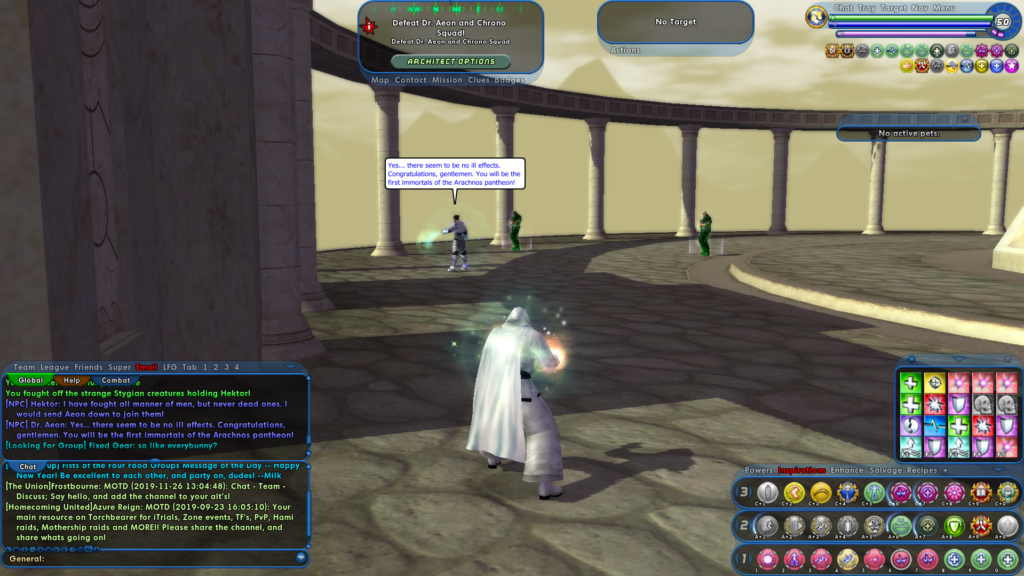
The players are summoned by Mender Lazarus, one of the guardians of the time stream, who says the balance of power in the player’s timeline is, was, or will be upset. Dr. Aeon, the chrononaut mad scientist for City of Heroes‘ premier villains, Arachnos, went back in time to the Bronze Age, to interfere in the course of the Trojan War. Why is he siding with the Trojans and assailing the Greeks with his high-tech weaponry? Therein lies the mystery.
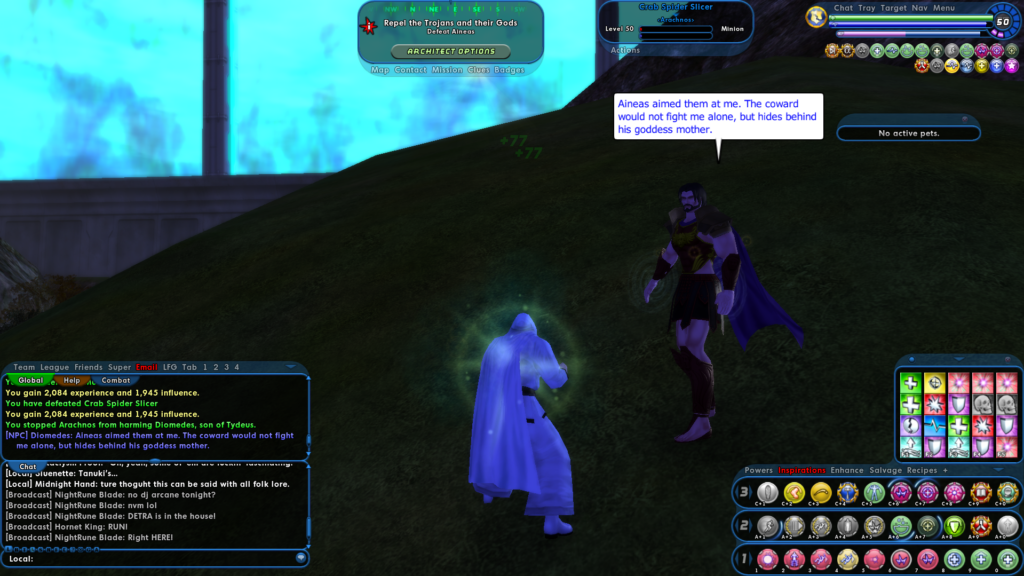
What follows is a lot of fighting, because hey, it’s an MMO. You beat up everything from Trojan soldiers and a river god to super-soldiers with mechanical spider legs coming off their back like Doctor Octopus’s tentacles. In an ideal world, I’d post video from City of Heroes to YouTube, but you’re not allowed to make ad revenue on the game for legal reasons. So I’m posting screenshots.
Mission 1: The Strange Case of Dr. Hamilton
Mender Lazarus, one of the guardians of the time-traveling society Ouroboros, has much to explain to the player. But the full details will have to wait. He wants the heroes to look into a break-in at Paragon City University’s Steel Canyon campus. If you’re thinking this sort of thing is below the pay grade of Ouroboros, you’re absolutely right. Except… it’s not.
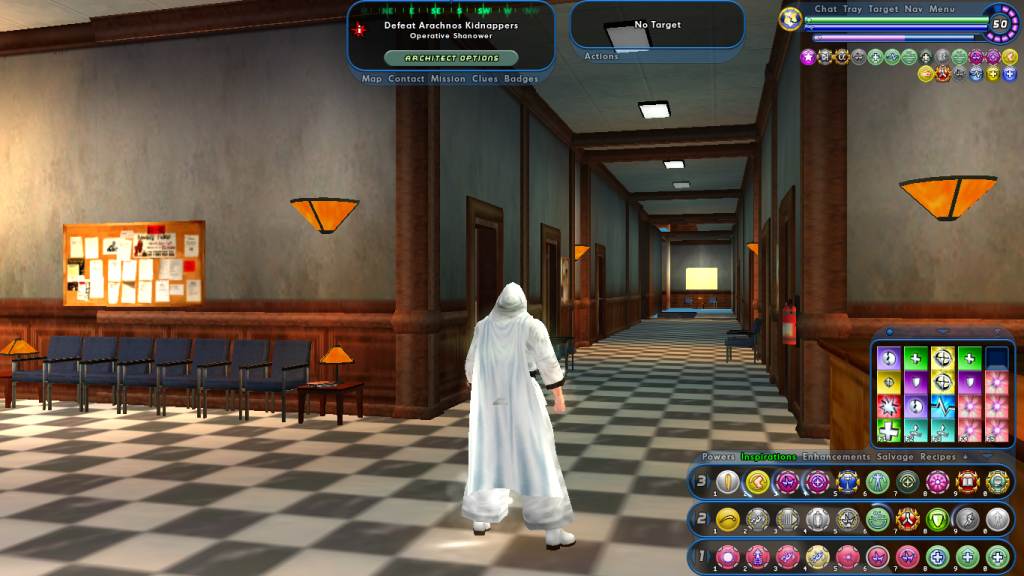
The superheroes rush over to PCU to find Arachnos have kidnapped… a mythologist?
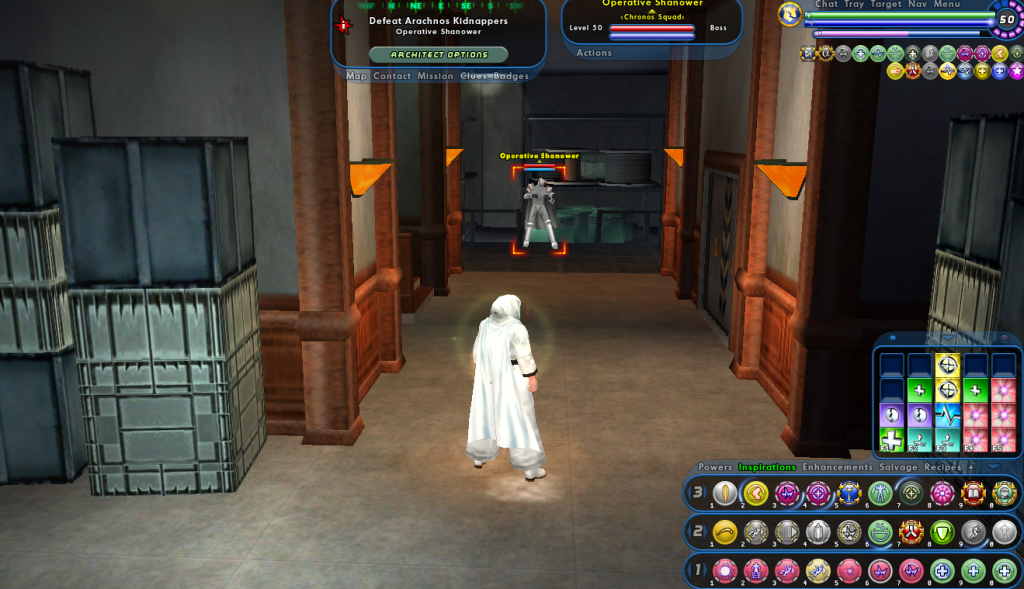
In the basement is an Arachnos arbiter, left behind to cover the spidery villains’ tracks. Bonus points if you know the comic book reference of Operative Shanower!
Mission 2: Evening the Odds
Dr. Aeon has gone back in time, using the mythologist Dr. Hamilton as a guide. Mender Lazarus has tracked him to the battlefield outside of Troy (the Troad). It’s at the point in the war where Achilles has abandoned the fight. (I use the spelling closer to the Greek, “Akhilleus.”) The Greeks, or Akhaians, as they were then known, are getting captured by Arachnos and interrogated for what they know.
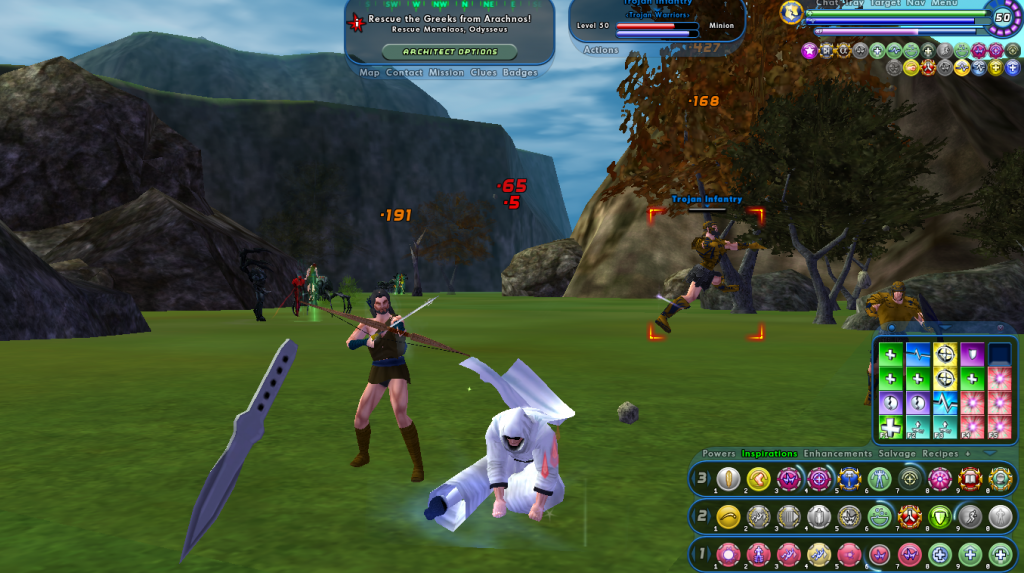
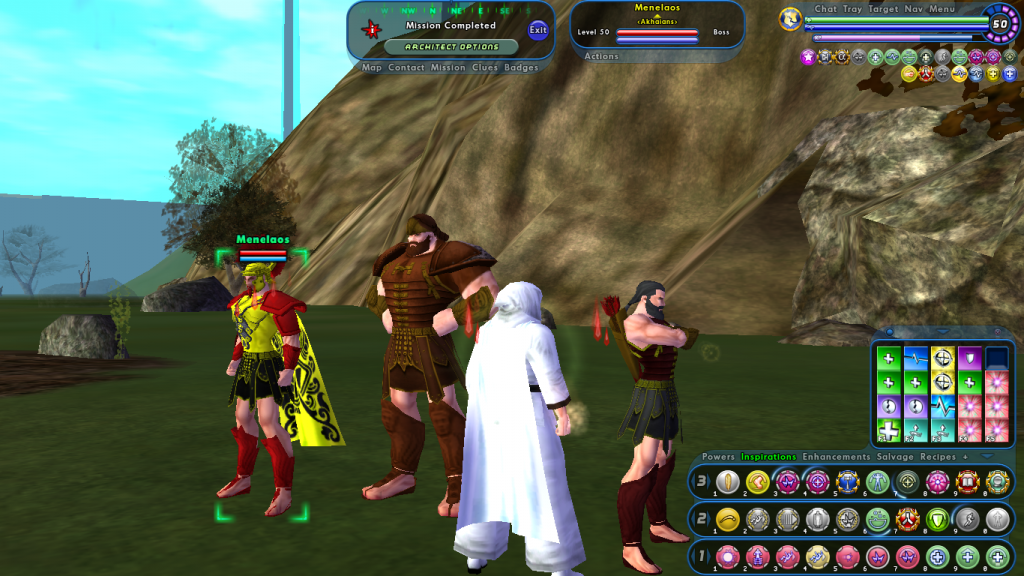
The heroes drop down into the Troad and fight their way through the Trojan ranks to reach the best fighters amongst the Greeks. It’s an all-star cast that Arachnos has captured: Menelaos, Odysseus, Great Aias (a.k.a. Ajax), and Makhaon, the Greeks’ healer.
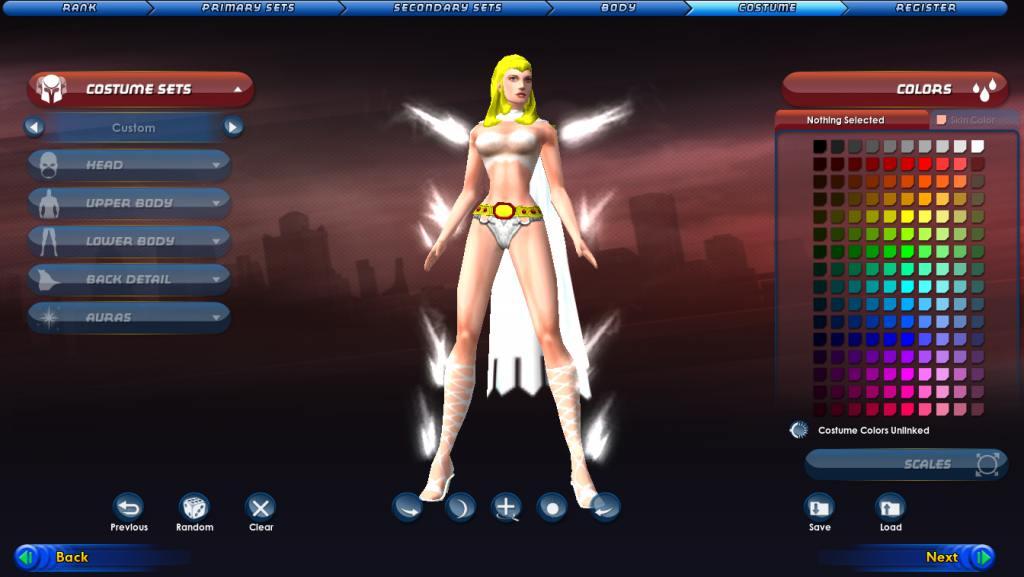
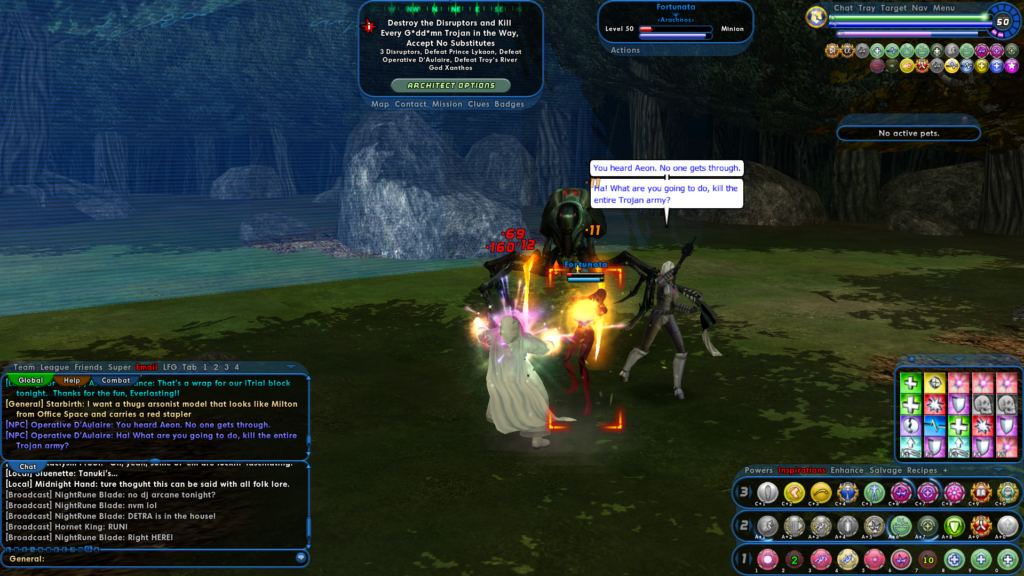
(Nothing like a good foot sweep to knock down a Trojan archer.)(Menelaos, Great Ajax, and Odysseus, as well as our hero in white.)
Mission 3: The Heroes Strive With Gods
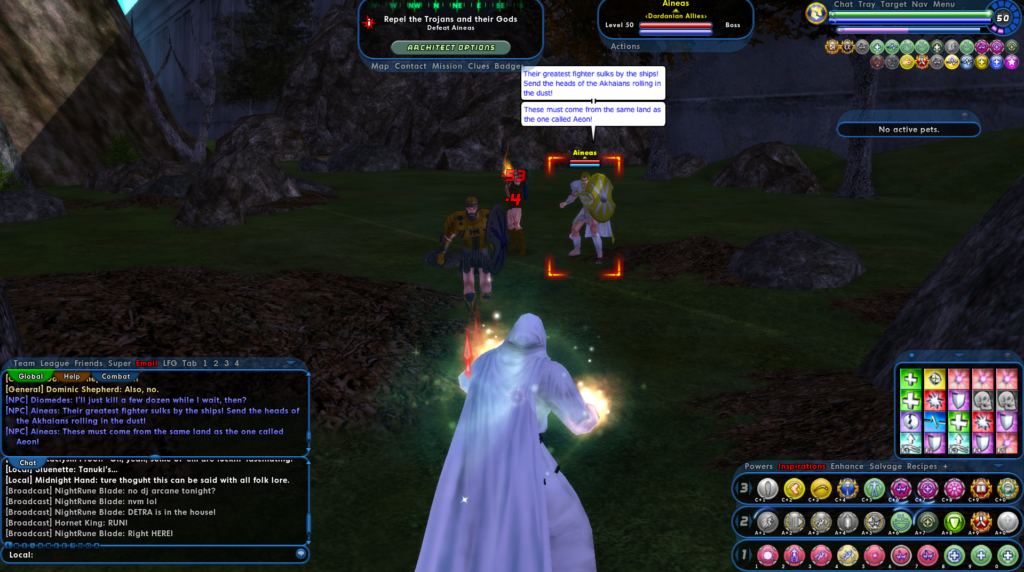
The balance of the fighting has shifted. Aeon tries to keep the Greeks hard-pressed, but the gods themselves are influencing this war, and more champions take the field. The heroes rescue Diomedes, who warns the player about the chief enemy on the field today: Aineas, the son of Aphrodite.
The player takes on Aineas! Surely a demigod can’t be too tough.
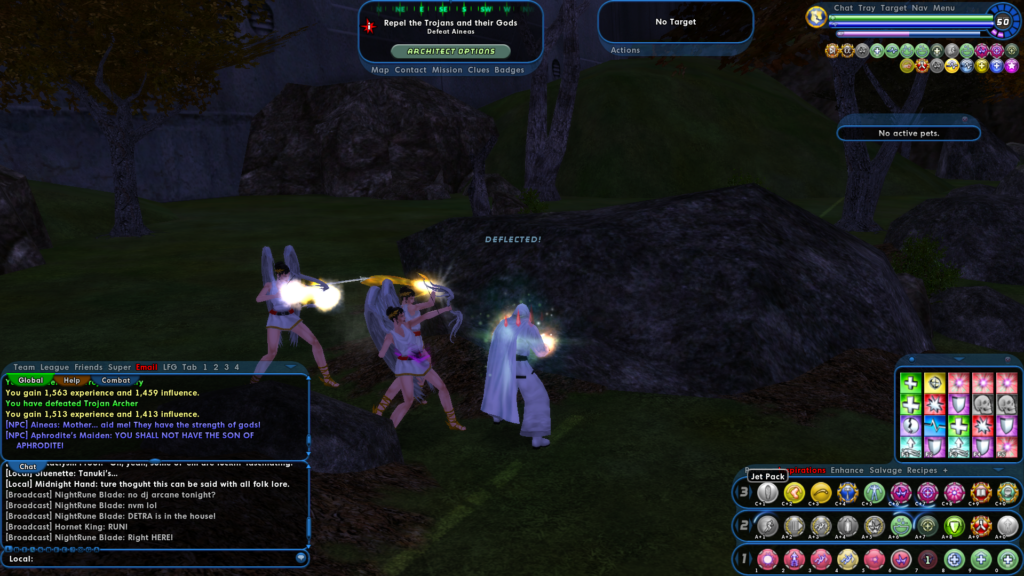
When he’s low on health, Aineas’ mother attempts to save him. If the team is big enough to fight an archvillain, Aphrodite herself appears.
(Aphrodite, goddess of love, sex, and sea foam. The sparkles animate.)
If the team is smaller, she sends her handmaidens, pictured here.
Amid all the fighting, Dr. Aeon has killed Patroklos, Akhilleus’s cousin, best friend, and in many interpretations, his lover. Akhilleus loses his freakin’ mind and starts on a rampage.
Mission 4: The Clash of Man and River
The rampage is cut short by Dr. Aeon, who has placed temporal disruptors around the battlefield in order to change history. Arachnos captures Akhilleus temporarily, though as the dialogue indicates, he’s about to break free when the heroes rescue him.
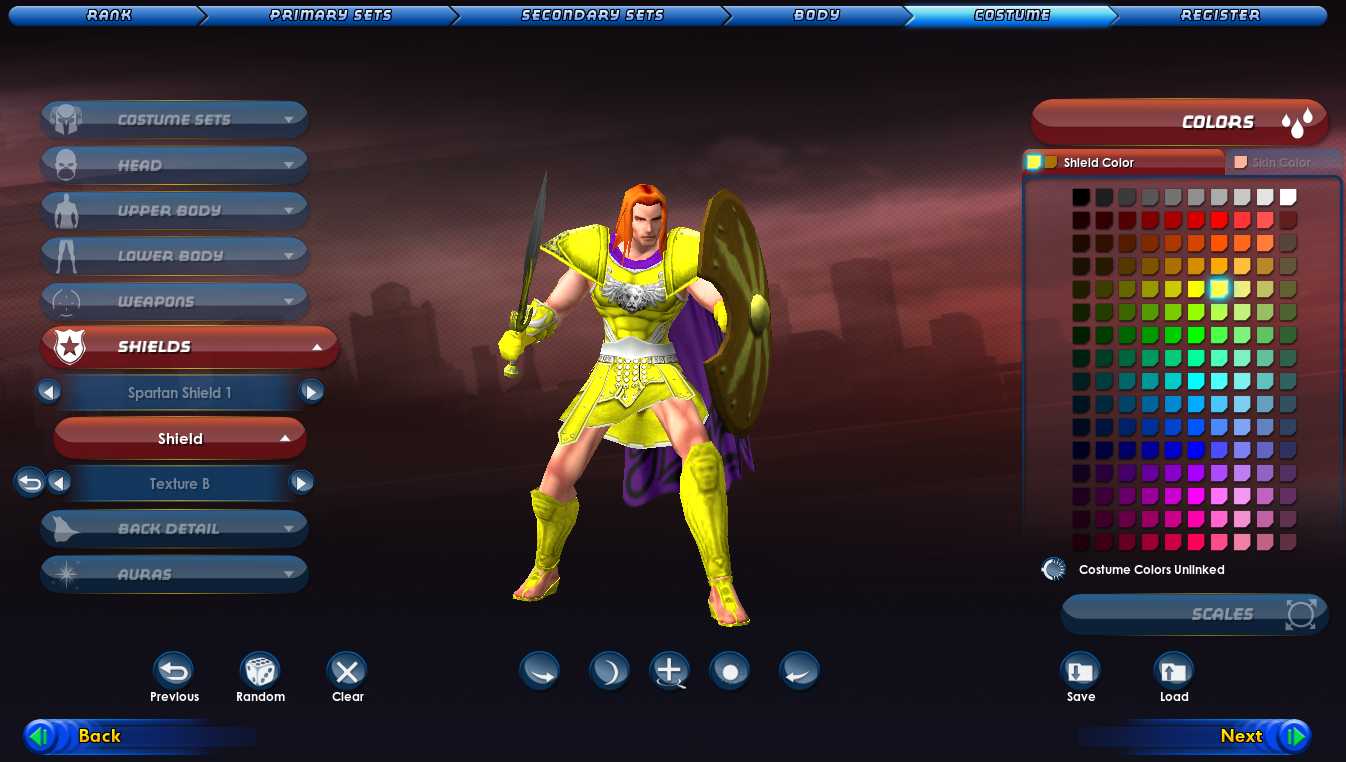
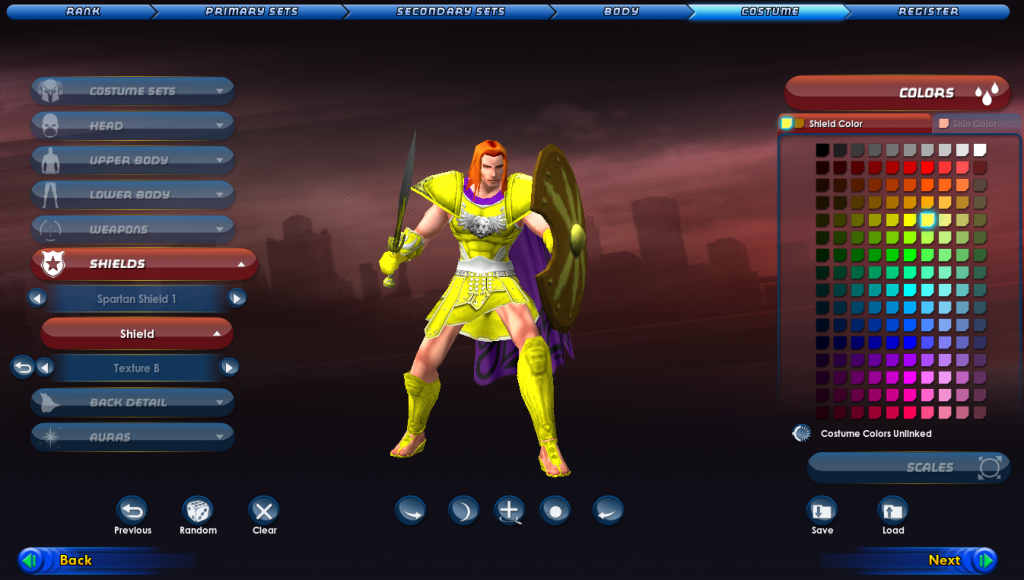
(Achilles, with his famous shield.)
It’s time for a team-up. But, as an Arachnos captor points out, what are they going to do, kill the entire Trojan army?
Spoiler alert: Yes, yes they are.
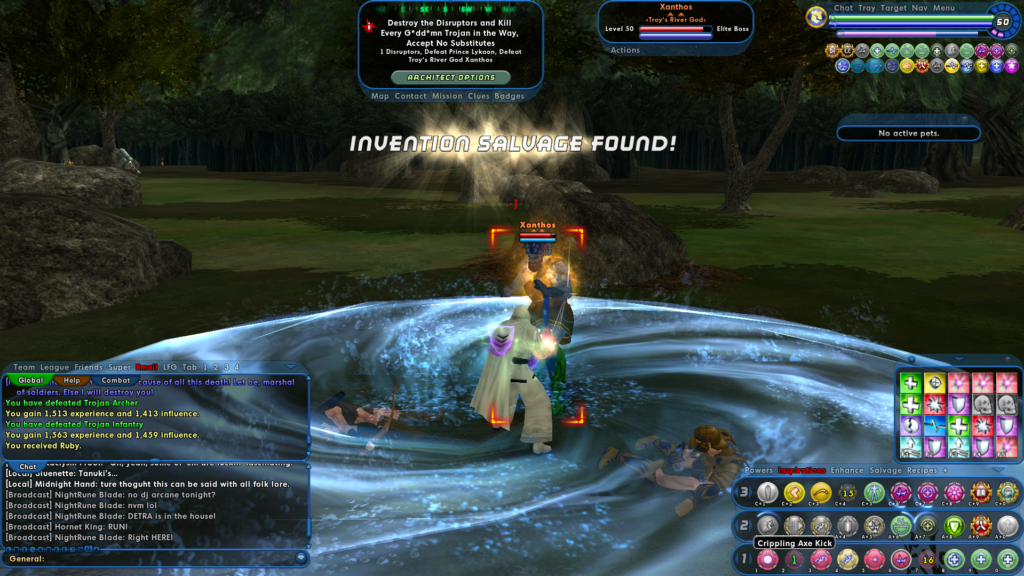
The rampage is the longest mission in the arc, as the players plow through a ton of enemies named in the Trojan epic cycle. Relative shlubs like Asteropaios and Lykaon go down first, and by then the Skamander river is so choked with blood that Xanthos, its river god, attempts its revenge.
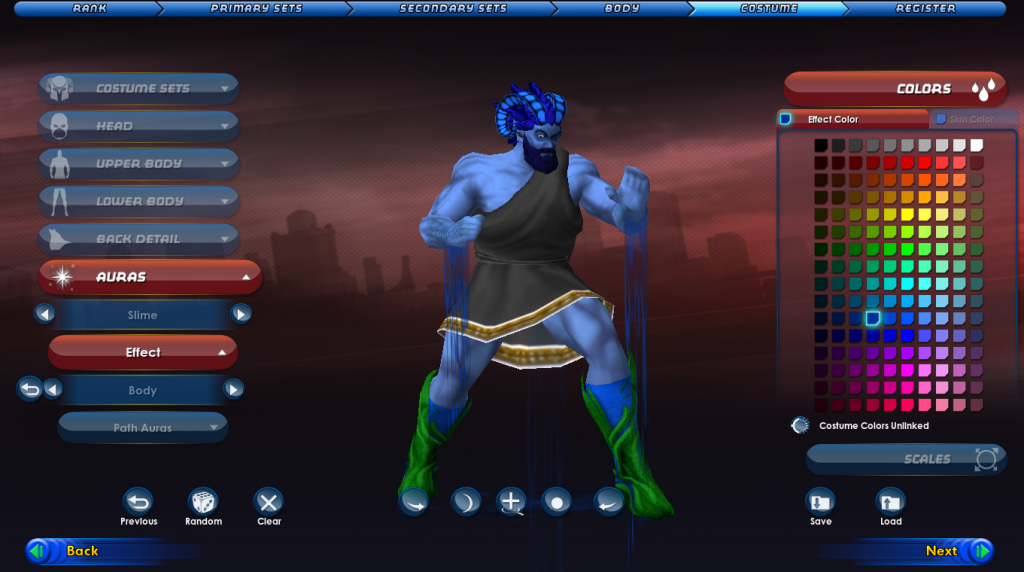
(Xanthos, a.k.a. the Scamander River God. The blue slime is water animated to drip.)Ever seen CoH’s Water Blast power set? Now you have!
But that’s not all! Prominent allies take the stage, like the Amazon princess Penthesilea…
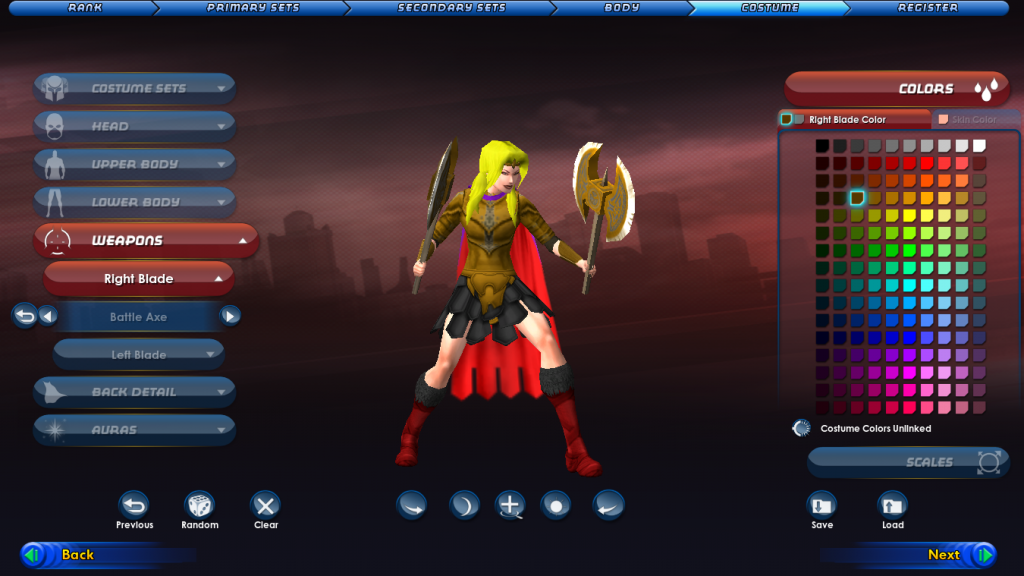
(Penthesilea, princess of the Amazons, with double labrys axes. Way to represent, girl!)
…and the son of the dawn goddess Eos! His name is Memnon, prince of Aethiopia.
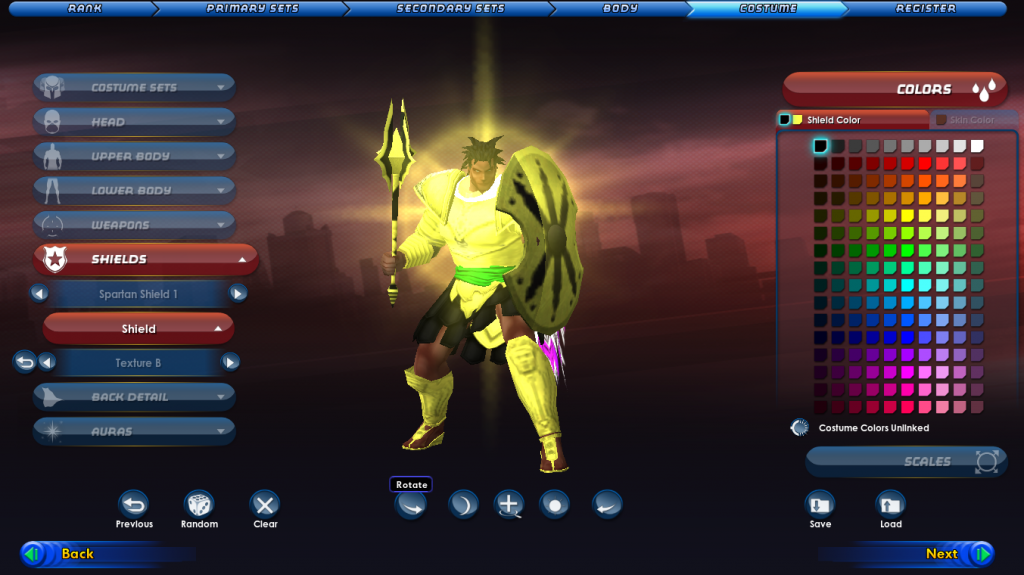
(Memnon, son of the Dawn and sporter of awesome dreads.)
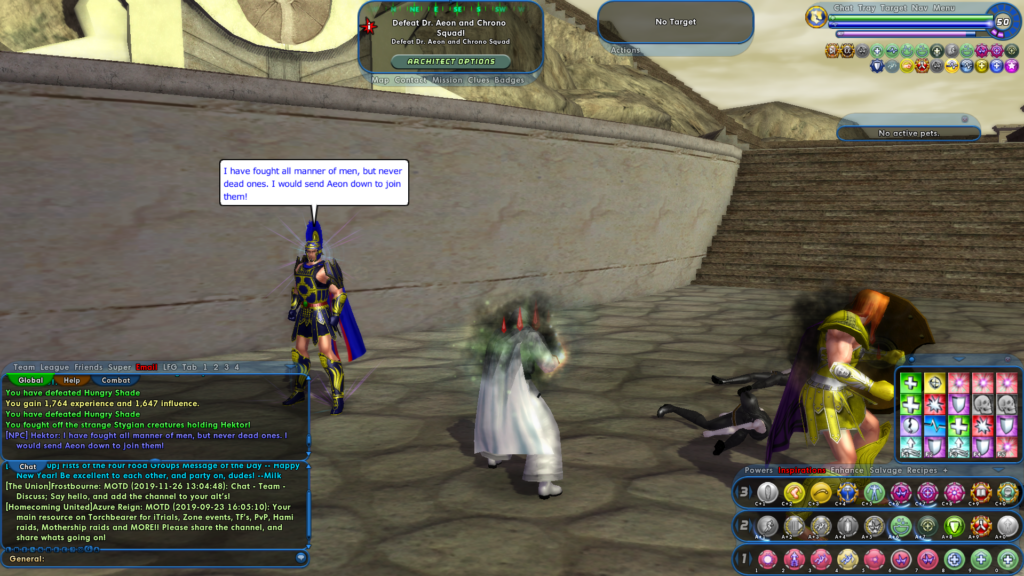
Each of them call on Dr. Aeon for help, but the villain is gone, leaving them to face their fates alone. Interestingly, the players find Dr. Hamilton amid all the fighting, and Troy’s star quarterback, Prince Hektor, reveals more as the players fight him.
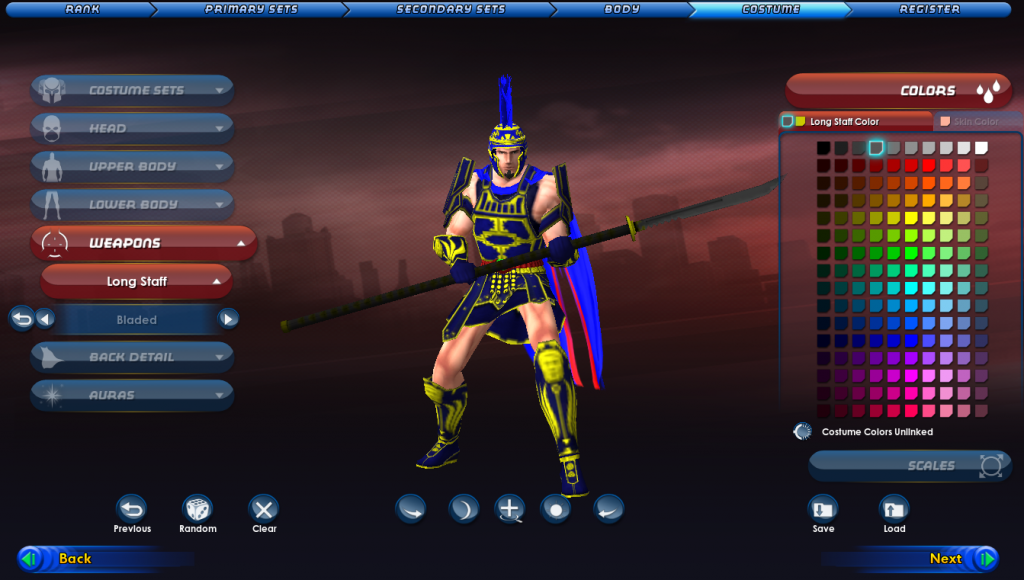
(Hector, prince of Troy. The spear looks more like a naginata, but it’s the closest I could get.)
Hektor says he knows where Aeon has gone, but to preserve his honor and spare the lives of his people, he’s going to throw the fight. The player makes it look good, defeating him as per normal gameplay. When the mission is over, Dr. Hamilton and Hektor let the player in on the Arachnos plan.
So What’s the Plan, Exactly? Enrage the Death Machine?
The reason Aeon interrogated all the Greeks he could find and killed off Patroklos was because he wanted Akhilleus to be visited by his mother the night before the battle, as the story goes. Akhilleus’ mother is Thetis, a sea goddess who is responsible for Akhilleus’s famous powers.
When Akhilleus was an infant, Thetis dipped him in the headwaters of the River Styx, and wherever the water touched, it made him immortal and invulnerable. Because she held him by the heel while she dipped him, that heel is his one weak, mortal part, the proverbial “Achilles heel.”
Dr. Aeon’s plan was to capture and interrogate Thetis for the location of the Styx’s headwaters. And now he’s taken his best commandos and dipped them in the Styx. He’s going to make an army of super-soldiers who cannot die.
Mission 5: The Isle of the Styx
The player goes to the island of Skotados to rescue Thetis. The player battles normal Arachnos enemies, the nymphs of the Styx (the river of death), and the now-invulnerable Arachnos soldiers. It’s a tough fight (the super-soldiers are a mob of all bosses), but Akhilleus and Hektor are there to take their revenge on Aeon, and having them both on the players’ side is a combo that the gods never saw coming.
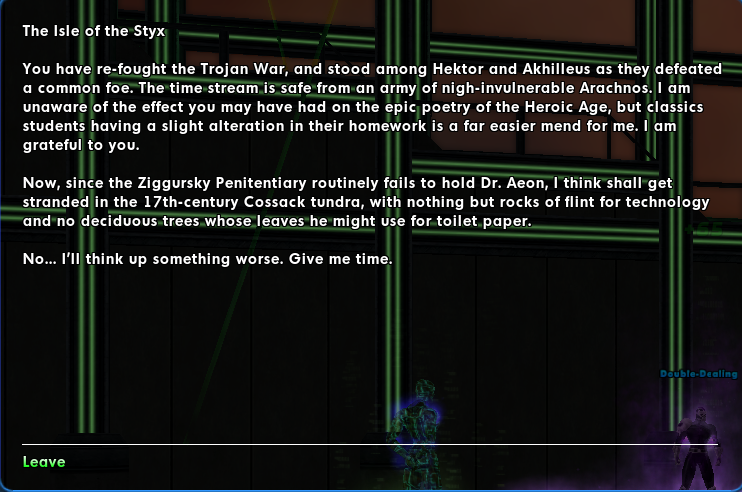
In the end, the player drops Dr. Aeon off with Mender Lazarus, who will enforce the sanctity of Earth’s timeline. What he does to Aeon is only hinted at, but it’s probably NSFPC: Not Safe For Paragon City.
And that’s our show! Hope you enjoyed this little excursion.
If you’ve made it this far and actually have a City of Heroes (Homecoming) account, the arc is #31899. Just enter that into the search bar at the Architect Entertainment interface, and the arc should be playable.
The worst job in the samurai fantasy nation of Rokugan belongs to the Crab Clan, who must maintain the Kaiu Wall to keep out the demonic armies of the Shadowlands. One particularly disagreeable duty is to scout out the blasted wastes and spy upon the enemy. When the ronin Seikansha sought this out, he discovered a portal to what he thought was Jigoku — Rokugan’s Hell.
This was not the case. When he followed a strike team of misshapen creatures into this distortion of time and space, he emerged in the laboratories of Paragon City’s Portal Corporation. The oni, goblins, and other servants of evil had no clue where they were — but wasted no time kidnapping the local humans to gain their secrets.
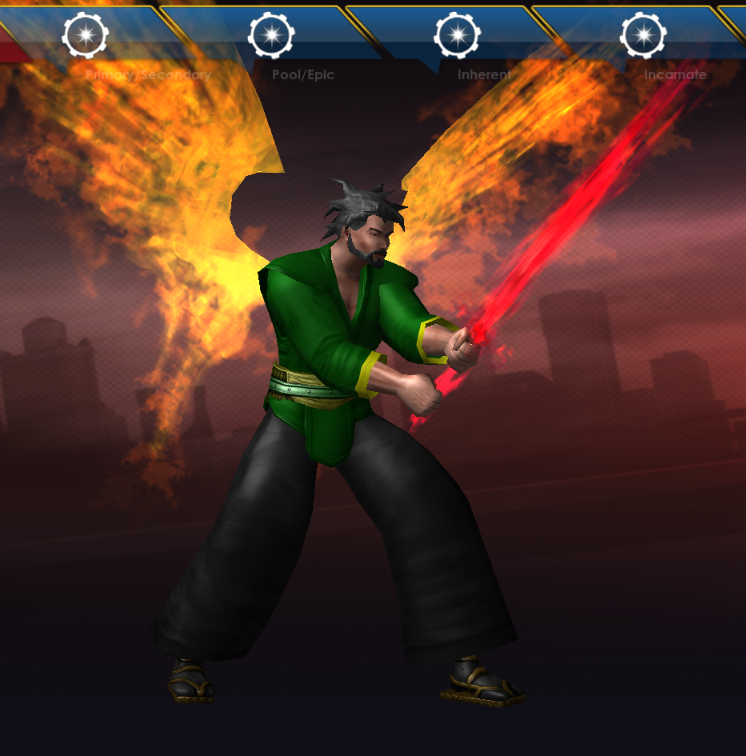
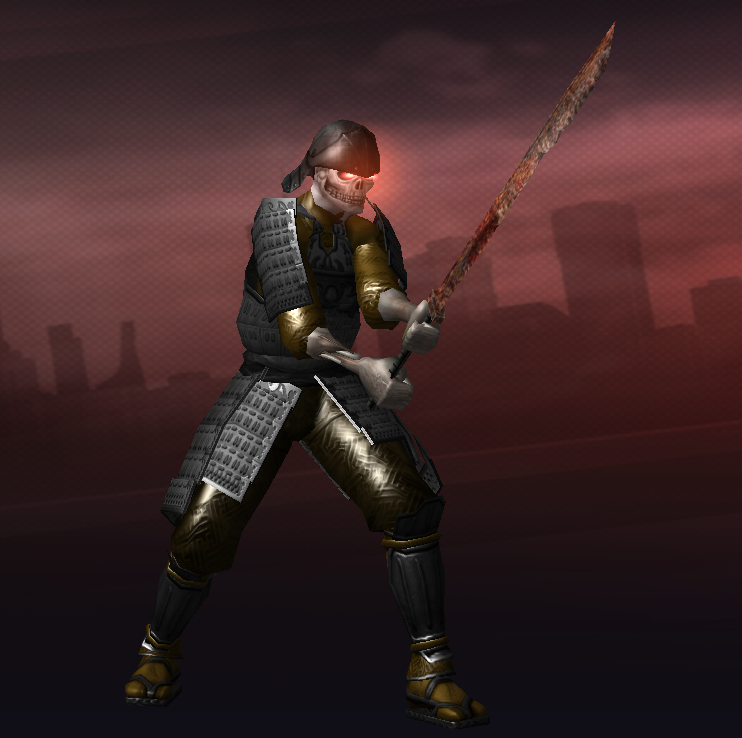
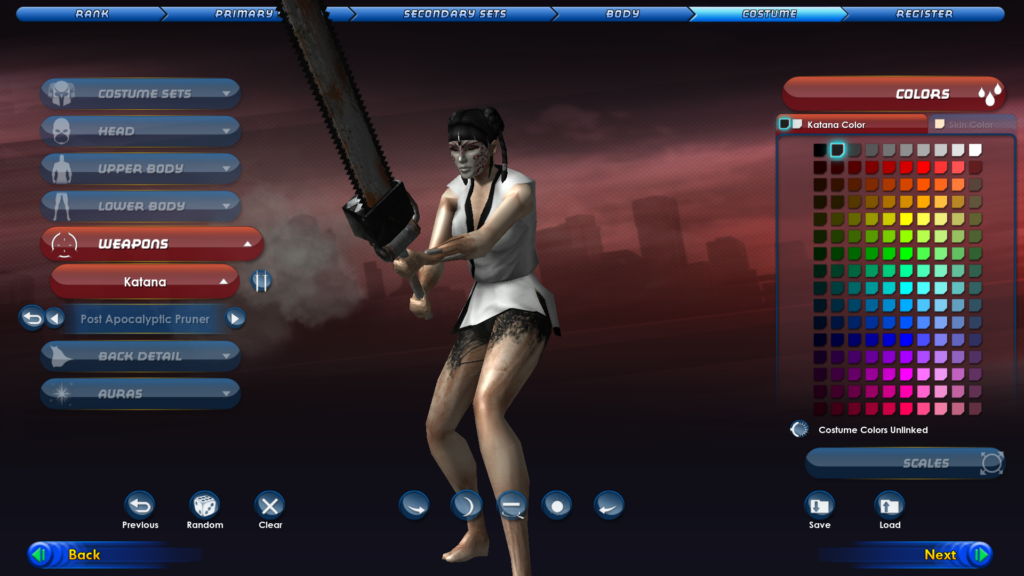
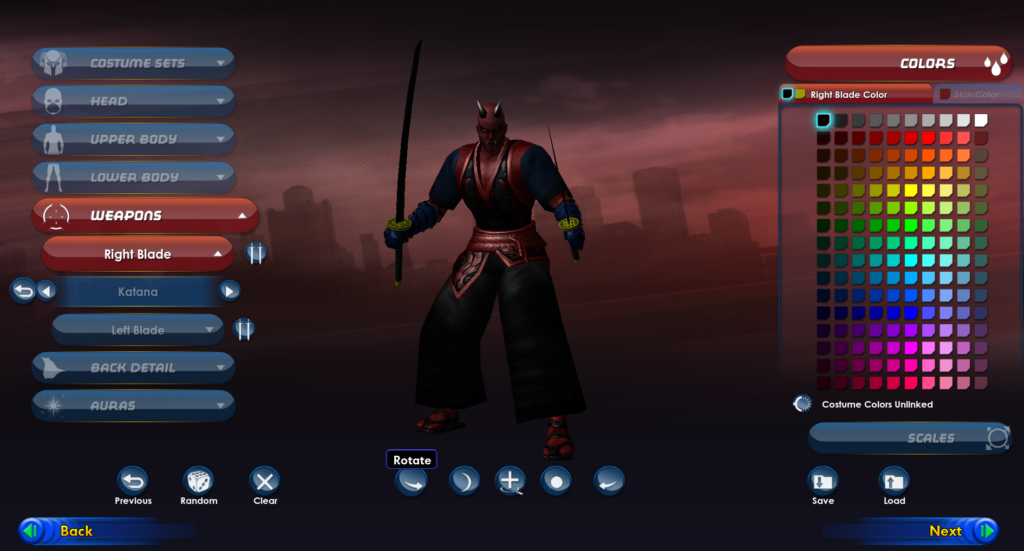
My approximation of the L5R shugenja Seikansha, featuring the Wings of Fire and Katana of Fire spells.
Alone, Seikansha knew he could not face all the enemy at once. But the language of heroes is universal. If the people here — however strangely dressed — seek to defend their home from the Shadowlands, they are no longer strangers, but brothers and sisters. It’s time for a team-up between samurai and superheroes.
“But wait, is this okay copyright-wise?”
Funny thing… yes. According to the guidelines of the current rights-holders of Legend of the Five Rings, Fantasy Flight Games, fans (such as myself) can create content so long as it is not sold for a profit. Since City of Heroes: Homecoming is entirely powered by volunteers and doesn’t charge for its services, no laws have been violated.
So… let’s rock!
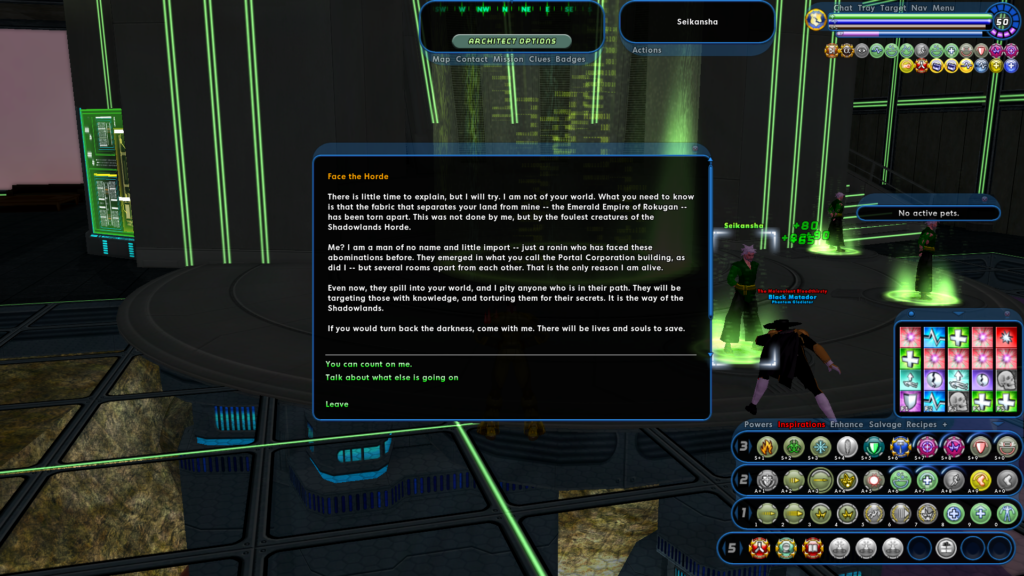
Part 1: Face the Horde
Once the player starts the Architect Entertainment arc, it creates a hologram contact for the first mission.
“If you would turn back the darkness, come with me. There will be lives and souls to save.”
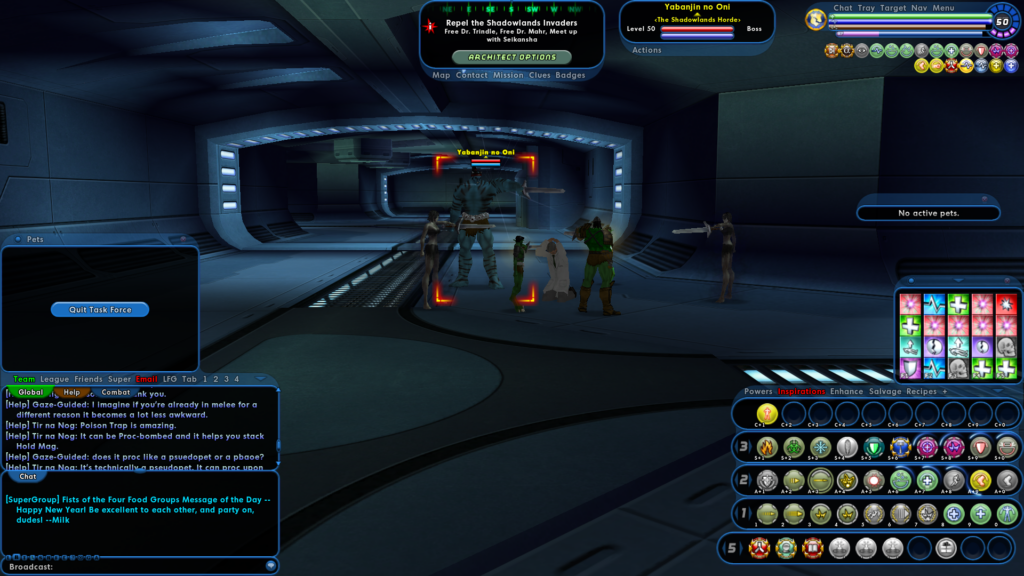
Here, the heroes retake the Portal Corporation building from the foot soldiers of the Shadowlands Horde. Since it’s just the first mission, I thought we’d ease into it with familiar enemies from L5R and a simple task: rescue the scientists of the Portal Corporation. The liberated scientists are eye-witnesses to the crime.
Who are we facing? Let’s zoom in on the bad guys with some beauty shots from the character creator!
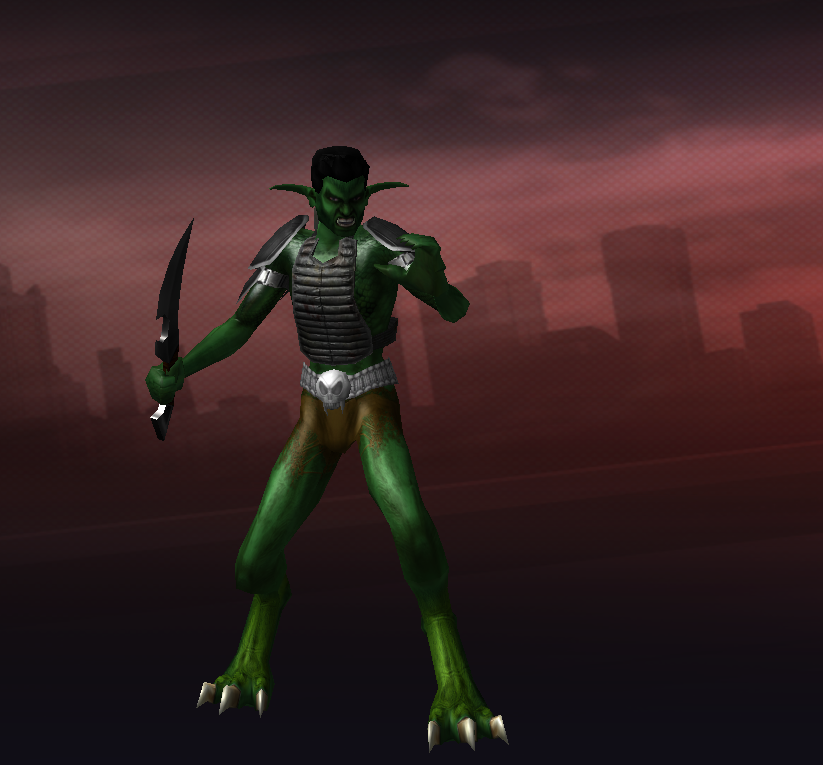
Bakemono (goblins):
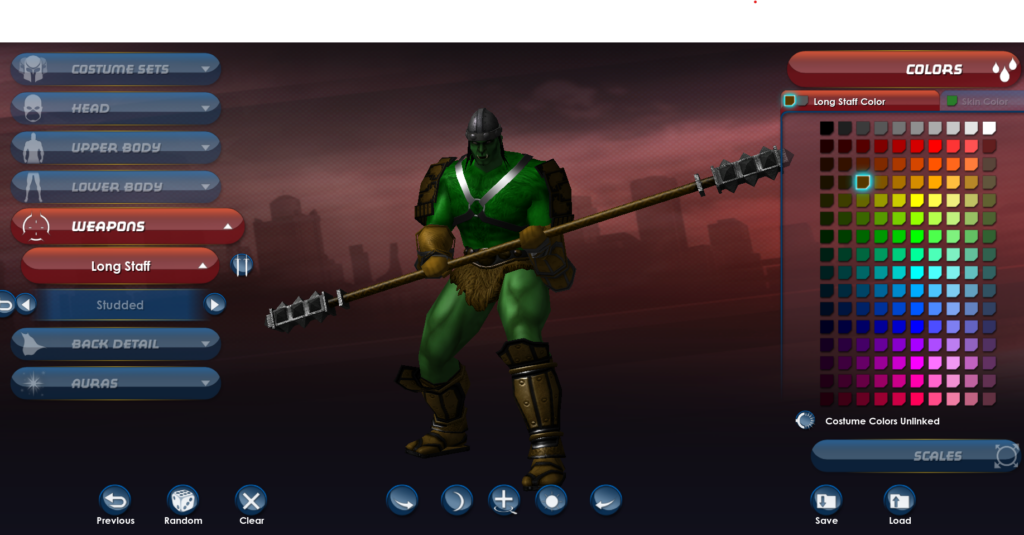
Bakemono Warmongers (goblin shock troops):
Hyakuhei: intelligent zombies of the Shadowlands that were once samurai. I particularly like the zombie bones in the hands and the rusty katana option.
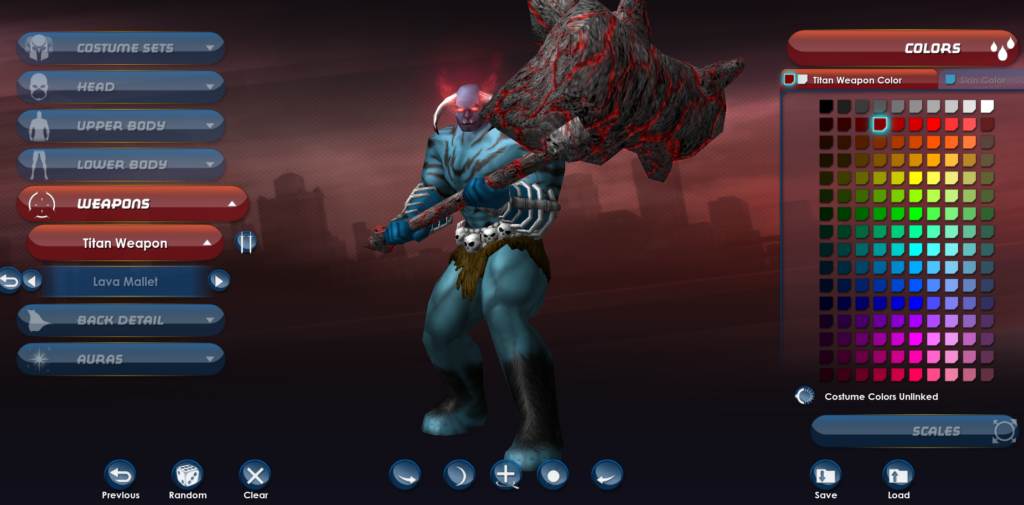
For bosses, we have Rokugani ogres. Since “ogre” and “demon” both more or less translate as “oni” and they share a number of similarities in traditional Japanese mythology, I gave these brutes the name Yabanjin no Oni. Yabanjin means, roughly, “barbarian” or “savage person.”
A Missing Expert
Back to the action. The heroes rescue two researchers who are able to tell them what’s going on, only to find their supervisor is missing: Tina MacIntyre, Portal Corp’s key expert on alternate dimensions.
Where would they take her? Seikansha says when the Shadowlands needs to grow its power, the first place that maho-tsukai (blood sorcerers) go is to the local graveyard. There, they can animate the dead to fight for them. In Rokugan, this is less of a problem, as they cremate their dead. Surely a worldly civilization like Paragon City does the same?
“Um, yes, bad news…” says the player…
Part 2: Digging the Grave
The heroes head to Peregrine Island’s graveyard to rescue Tina MacIntyre. There, they find Rokugan’s worst nightmare. When Tina is freed, she says the oni and goblins snatched weapons from Portal Corporation’s security teams and the SWAT department of the local police who deal with superpowered beings.
In other words, that sound of approaching feet is going to give way to bursts of assault rifle fire, grenade explosions, and the zapping sounds of beam rifles. The Shadowlands Spec Ops team may not have a lot of experience with these weapons, but thanks to modern technology, they’re pretty much point-and-click.
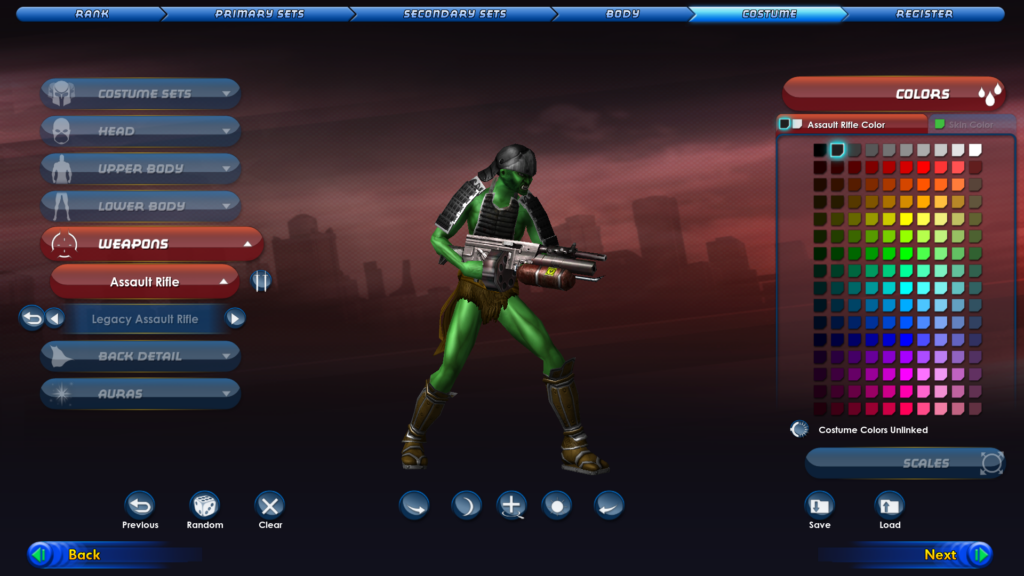
Even the lowly shlubs have automatic weapons:
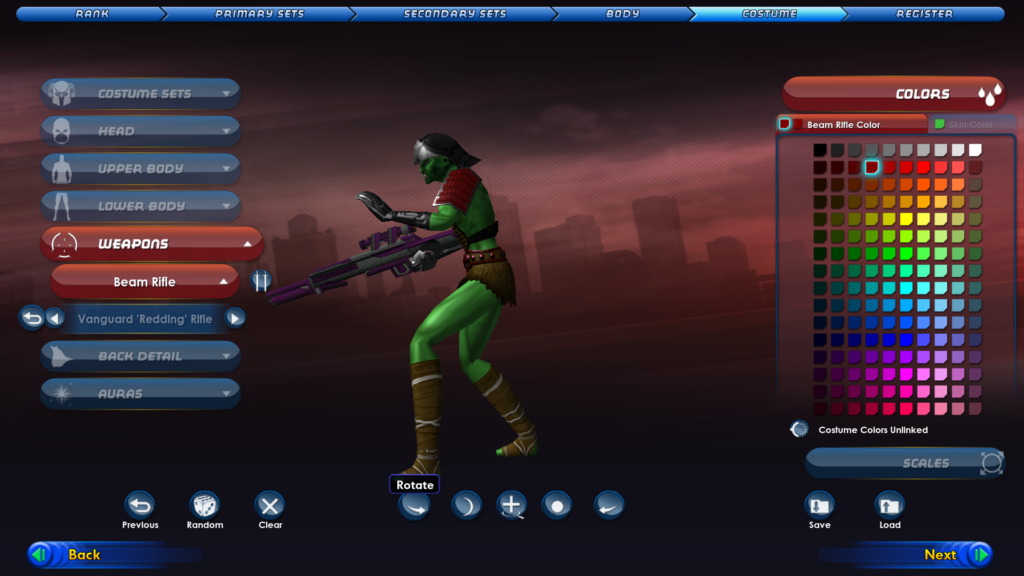
And their buddies pack beam rifles that can disintegrate their targets:
The zombies created by maho-tsukai have found themselves some chainsaw swords… and in this close-up, you can see the porcelain masks that let their bodies animate.
When the heroes rescue the Tainted Tina MacIntyre, she confirms their plan… they’ve taken a small army back to Rokugan… with weapons enough to devastate whatever medieval troops are in front of them.
Part 3: The Guns of Yojin
Those troops are in Yojin Province. In case you’re not up on your Rokugani geography, that’s the land immediately outside Otosan Uchi… the Imperial capital.
The good news? All seven Great Clans have soldiers stationed there. The bad news? Six out of the seven are blaming the Crab for failing to contain the Shadowlands threat.
Fight, Grab, and Rescue
The heroes have a threefold mission.
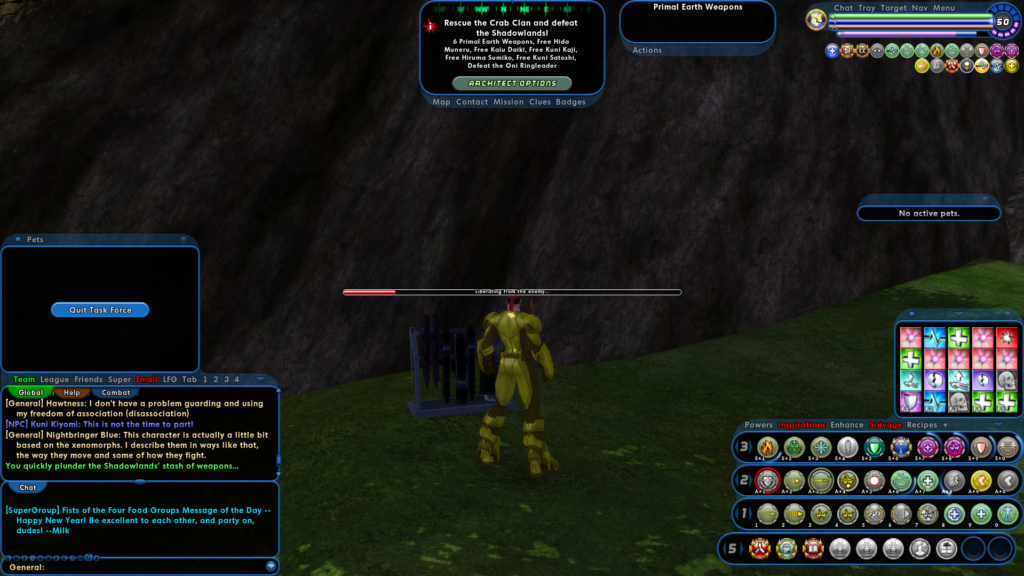
Find and confiscate the stashes of weapons from Paragon City so the Horde can’t use them.
Rescue the Crab scouts who were tracking the Horde and got caught by the Great Clans. There are six different Clans and six different Crab allies to free.
Take the fight to the demon in charge, Hoshasen no Oni.
The weapons use City of Heroes’ “weapon stash” icons, which admittedly look out of place in the hills of pseudo-Japan, but they’re supposed to!
The scouts to rescue are from some of the samurai families of the Crab:
The Hida are known for tough shock troops.
The Hiruma, usually scouts.
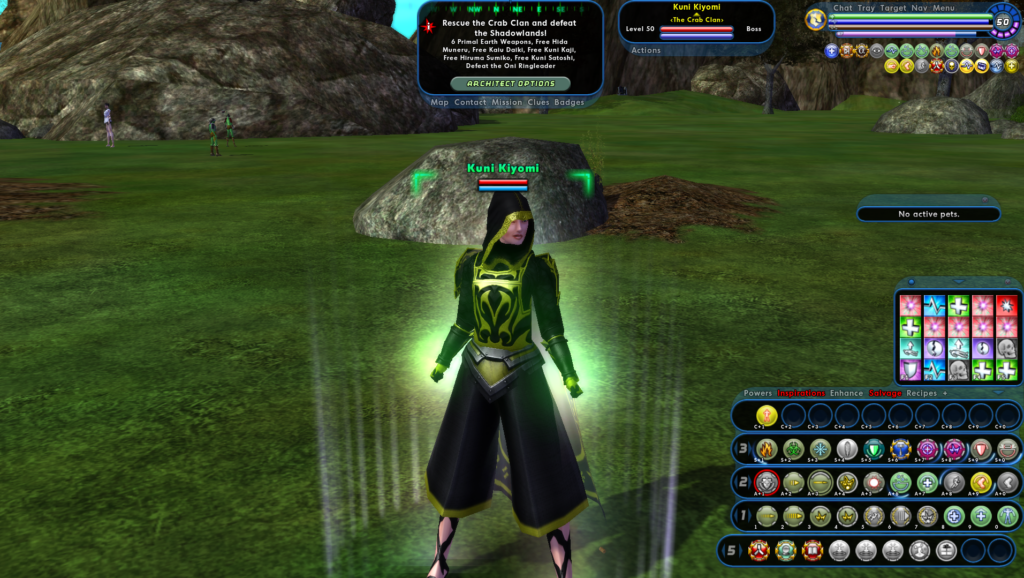
The Kuni, often shugenja and witch hunters.
The Kaiu, known for engineers and battle-masters.
The Yasuki, who are mostly courtiers and merchants. They aren’t present here.
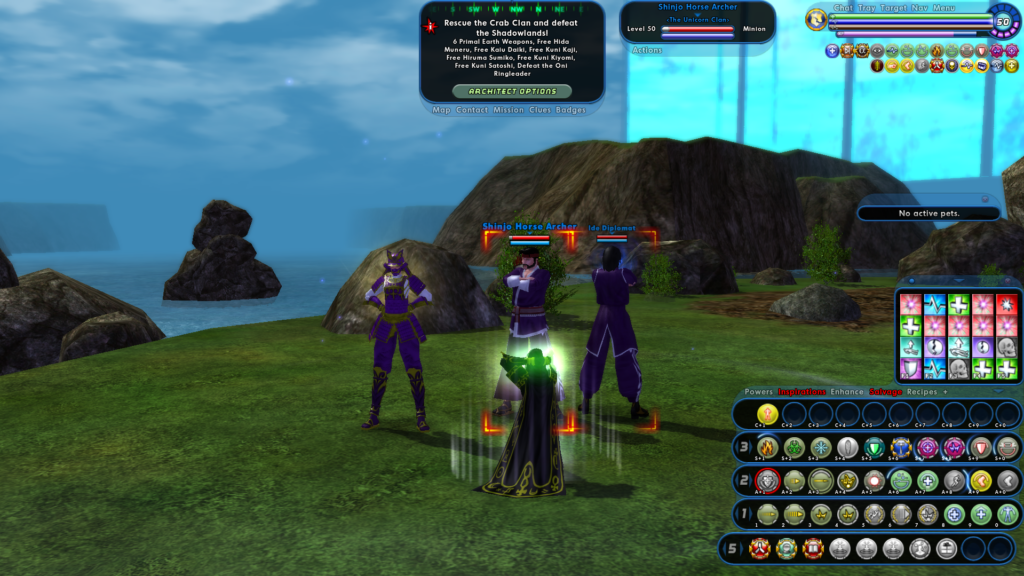
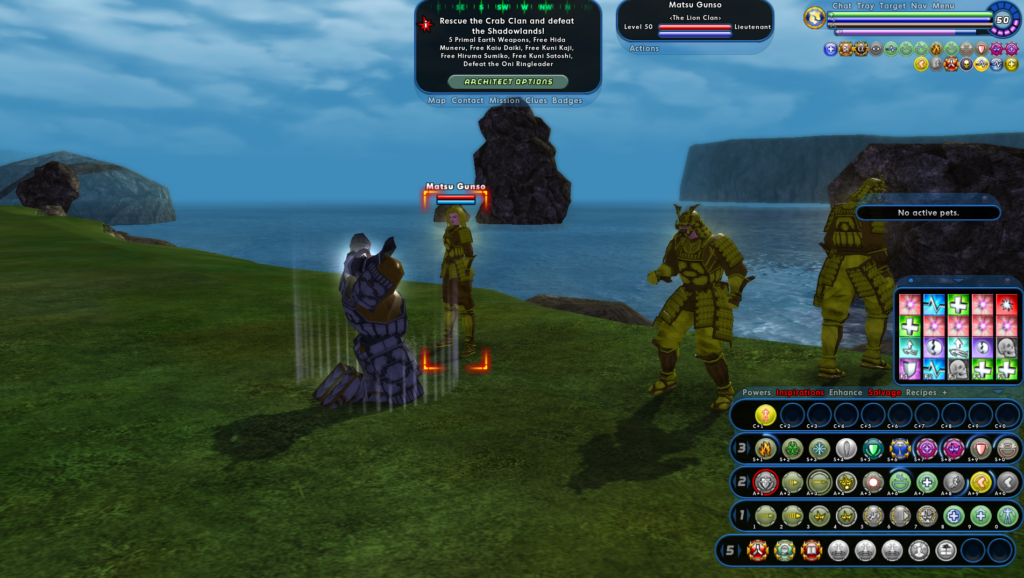
Here’s a Kuni, captured by the Unicorn (Ki-Rin) Clan. They have a mix of the samurai families of the Utaku, Shinjo, and Ide. The Utaku Battle Maiden is the armored one on the left, a literal girlboss. The Shinjo is an archer, and the Ide is a courtier who knows how to use a dao (Chinese broadsword). They’re minion-rank. As with all CoH adventures, the more players are in the team, the more enemies they will face. Since there’s only one player here, the mob is only three enemies.
After the Kuni is free, she joins the player and fights on their side.
The Kaiu warrior, a big tanky type in heavy armor with a tetsubo, has been captured by the Lion Clan. The Matsu family form the minion and lieutenant ranks of this mob. The highlighted one is a gunso, or sergeant, who specializes in katana moves. The other two are ashigaru, foot soldier spearmen.
If there were more heroes in this mission, there would be more enemies. In that case, there’d be Kitsu family shugenja (priest/wizard) and a boss, the Akodo family tacticians.
But don’t forget the real enemy! Amid all the beating down of other Clans (Phoenix, Scorpion, Crane and Dragon are not pictured), there’s still plenty of Shadowlands enemies, none more notable than the Hashasen no Oni.
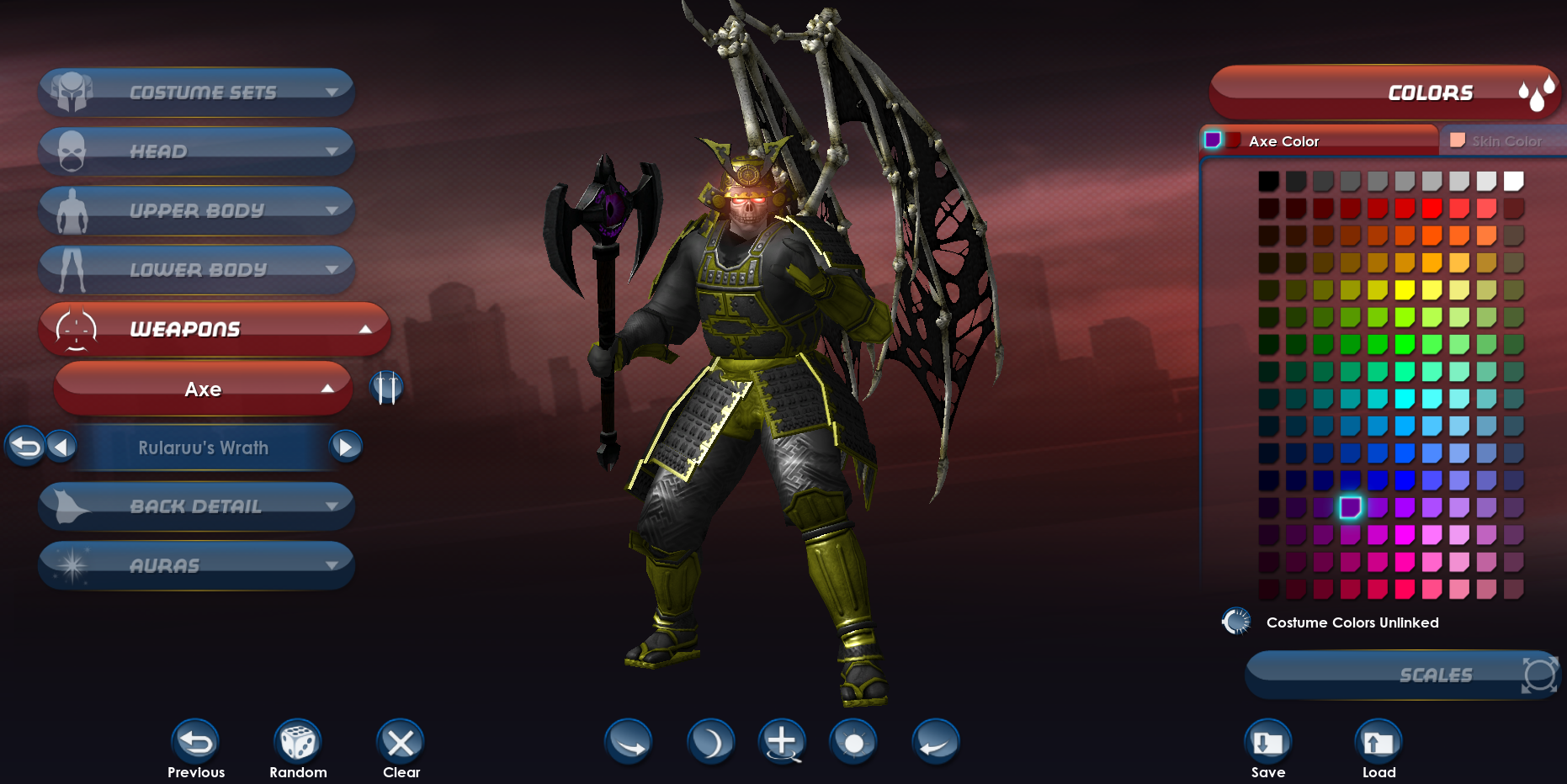
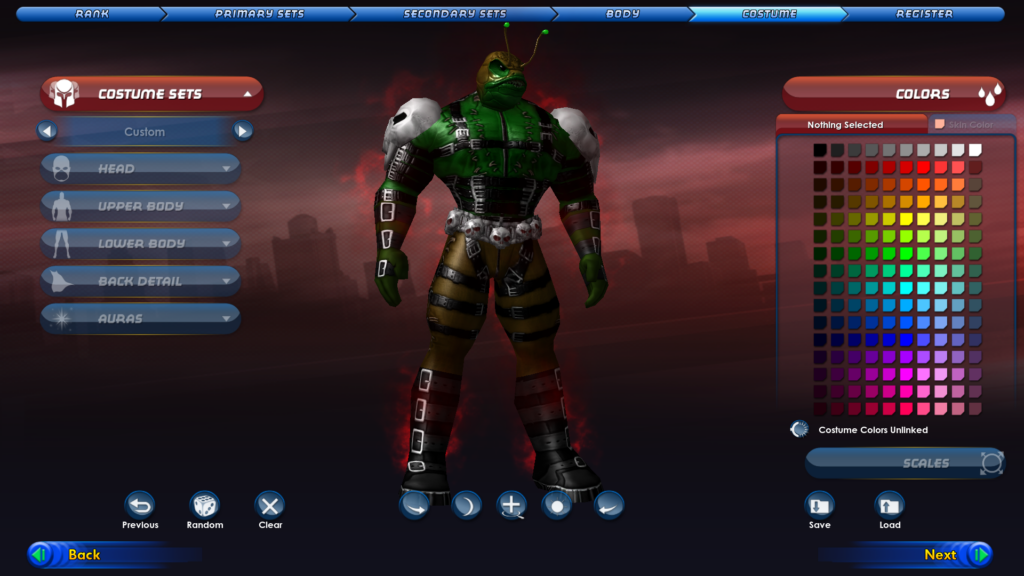
Pictured here in the character creator (because taking screenshots is chaotic while getting your butt kicked), the Hashasen fights using weakening energies. In the parlance of CoH, it’s radiation emission, but the description themes it as debilitating energies of the element of Corruption.
When it falls, the Hashasen no Oni tries to crawl in a specific direction… a tunnel opening leading far underground…
Part 4: Six Shaku Under
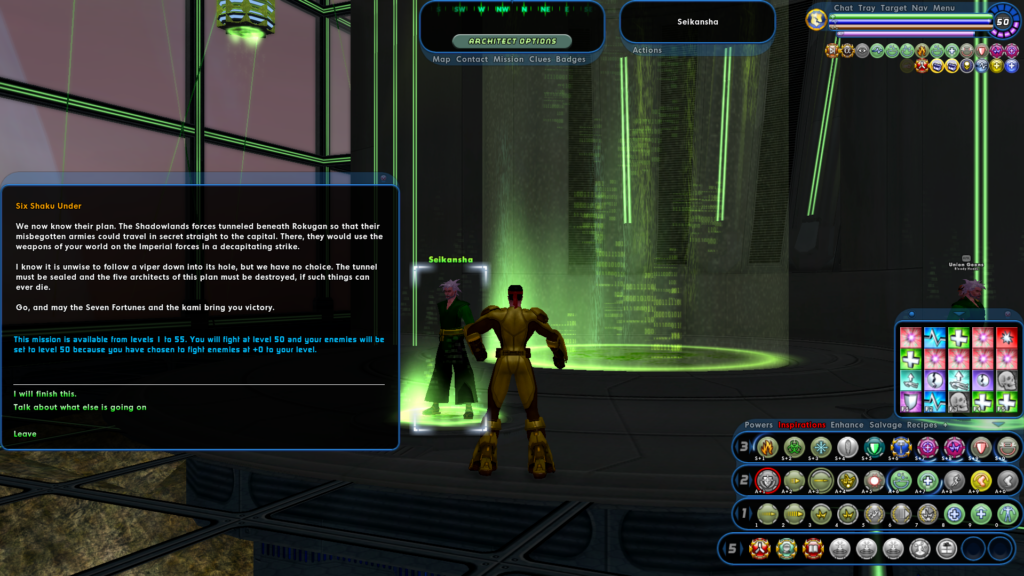
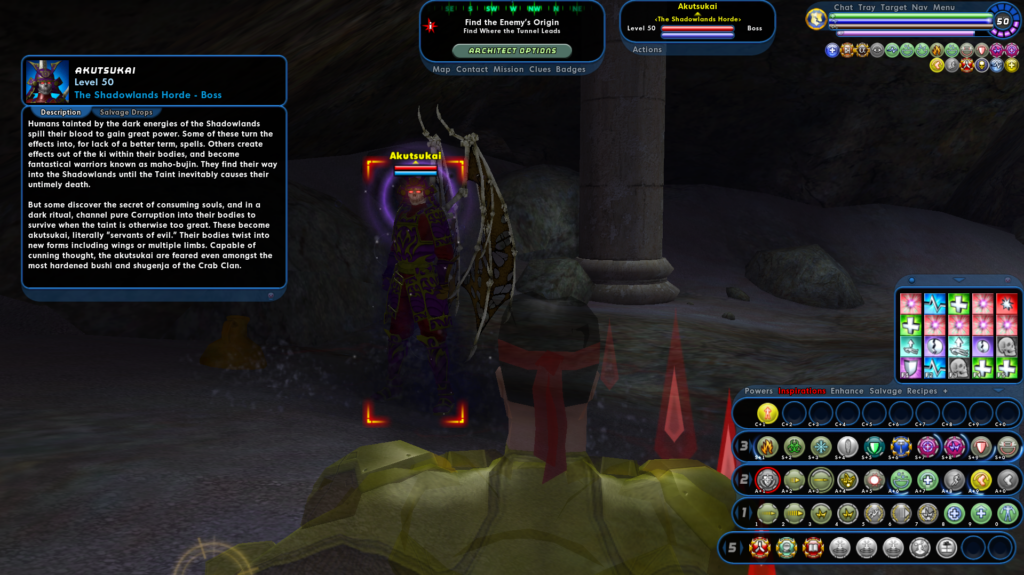
Seikansha and the players draw a logical conclusion — there were too many Shadowlands troops compared to the ones he saw in Paragon City. They had reinforcements, and they came from the tunnel beneath Rokugan. Does it go all the way to the Shadowlands? Or is the Horde using some other method than simply carving out a 200-mile tunnel? The player vows to find out.
The Shadowlands have, of course, underestimated their enemy. Samurai are no great spelunkers, but if there’s one thing Paragon City knows, it’s fighting enemies in caves! The heroes set bombs throughout the tunnel system, wiring it to blow. Sure hope they wrote their final haiku before coming down here!
It turns out the enemy are guarding a ritual altar, and that spilling blood on it will create a gate… not between worlds, but to Jigoku itself.
There, the five servants of Fu Leng responsible for this plan are known as the Star of Darkness. They must be destroyed, or the forces of Hell will continue to surface in the caves, and from there, assail Otosan Uchi until it falls.
Part 5: To Shatter a Star
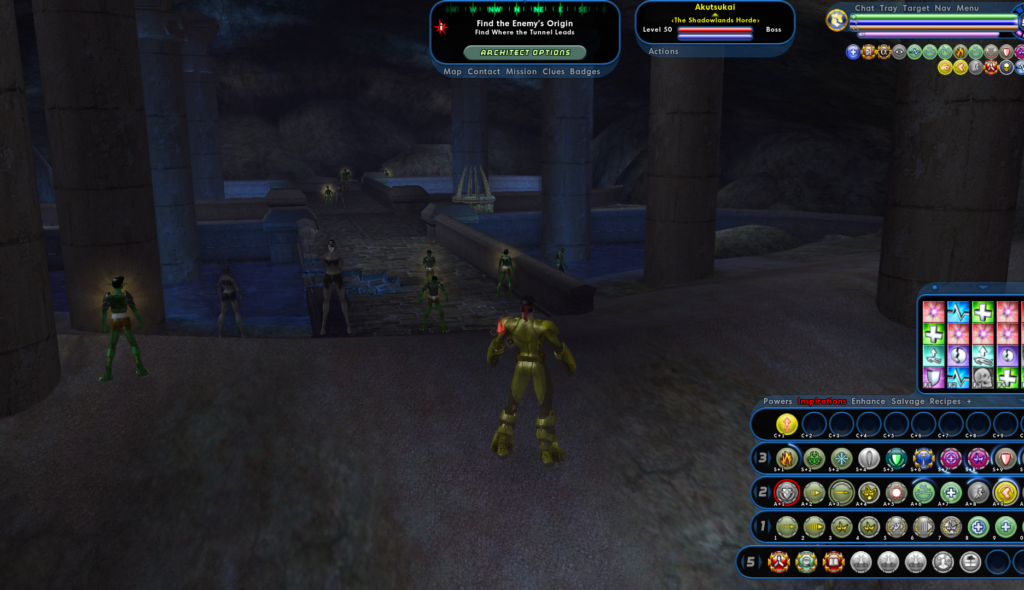
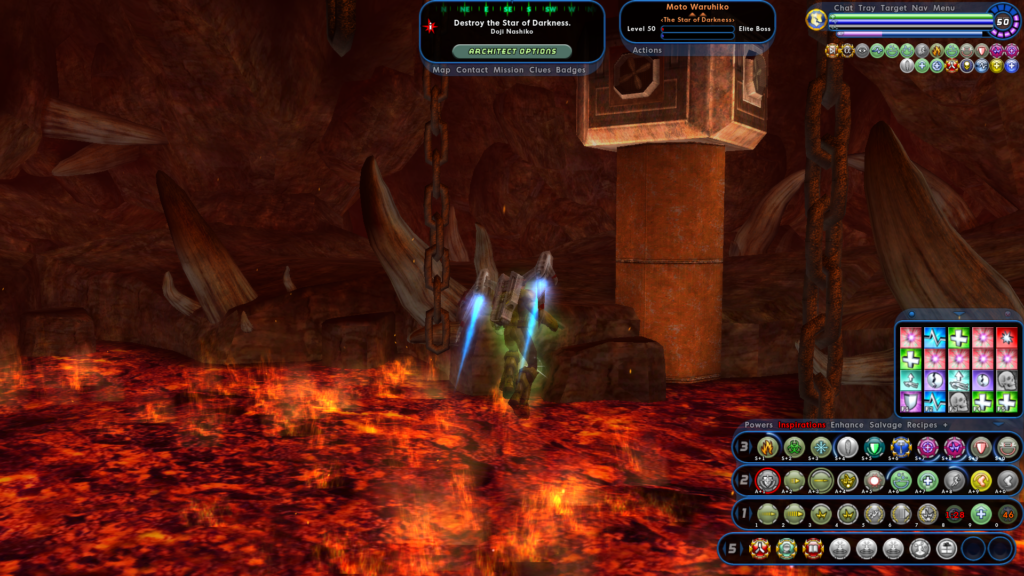
The portal takes the players to Jigoku, a burning hell where the Star of Darkness has retreated to plot their contingency plans.
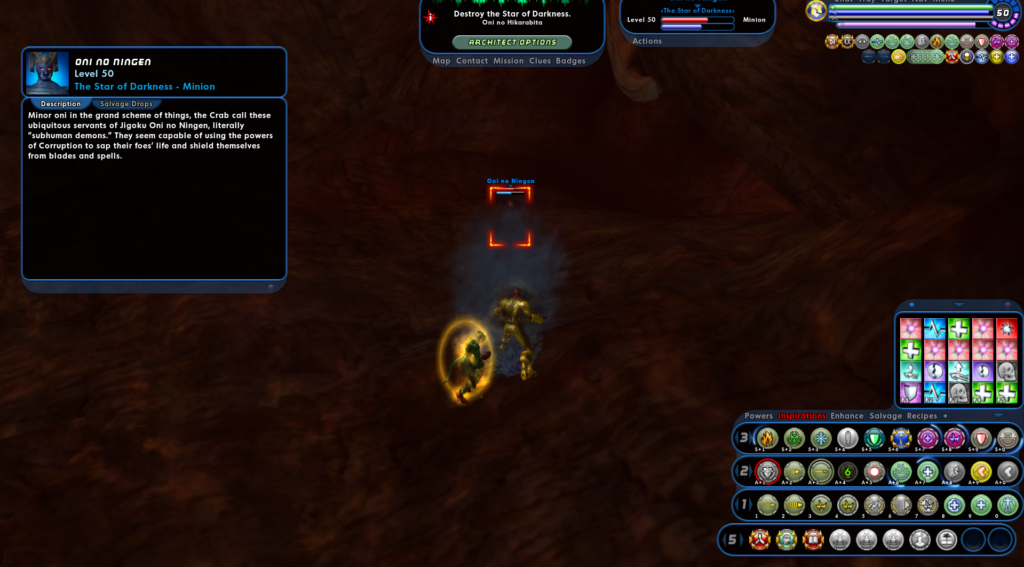
The heroes will find new enemies to face here, including dozens of minor oni not seen outside of Jigoku.
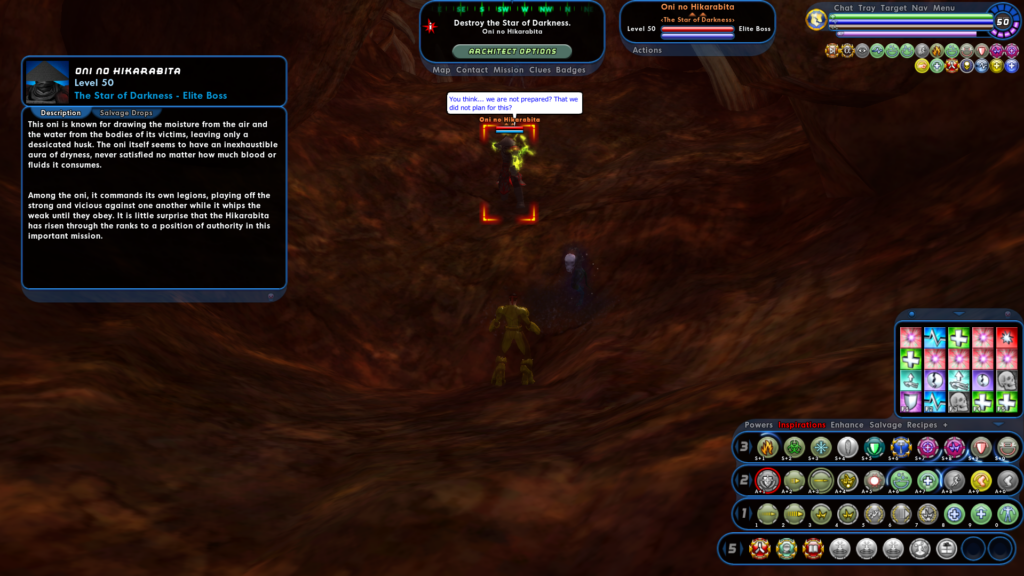
The stars of the show are the five points of the star. The Hikarabita no Oni lashes a burning whip and summons demons in an attempt to vanquish any foes who refuse to die. Using thermal powers, it sucks the moisture from its victims, leaving dessicated husks.
Genso no Oni mocks samurai by dressing and fighting like them, creating fear and darkness wherever it goes. Because City of Heroes adds on special effects with Dark Armor powers, fighting it is like fighting a cloud of darkness. I got a clearer picture of it in the character creator.
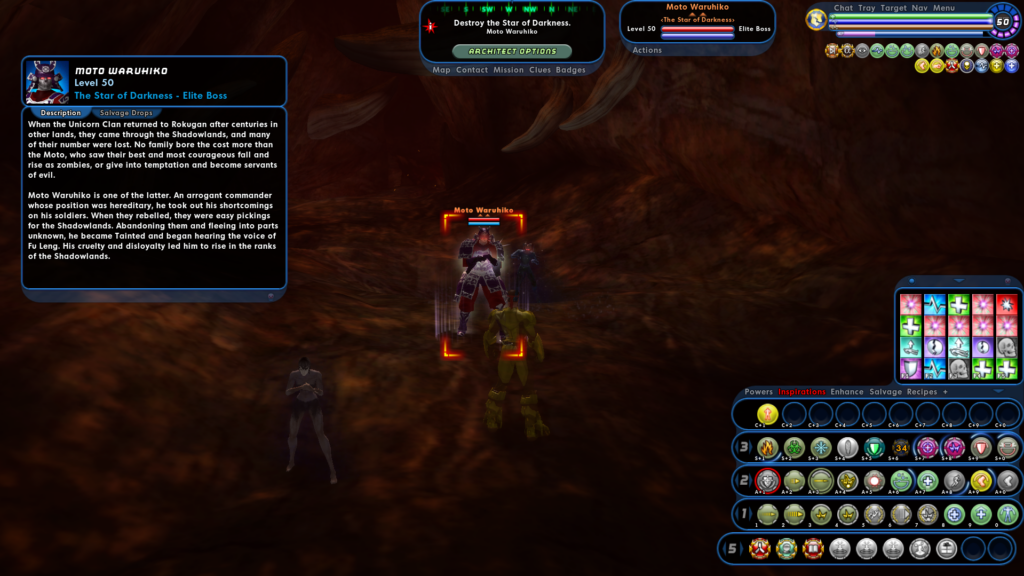
The other bosses include a fallen Moto samurai (a family of the Unicorn Clan largely taken by the Shadowlands).
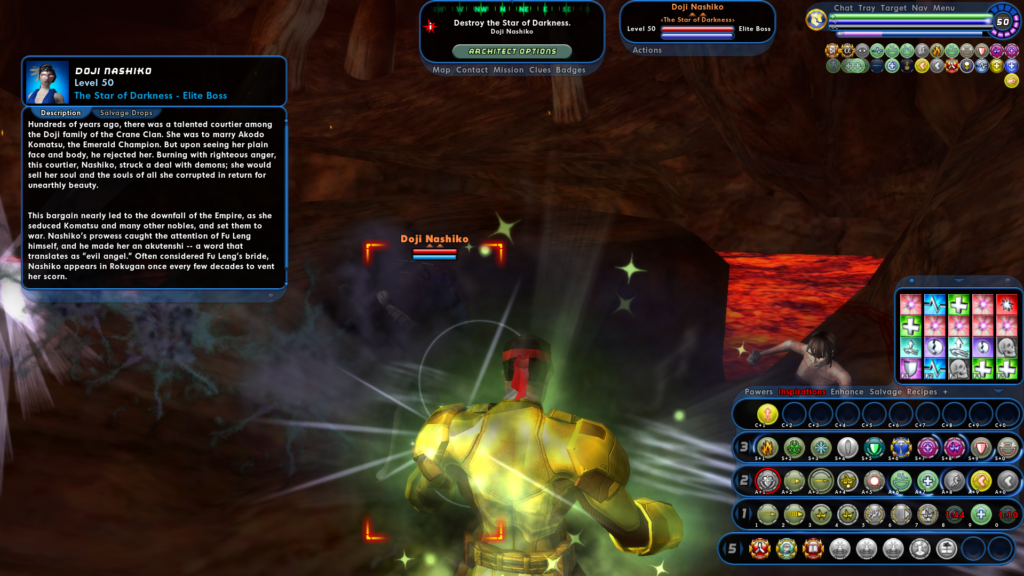
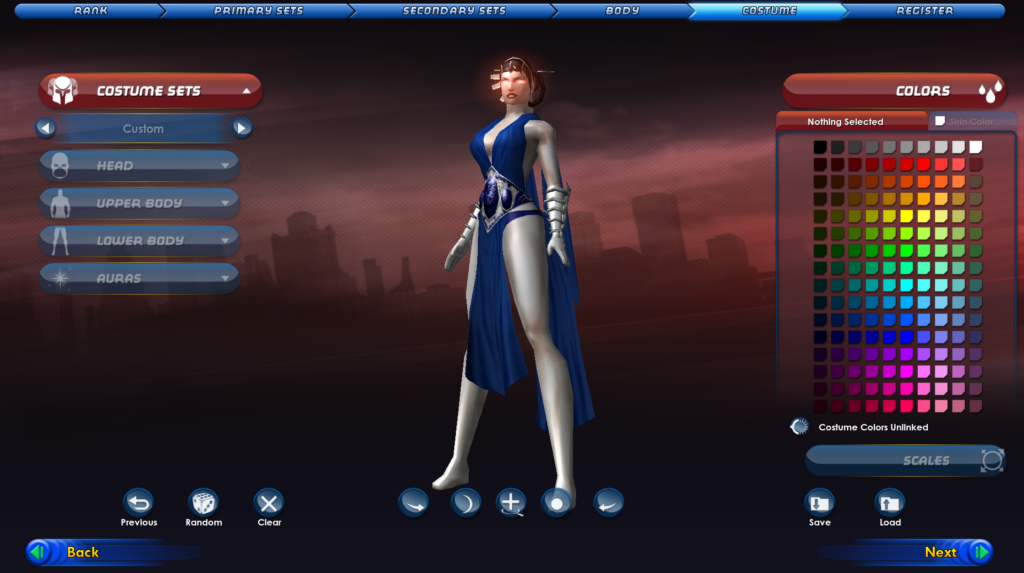
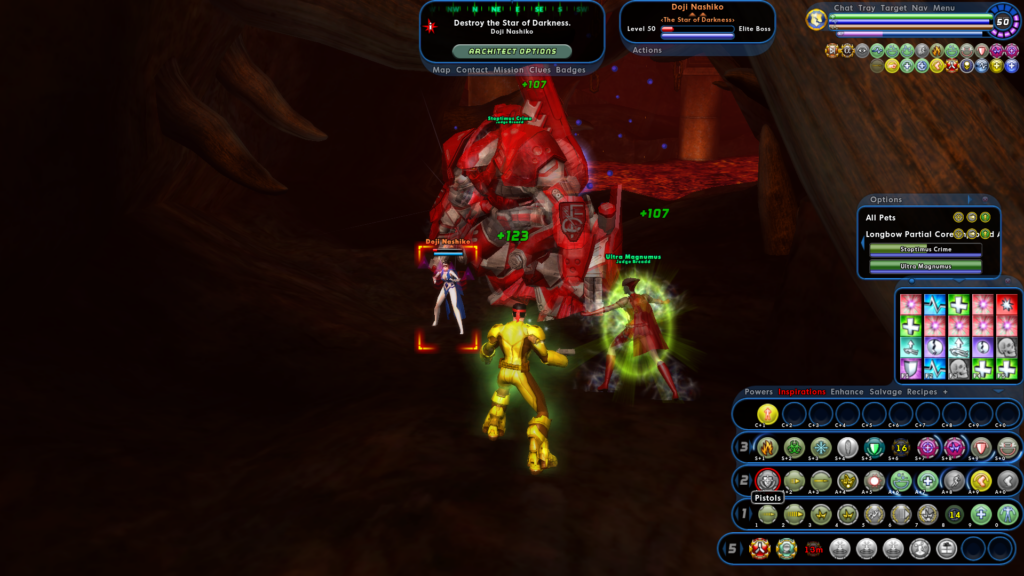
Topping things off is, of course, the archvillain of this plan, the pale princess of the Shadowlands, Doji Nashiko.
Who’s that, you ask? Right-click on her to find out!
I tried to get a picture of her at rest, but she can see through invisibility, so I got one of her in action. Here she is fighting the 8-ton Longbow battle robot I used to keep her busy to get the screenshot.
With Nashiko’s defeat, the players have driven the last nail into the coffin of this evil scheme. But now that Rokugan and Paragon City know of the other realms’ existence, who is to say what will happen next? Will the Emperor send diplomats or soldiers? Will they still remain isolated from all other lands when an existential potential threat to the Empire is just a portal away?
Create your own Architect Entertainment arc and let me know!
In 2004, the massively multiplayer online role-playing game City of Heroes hit the shelves. A little awkward at first, it had a few laudable strengths. It wasn’t trying to compete in the same space as the innumerable fantasy MMOs. The costume generator kicked butt, assuring that ensured no two heroes looked exactly the same. It had mix-and-match power sets that made you feel like a superhero from the get-go. Who really wants to play a level 1 peasant with “tattered cloth armor” as your starting equipment every time? And, importantly, it continued to constantly improve with every new patch (or, as the game called them, “issues”).
One of these improvements was the capability to design your own player-created content. Using the “Mission Architect” system, players could create up to five missions in an arc. Each could use pregenerated maps, normal or customizable enemies, a selection of mission goals, and NPC dialogue they could enter themselves.
Choose Build Your Own Adventure
Two notable types of adventures resulted. The first type was players designing the missions’ enemies for maximum experience gain. They ground out levels and loot as fast as humanly possible. Useful for condensing the time you spent getting levels, but overall, nothing amazing.
The second type of adventure unleashed the creative energy of thousands of players, as they spent hours polishing their virtual baby until it shone. I saw adventures where you descend into the Paris catacombs to fight the Phantom of the Opera. You could battle archvillains themed to the major arcana of tarot cards. One that I found particularly hilarious had you take the job of the Fashion Police, dueling enemies with the most garish costumes imaginable.
And Then the “Thanos Snap” Happened
Despite the love and money of a sizeable fan base, City of Heroes was shut down in 2012 by its parent company, NCSoft.
Unknown to NCSoft, however, a Secret Cabal of Reverse Engineers (names obscured to protect the criminals) absconded with the game’s source code and played in private for the following seven years. In 2019, their secret came out and they opened the servers up to players. Coming home was remarkably like the citizens of Marvel’s Earth-616 after their five-year absence.
A year or two later, NCSoft, who had moved on to other ventures, eventually gave the servers an official blind eye. As long as the private servers didn’t attract attention with bad (read: legally liable) behavior, they could operate and even create their own new content.
Due to differences in philosophy and general drama, several different teams managing their own servers have popped up. I use the Homecoming servers. Homecoming doesn’t try to preserve the game exactly as it was in 2012. Instead, it adds content for a better user experience. Though I haven’t tried to create official content for them, I have made use of their Mission Architect to create stories I think players could love.
So, Get to the Game Already!
So far, I’ve written two Architect arcs, each with five missions:
The player tries to stop Arachnos’ obnoxious super-science expert from going back in time to change the course of the Trojan War. The heroes battle Trojans, Amazons, Aethiopian allies, a river god, and Arachnos soldiers with a certain… mythological edge.
The Portal Corporation opens up a wormhole to the land of the samurai RPG Legend of the Five Rings. The oni of the Shadowlands steal weapons from Paragon City and intend to use them to conquer the Emerald Empire. It will take heroes from both worlds to stop them!
If you check me out on social media, you may notice my Bluesky and Twitter aren’t particularly self-aggrandizing. When I found “chrishepler” taken on Twitter, I decided against calling myself “realchrishepler” and went entirely in the opposite direction. My wife, Jennifer Brandes Hepler, had recently gotten Internet famous for all the wrong reasons.
Some background, for those who don’t know the story:
Back in the day, Jennifer was a writer on Dragon Age: Origins and Dragon Age 2, and was active on the BioWare forums. This led to a notorious harassment campaign, basically a GamerGate kind of thing a few years before that movement ever happened.
Why? Well, she wrote a companion character for DA2 who was a) attracted to the player regardless of gender, b) made the first move in romances by hitting on the player, c) gave minor disapproval points if you turned him down, and d) was the best party healer. Some of these were decisions made in the writers’ room, some were systems and mechanics decisions that came together only in the final product. But the end result was, she got all the blame for writing The Gay Guy That the Game Forces You to Bang.
Jennifer got her own Reddit thread as “the cancer killing BioWare.” Doxing and death threats followed, along with a dissection of an old interview in which she said “you know, the part of the game industry I find hardest is putting enough time aside to play a lot of video games.” That, of course, became the evidence that she was Even Worse! Fake Geek Girl!
I think the one lighthearted moment in the whole mess was when an old acquaintance from our college science fiction club read the news. We’d grown apart from him, and neither of us were particularly friendly by the time we’d left Baltimore. But his reaction was “Fake geek? Jenny was writing Shadowrun LARPs with me when there were no Shadowrun LARPs. She founded JohnCon while these idiots were still in diapers. If she’s not a real geek, no one is.”
Anyway, to make a long story medium, the gaming press picked up on the harassment, and it made enough news that when she and I left BioWare, there were a few more articles written about her. And when I was picking out my social media handles, I knew that no one Googling “Hepler” was doing it to find me. So, I just called myself “theotherhepler.” Irony, yes — it’s my last name, she married into it. But she’s always been better at this writing thing than I have, and more famous for it.
Case in point:
Kinda harsh on Irvine, don’t you think?
Jennifer Hepler is now Narrative Director on the Diablo Franchise
Fast forward to 2025, when the fine folks at Blizzard were looking for someone with lead-writer and writing-director chops. Jennifer’s been doing similar work at another company for a few years now, on an unannounced franchise with a similar vibe, so her work caught their attention. It also didn’t hurt that this year, a lot of Dragon Age fans were looking back and saying, “What made DA: Origins work so well?” Jennifer, who coined the phrase “dark heroic fantasy” that the Origins marketing team ran with, had answers prepared for questions like that.
I could go on all day about how competent my wife is. Since BioWare, she’s worked on Game of Thrones: Ascent (more darkness!), cranked out awesome choose-your-own-romances for the Choices visual novels, edited I don’t-know-how-many other writers, and spoken at GDC summits in which she broke down how she approaches the nuts and bolts of exposition. (She’s super analytical about story structure.) And yes, she’s great about researching the projects she’s on so she doesn’t screw up the essentials. If you’re going through Hell, she’s the writer you’d want plotting your way out.
And me?
I have some gigs, but they’re nowhere near as impressive as the news about Blizzard. I mean, Diablo IV alone was a megahit, to say nothing of Blizzard’s other massively successful online games. It’s one thing to know that intellectually and quite another to see a nine-foot Lilith statue on the company campus grounds.
Meanwhile, I’m working with an indie studio, Quintessence Games. As with the last two indie studios I helped out, our primary focus is to build what the industry calls a “vertical slice.” Basically, early in development you build a mini-level that showcases the kind of gameplay it will have, the kind of art style you want, and the general flow of how it’ll all come together. You then show that to higher-ups and investors, and if successful, you get your game off the ground.
I’ve got high hopes for our project. It is not, however, a good time to be in video games unless you’re sitting on a megahit. More of the companies that can afford writers have been laying off their staff, sometimes by the thousands, in an effort to goose their stock prices. Short-term gain is the only gain in town.
Indie companies have been scooping up some of these writers and focusing on creating games, but in 2024 there were literally thousands of indie games released onto Steam. It is impossible to play all the games released in one year, and difficult to even play a representative selection of a given game’s genre. Standing out from the crowd is a Herculean task, and so working for indies is best done part-time or while lining up future opportunities for employment potential when the contract is done. In other words, my job is work all day, search and plan all night, just in case.
As for spare time… sometimes I have been playing prominent video games that I should’ve played long ago.
A couple of times I took a moment to protest the current political climate (that’s a pile of posts on its own).
I caught up on Ursula LeGuin’s The Left Hand of Darkness, which I’ve never read before.
And, because I’m considering expanding my day job options, I’ve tried a little training for extra skills such as working in the Unreal Editor and copywriting.
Some of these activities felt like a chore — others were comfort food in a world that is becoming defined by its complete lack of comfort.
That means Civil Blood‘s sequel, once again, has been delayed. I hit the milestone of 100,000 words, but the velocity has been at a snail’s pace and the plot is demanding many more scenes than the outline anticipated. Being a political novel about vampires, everything that happens on the news makes me reconsider how I want to explore the themes.
I don’t expect the rough draft to be finished by the end of the year, but I am hopeful. I’m going to do my best to avoid writing The Winds of Winter II: Lady Stoneheart’s Boogaloo — we shall see.
In the meantime, I look forward to seeing what Hell holds.
When I was writing for Star Wars: The Old Republic, BioWare Edmonton’s design director called me into his office and said “How do you feel about working on Mass Effect 2?”
My response was, “Um… why? Do they need me?”
ME2 had six writers on it already. But it turned out that three of them were leaving the company when they were done writing the dialogue, and a fourth one broke his shoulder slipping on an ice rink at a kid’s birthday party. The grunt-work writing remained: the Codex entries, the Galaxy Map, the weapon descriptions — essential words to make the game function, but nothing as glamorous as writing characters the audience would love.
So I took over the non-voiced text from the previous IP expert, Chris L’Etoile, starting with the Galaxy Map. I said, “This works like Star Wars, right? Ice planet, swamp planet, city planet?”
In response, Chris sent me a chart of the minimum molecular weights of gases retained by a heavenly body. This was important to get right, he said, because 90% of the 300 planets on the map were not going to be able to support life. They were going to be barren rocks with gases, just like in the actual Milky Way. My job was to turn them into something interesting and accurate at the same time.
“Uh… does your audience actually care about this?” I asked.
“Yes,” Chris replied. “This chart is why you can’t terraform the Moon. Even if you pumped in all the oxygen and nitrogen you needed to create an atmosphere, the weak gravity means it’d float off into space. You need to know that, because this is the way we did it on Mass Effect 1 and some of our fans on the forums are astronomers. They’ll know if something is off and they’ll tell everyone. By the way, remember that BioWare’s CEOs are doctors, so they’ll know if any alien biology doesn’t work. Good luck!”
That was my introduction to writing hard science fiction, or at least harder than I’ve seen in any other space opera video game. Video games, as a rule, are soft science fiction, with plasma guns and teleportation and all kinds of tech that would require huge leaps in science but makes for easy narrative grease.
I had to learn the rules before I broke them, so I learned all I could about planetary formation and the early stages of life on Earth. Then we got to the Codex entries on weapons, and I had to figure out how to make things sound awesome and match up with what the combat team wanted. I did this through the game shipping and 9 pieces of downloadable content. I also headed up the team on the Cerberus Daily News, 365 player-facing entries that had to be important enough to seem newsworthy but inconsequential enough that we didn’t complicate the writing of Mass Effect 3.
By the time Mass Effect 3 rolled around, I was designated as “the writer who cares about the science,” and was dubbed the de facto IP expert. I did what I could to make the game and its accompanying DLC (another 9 pieces) as consistent with the laws of physics as possible.
Below are some examples I’m proud of.
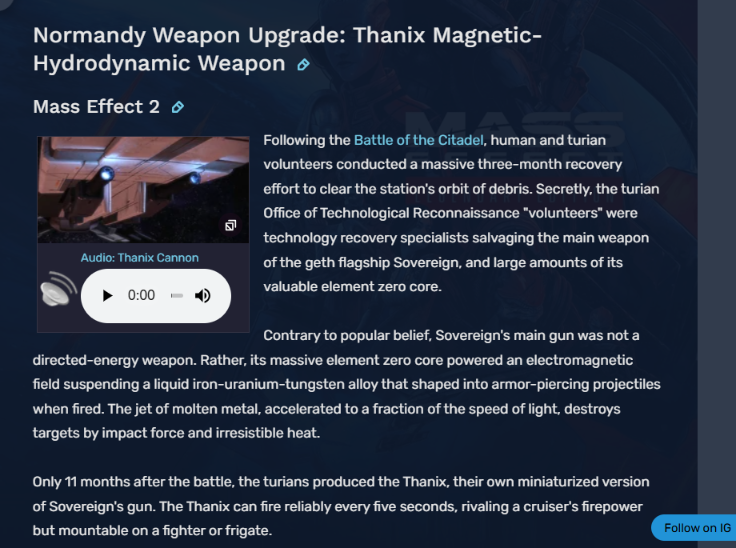
The Thanix “Cannon“
The Thanix weapon you get for your crew’s spaceship is an example of the writing “iceberg” in ME2: a lot of effort, 90% of which the player will never see. We knew that we wanted the weapon to be adopted from Sovereign’s main gun in Mass Effect 1, and that it was super-advanced. The Reapers had a civilization millions of years old and technology that should sound awesome.
It couldn’t just be a laser, because how boring would that be? Further, it shouldn’t be a particle beam (you get that as a hand-held weapon in the game), or a microwave/maser weapon, or anything we’d heard of before. On the other hand, it still had to make physical sense and look like a directed-energy weapon, because that’s what the cutscenes in ME1 showed. So the bar was high.
I ended up scouring pages from the U.S.’s Defense Advanced Research Project Agency and ultimately a 1951 book by Arthur C. Clarke from which a DARPA project (MAHEM) was inspired. Yes, it was an old idea… but if an old idea is grounded in physics, it still works.
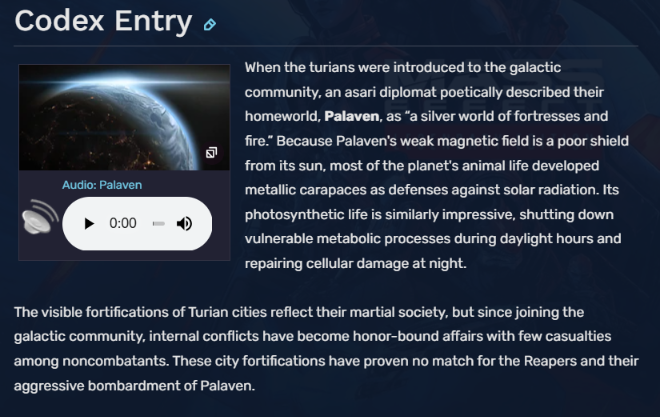
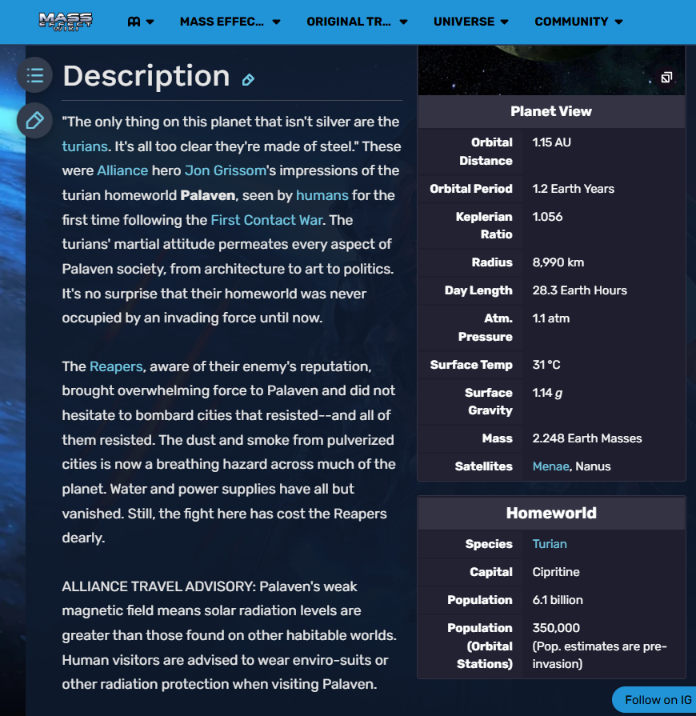
Palaven, the Turian Homeworld
I like this one because it’s an example of literal world-building. It’s also an example of where the Codex and Galaxy Map overlapped, and I had to say similar-but-not-identical content in two places.
We met turians in Mass Effect 1, and Chris L’Etoile’s codex entry mentioned that their homeworld had intense solar radiation, more so than Earth. This is why turians look metallic — their life evolved to incorporate metals in their organic processes so that their silver carapaces reflect away the damaging rays.
But when we finally got to go into the system in Mass Effect 3, I had a conundrum. How would their plants work? Turians breathe nitrogen and oxygen just like humans, and their plants photosynthesize the same… so if the plants were metallic, wouldn’t they be handicapping their energy source?
That’s when I researched my butt off, and found out how Earth’s life deals with intense solar radiation. I wrote that bit about shutting down metabolic processes during the day and repairing the damage at night because lichens on Earth do that already. That’s how good science fiction works — you find a factual core around which you can wrap a narrative.
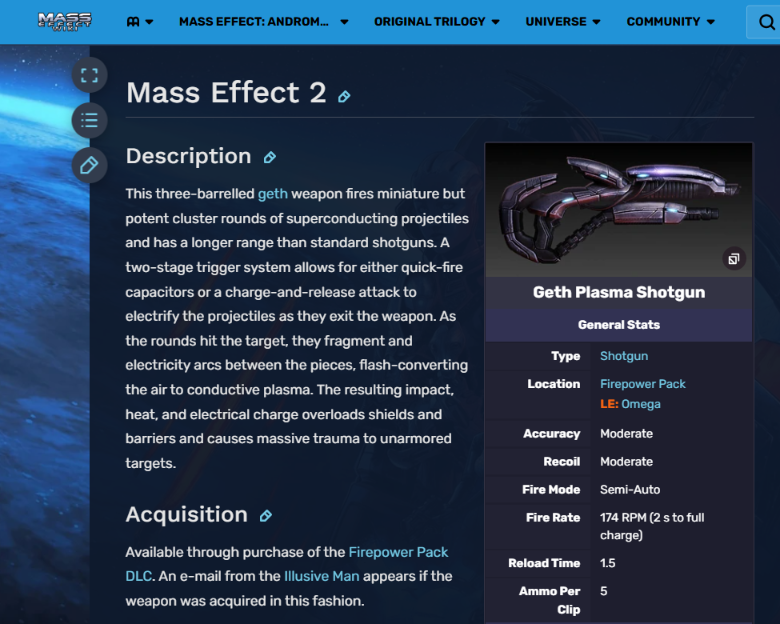
The Geth Plasma Shotgun
I bring this one up in interviews a lot because it’s an example of being a team player. The combat designers wanted an “unshotgun” that could operate at longer ranges and charge up for higher damage. They spent a lot of time and some art resources on it and they had really good gameplay reasons: certain classes that could use shotguns were due for a buff and would love this weapon. It was the “energy shotgun,” or the geth’s “Plasma Shotgun,” since ME1 mentioned that geth sometimes plasma-burned Alliance soldiers.
Here’s the thing: plasma weapons, in physics terms… are bullshit.
I know they’re in a lot of science fiction, but there are reasons real-life weapons manufacturers aren’t making them. Yes, plasma is hot and would burn enemies. But you don’t fire “bolts of plasma” and certainly not “shotgun shells of plasma.”
Plasma’s a superheated gas. A stiff wind would blow it back in your face. Nor is it easy to magnetize it and fling it, especially with enough force to do much to an armored, moving opponent. It’s orders of magnitude easier to make a gun or flamethrower that does the job better and cheaper.
But… my job is not to make other people throw out their work. So I didn’t say no, and I didn’t give up. Giving up is not in my workflow.
I talked with a physics teacher I once had who now works at NASA, and with a science-fiction conflict-simulations group, and we brainstormed over e-mail. The result is what you see up there: room-temperature superconductors, miniaturized into toroid-shaped shotgun rounds, that are charged up and flung at the enemy. When the high-energy conductors break apart on impact, the energy is released, flash-creating plasma.
Pow. The Geth Plasma Shotgun that made the writing, art, and combat teams happy. And players got that sweet gameplay we all wanted. They freakin’ loved it.
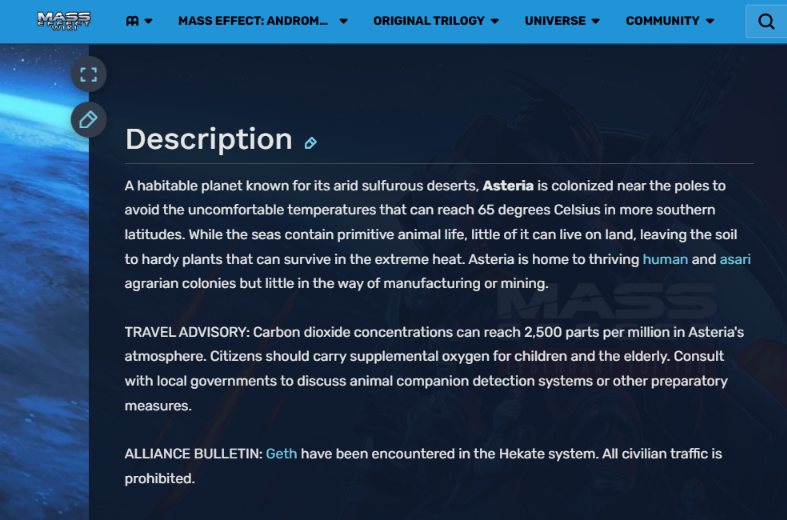
Asteria
This was a little throwaway entry in the Galaxy Map. I wanted to include it because every science fiction property in the world has habitable planets that are filmed on a back lot in Southern California or something similar. The air is hardly ever a problem, the animals look like pets from a store like those snakes in the Dagobah swamps… they’re just not alien.
So, I made Asteria, which is a habitable garden world… except the numbers are 95% right instead of 100% right. It’s just a little off-target, with too much CO2. Not enough to totally prevent humans from adapting, but retaining enough heat to feel worse than Earth. And advising visitors to, almost literally, bring a canary like it’s a frickin’ coal mine.
This detail was possible because the player can’t land on Asteria, so we didn’t have to expend resources on some weird mechanic showing it off. You don’t want to go there? Super. We give you just what you want, and get text that evokes versimilitude to the universe at the same time.
Bekenstein
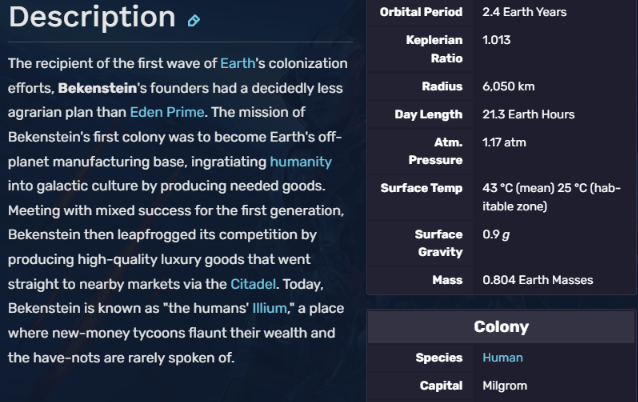
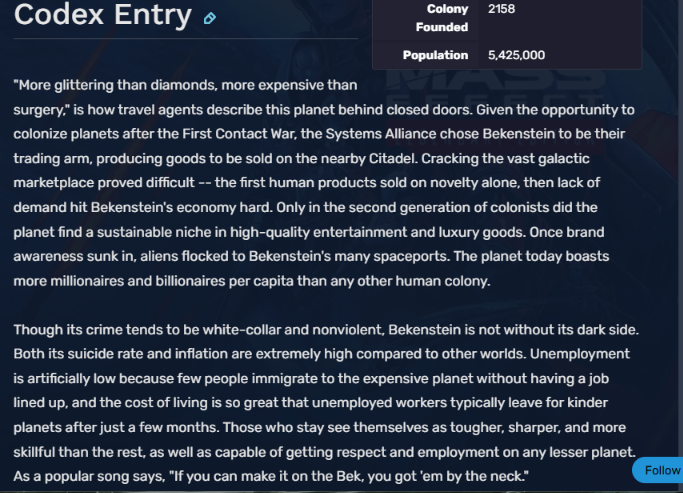
I wrote this one up for the Kasumi: Stealing Memory DLC, the planet where Kasumi Goto takes you to an arms dealer’s fancy party. Having seen farming colonies like Eden Prime in Mass Effect 1, I thought it’d be neat to make the planet the equivalent of the humans’ New York or Tokyo. Its proximity to the Citadel made it all come together.
My one regret is that if you’re not from the USA, “more expensive than surgery” may not ring quite as true.
The Omni-Blade
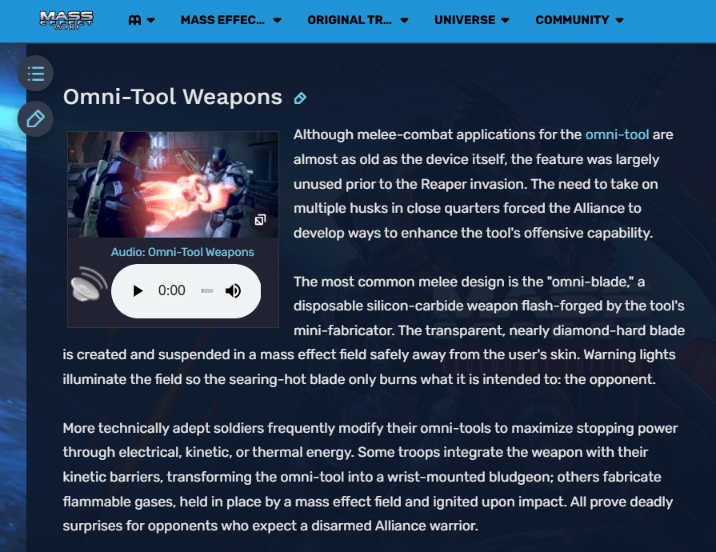
This was an example of retroactive continuity and avoiding worse retroactive continuity.
By Mass Effect 3, we wanted a melee attack that was cooler and more unique than Shepard elbowing his enemy. Word came down from on high to make a “holographic switchblade.” Which, of course, doesn’t make sense. Early ideas (from someone I’d rather not rat out, since God knows I’ve had my share of non-starters) justified it as saying it was a form of “hard light.”
Of course, the previous two games didn’t have any hard light. No lightsabers, no holo-shields. And this wasn’t even newly-captured Reaper tech, it was a weapon Shepard has from the get-go. It was going to have variations based on Shepard’s character class, so the Alliance had clearly mastered it.
So, it was up to me to craft a Codex entry explaining what this glowing blade (or bludgeon, or whatever) actually was. And, as a bonus, I avoided saying they were just invented, because at the time we didn’t know if we were going to visit the First Contact War in another game or comic or whatever else the franchise needed next.
Thus, this entry: highlighting that Alliance soldiers, like real-life modern soldiers, rarely kill in hand-to-hand, but the Reaper invasion demanded new tactics.
And Let’s Not Forget the Cerberus Daily News
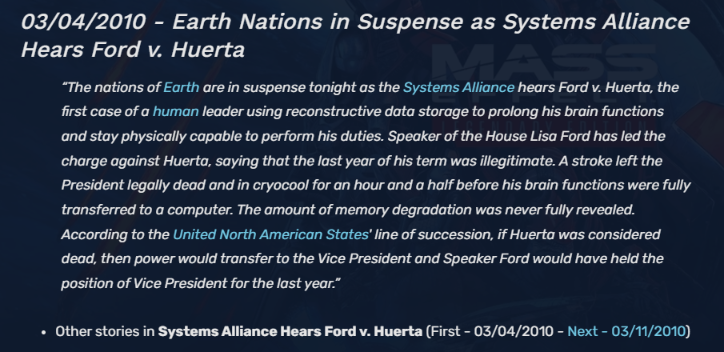
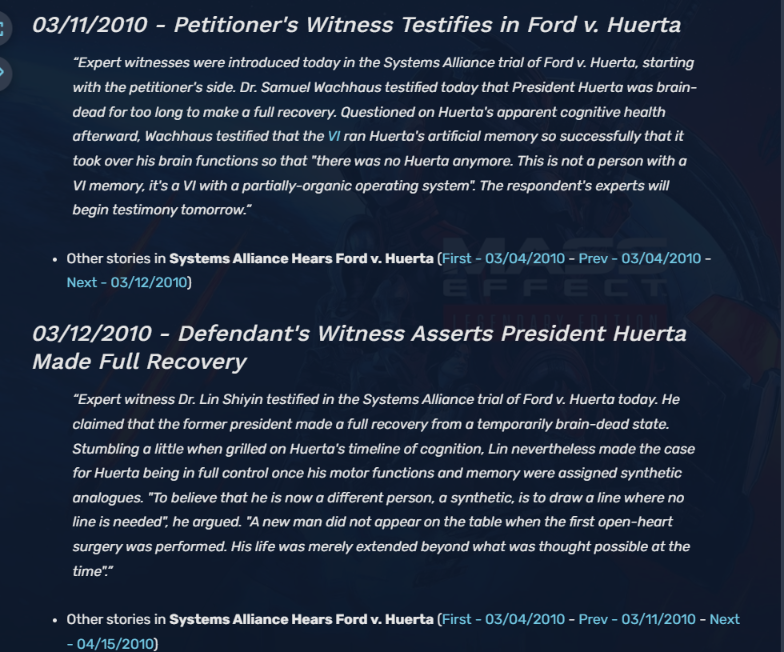
President Huerta’s Predicament
I wanted to have some news items from Earth, since ME1 and ME2 never took us there, and many players would want to hear what Earth life is like. Some of my biggest writing influences were in the cyberpunk genre, and though Mass Effect is more space opera than cyberpunk, the advancements of technology would change the world.
The Huerta stories explored this idea — that humans would use data storage in medicine, and somewhere, the law would need to draw the line differently regarding what “death” really is. Of course, the story grabs more attention if you give it enormous stakes, such as the Presidential line of succession. Incidentally, the Huerta stories showed up as a tiny mention in Mass Effect 3 with Huerta Memorial Hospital — a hospital named after a President who insisted he wasn’t dead yet. Welcome to the politics of the future.
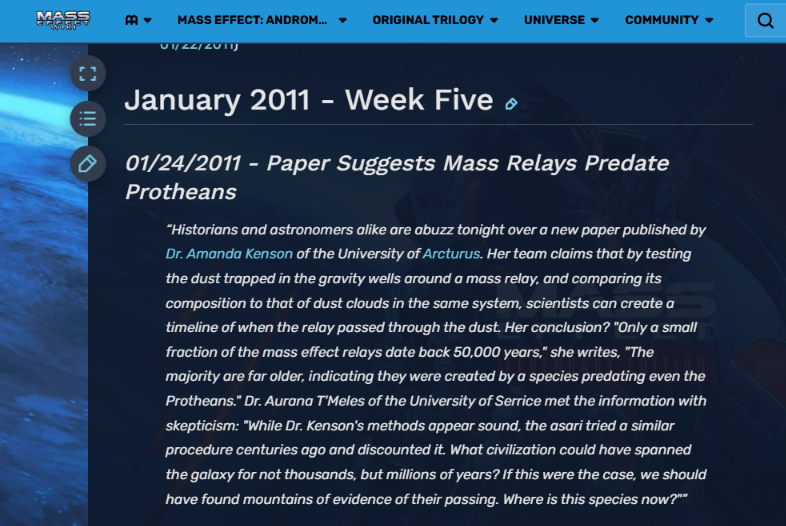
Let’s end this sample with a bang — the final entry of the Cerberus Daily News when the collected peoples of the galaxy started to figure out that the Reapers were coming. This last entry left on an ominous note (if you were following the storyline ending in ME2 and/or the Arrival DLC) and the next thing the players would see was ME3 trailers that showed the Reapers attacking Earth. I thought this put a nice capstone on the entries and built the hype like we needed to.
New Year’s is the time of the obligatory retrospectives, and I am not immune to the call of tradition. My writer friends are posting lists of the short stories they sold, or the final page of their manuscript’s rough draft, and other celebratory milestones. It makes me take stock and think about how much I’ve done… and also, how little.
Last year at this time, I was riding high with 75,000 words of my manuscript in the can, and a goal of 130,000 or so. But when 2024 ended, I counted it up and found I only reached the 93,000 mark. Honestly, as writers go, that’s not a lot of improvement. Sure, some of it required research, and it’d be hard to write a novel about a presidential campaign without seeing the new political landscape determined by November 5th’s election, but it made me ask, what happened? Was I just, as Brian Michael Bendis put it in Fortune and Glory, “the suckiest suck-ass in the history of sucking?”
On New Year’s Eve, I spent some time with the accomplished Whitney Beltran and a few other luminaries in the TTRPG space. Rather than just making up a sentence or two for resolutions, she had us fill out a party activity/personal growth booklet called YearCompass. It’s like 15 pages of conversational material about what you accomplished and what you didn’t, and it opened my eyes enough for an in-depth retrospective.
So Where DID the Time Go?
Part 1: Health
Well, I came closer to being the subject of a meme than I ever wanted, even before the term “brainrot” was a thing…
In January I had the double-header of dislocating my knee and getting laid off. My priorities had to be getting out of my leg brace so I could resume being able to drive, and then later, walk unassisted. Though I was able to get around without a crutch by the time of the Game Developer’s Convention in March, I still had an 11mm chunk of cartilage floating around in my knee. I got it removed via surgery June 5th or so. I lucked out and didn’t need donor cartilage. My surgery recovery was a lot shorter than expected, but still, the knee didn’t hold weight for a few weeks and it took a bit out of me. The rest of the family didn’t get off scot-free, either: besides having to help out with the things I couldn’t do, we also had a broken foot and some illnesses in the mix.
Part 2:Doing Those Adult Things
In case you haven’t been following the state of the video game industry right now, it’s at about a 20% unemployment rate. The Great Depression, at its height in 1933, was 24.9%, so while it’s not the literal worst it could be, it’s comparable. The least common positions to be hired? Game Designer and Narrative Writer. So believe me when I say when I got laid off from Airship, I didn’t know if I was going to get a gig in weeks, months or years.
Fortunately, I shmoozed to the best of my ability at GDC, and got a 13-week contract, writing for an adorable little New York startup called ThrivePal. I worked on a game that has yet to be announced… and then my contract was up. Back I went into the mix, and wound up at Eram Games, a Jordanian company working on another largely-unannounced project. As of now, my duty there is done and I’m back out on the streets.
Simultaneous with all of this was the discovery of mold in our house. Not only could we not live in it while it was being stripped and reconstructed, my wife found a new place that came on the market that fit a lot of our criteria. We could do a down payment, get a loan, put the old house on the market, and because it had appreciated in value (other than the mold), we could pay down the new place enough so that the mortgage was back to a sane level. Provided the old place sold. Right?
Actually… yes.
I was scared out of my damn mind with what we call “provider panic.” I thought the old house wouldn’t sell, or not at a level that the numbers would work, but they did. Was that the end of our crazy ride? No, not by a long shot. This year my son had a bar mitzvah in the middle of all this, and my daughter graduated high school, got her first summer job, and went off to college.
Part 3:Electioneering
As I wrote a few times this year, I was also hell-bent on writing literally hundreds of letters to eligible voters and tried my hand at recruiting new ones in person. I went to a local mall to register voters and took a bus trip to a nearby swing state to knock on doors. And, come November 5th, all of it was for nothing.
Well, not quite. I kept at it after the election, doing ballot curing by phone. In some incredibly tight races, we helped swing a Senate seat. So that’s not nothing, exactly, particularly if the other side has any infighting during their votes over the next two years. And, of course, this all meant I had a clearer view of a presidential campaign, which is the subject of Civil Blood’s sequel.
Part 4: Personal Writing
During the election, there was a part of me that had another gut check, because the tone of my novel could seriously need to change one way or the other. I’m trying to avoid writing something ripped from today’s headlines, because I’m aiming for the feel of a future time rather than five minutes ago. So some of my procrastinating was because I wanted to see how November 5th turned out.
I also got distracted by the chance to sell some short fiction. I wrote, revised, and polished two short stories, “Prisoner of the Freest World” and “A Jones For Your Affection,” each targeted to separate small-press anthologies. And will you be seeing them?
No.
No, you will not.
After writing, getting feedback, rewriting, and submitting the stories before the deadlines, neither anthology got enough quality submissions to launch. It’s theoretically possible that some magazine might like the material, but I’ve done a lot better with anthologies than I have with magazines that don’t specify what exactly they want.
So in many ways, this year hit me, over and over again. But I’m gonna take the “growth mindset” option here and count what blessings I do have, because my life could be a lot worse.
For those that don’t recall, Thor and his pals journey to Jotunheim and meet Utgard-Loki, the king of the giants. Utgard-Loki asks Thor to wrestle his decrepit old grandmother, drink from their mead-horn, and try to move the giants’ sleeping cat. The thunder god who has no equal struggles to do each, and only afterwards finds out he was tricked by the giants’ illusion magic. He was actually wrestling Old Age, drinking the sea, and trying to move the coil of the Midgard Serpent.
The lesson here is that though you may beat yourself up for a lack of success, you might not be considering the reality of how difficult your struggles might be.
In trying to summarize my last year to Whitney and her friends, I mentioned I was feeling down because of how little I accomplished. Part of the YearCompass asked “What are you most proud of?” And I wasn’t sure.
Then Beth, one of the participants, said something to the effect of, “Well, if I were you, I’d put down ‘resilience.'”
So, I haven’t succeeded as much as I’d like to have, but I’ve been someone my family can rely on while we got hit with a few crises. I needed help with physical damage, but at least I held it together emotionally. And if you did, too, remember that in a year like 2024, that wasn’t a given.
Looking to the Future
Okay, so let’s give the forward-looking goals, if not actual resolutions.
I want to get employed again. With the game industry as grim as it is right now, I’m looking both in and outside it. That means training for alternative professions if I have to.
I want to finish the rough draft of Civil Blood’s sequel. Not necessarily a draft good enough to show other people yet. The rough draft is, in the words of some writer or other, “being able to tell yourself the story, before you can tell it to anyone else.”
If I find myself with free time, I’m going to polish my portfolio. I have samples for various formats that aren’t represented, and I can write more, so that page may be built up in the coming days.
I’m learning about SEO optimization, so perhaps this site will have some more visitors as I experiment and implement my new knowledge.
I haven’t decided yet on what I want to do with my social media presence. I want to cut down the number of hours a day I look at it, while also making myself visible on BlueSky, where I’m growing a following.
I may post more about my martial arts hobbies, which I haven’t mentioned on this page yet. I’m experimenting with Chen family tai chi, which is not as combative as some of the other arts I’ve studied. But it’s aces at rebuilding leg strength!
So let’s ring in 2025, and brace ourselves, ’cause we may need all the resilience we can get.
Slowly, the world turns, leading to more troubles and more triumphs. You may have read about the troubles in the last post: a double-hit of injury and unemployment. But pain doesn’t last forever, and, in my case, unemployment doesn’t either.
I lucked out in more than one respect — I managed to make it to the Game Developer’s Conference in San Francisco, and networked my butt off. Not every meeting bore fruit, but one did — I met Y-Lan Boureau, the founder of a startup called ThrivePal. She was looking for nerdy writers, and I happened to be one. As of April 12th, I have some contract work with ThrivePal, so you may consider me gainfully employed as a writer once more.
That’s probably the biggest news, but as far as You the Gentle Reader are concerned, it may not make a vast, visible difference just yet. I can’t talk about the project, probably for a long time. So let me distract you with something that might entertain… a lovely bit of cover art!
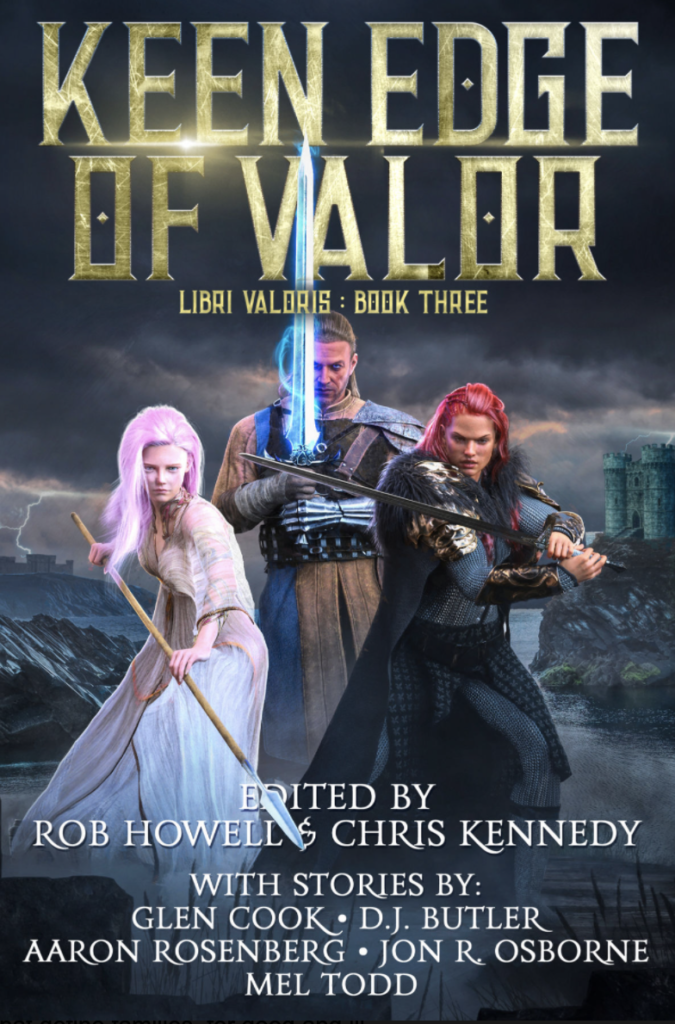
Remember this one?
I still don’t know where the pink hair came from.
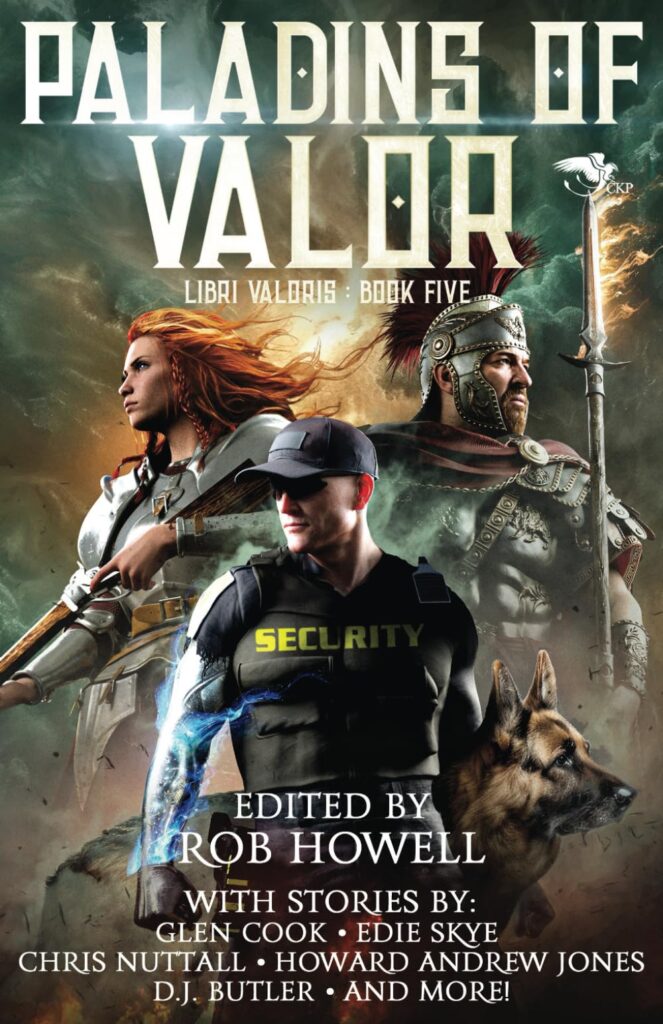
Like with Keen Edge of Valor, a character from one of my stories made the cover of the brand-spanking-new installment in the Libri Valoris (Books of Valor) series. Keen Edge up there has the Lady of the Lake on the left with King Arthur’s spear (the Rhongomyniad), as detailed in “The Torturer of Camelot.” Well, now we’ve got a new heroic trio, and I’m not talking about that movie with Michelle Yeoh. I’m talking about…
Warning: Contains an unsafe level of redheads.
All the Details, a.k.a. A Brief Commercial
Paladins of Valor is the fifth and last anthology in the Libri Valoris series, and it’s coming out April 19th, 2024. As I write this, it’s still in pre-orders, but by next week’s FantaSciCon, it’ll be available to all.
For Paladins, I wrote a story called “High Water Mark” in which a paladin, her apprentice, and a formerly enslaved camp follower serve the Union Army at the Battle of Gettysburg. The paladin, Seraphine, is pictured on the left with her armor and a Sharps rifle. (Yes, I know plate mail doesn’t stop Civil War-era rifle rounds. I took that into account in the story.) The apprentice, Miri, and her new friend, Jessie, are just as important, but you’ll have to read the piece to see how it all shakes out.
There’s 14 stories of paladins in the anthology, some of whom you may know from already-existing worlds printed by Chris Kennedy Publishing. The guy in the middle of the cover is Gavin, the bearer of Nuada’s Silver Hand in a story of the Milesian Accords universe by Jon R. Osborne. (The dog’s name is Zeus.) The legionnaire on the right is (I think) from the Roman-esque Chronicles of Hanuvar universe by Howard Andrew Jones, and he’s Killian Pullio Vicentius. I’m not 100% sure, because there’s also an appearance in the anthology from the legendary spear-wielding centurion Longinus. But that story takes place a long time after the Roman era, so either it’s not him or the artist just put him in armor because of the Rule of Cool.
What Other Books You Got?
If anthologies aren’t your speed, I don’t have any other new writing coming out, but I have been reading and reviewing books on the regular. A website called Shepherd.com asks authors for their three favorite reads of the last year so they can build a library of short and sweet reviews. Their landing page lists the most popular. They hit me up and I sent in my faves. It sort of defeats the point for me to repost them here, so here’s the link to my three — one traditionally published, two indie.
And What of That Fancy New Novel?
The short version: I’ve been focusing on getting a job and researching games at night. I’ve been almost completely stalled on Civil Blood’s sequel. Over the last two months, I’d guess I got about 5,000 words added. Not zero… but not good. Hopefully my life will get a little less complicated and I can make some real progress.
Hi, how have you been? Things were going pretty great for me two months ago, right? Oops, here comes the karma train, and it does not appear to be slowing down.
To start with, at the end of January I suffered what you might call a “sports injury.” I was stretching, because one of my goals was to regain a little of the flexibility I had when I was younger. One of the stretches was a front split. The stretch lets me do higher front kicks, and I like to be able to get my foot up to head height. I can’t really do “the splits” in the way people think of them — I can feel the limits of my hip sockets far before I get there, but I can usually get a nice hamstring stretch out of trying.
Usually.
This time, instead of doing the safe thing and kneeling on the rear knee while stretching the front leg forward, I tried to just slide into the split. I was in socks on carpet. But my rear leg twisted and somewhere between half or all of my weight was on it. And I dislocated my kneecap.
It popped back into place immediately, but the damage was done. I had excruciating pain and a leg that could bear no weight. I have a few canes in the house but no crutches, and canes were simply not good enough. My wife drove me to the ER. At about two in the morning, we got home with a leg immobilizer, crutches (which make all the mobility difference in the world) a bottle of 600-mg prescription ibuprofen, and some hydrocodone. For those who only know brand names, that’s tabs of Advil and Vicodin. I slept in my clothes (because taking off clothes was actively painful), and got up for work the next day with a story to tell.
Then, like dang near every other company in the games industry this year, Airship Syndicate decided it was time to do some layoffs.
To be clear, I don’t begrudge them the decisions they had to make. The upper management were pretty transparent about the source of the decision and cut their own pay in solidarity. They didn’t want to lose anyone.
It came as an unpleasant surprise, because I had been deliberately busting my butt for the previous month to hit deadlines. One of the things I’d learned in other jobs is that while management likes to say layoffs are not performance-related, when they make the decision of who the company can afford to lose, a proper manager will look at some kind of semi-objective metric. Who’s got a high-paying salary that will save us a good chunk of change? Who’s got bad performance reviews? Who’s got measurable accomplishments as represented by tasks checked off in the task tracking software?
I don’t know the decision process used at Airship. I do know that this time around I have no basis to wonder “was I not enough?” I was writing a lot of content, and my team and manager were pleased with my work. And because I’ve gone through this before, I’d been knocking out a lot of tasks and checking them off. But as several thousand highly experienced people in the game industry can tell you, sometimes it’s not just about being a valuable employee. Sometimes all you can do is say goodbye, update your resume, and start the application dance once more.
Out on the Streets, Into the Orthopedist’s
Of course, the main thing that occupied my mind was my new handicap. I’ve never broken a bone before, or anything on the scale of a dislocation. A visit to the orthopedist led to X-rays and a leg brace, which I actually managed to sleep in for a week or two. Then came an MRI, which revealed that I managed to bruise the end of my femur and break off a small amount of cartilage. I may need surgery to remove it, depending on how it heals. Apparently it feels like having a stone in your shoe, except it’s in your fricking knee.
Then there was physiotherapy. Two crutches gave way to one crutch, and then, as long as I don’t go super far, no crutches. Slowly my need for the leg brace has lessened, from sleeping in it to limping in it to going a whole day without it so long as I’m super careful. Vicodin was necessary for the first night or two, but after that, Advil was the way to go, sometimes for the pain but more often to try to reduce the swelling.
Next up came the applications. While waiting for any replies, I sat in bed, paid bills, prepped my taxes, and refreshed my memory on a bunch of relevant video games.
Lest you think that sounds like paradise, I’d like to introduce you to my wife. Jenny is working a full-time job, and now she had to feed me and strap me into the leg brace, while also picking up the slack of dishes, driving, cleaning the kitchen, trash, hauling laundry, and other things I was no longer capable of handling. We also had two blackouts (thanks, Pacific Gas and Electric!) and some strep throat going around the family. So while I got better, everybody else got measurably worse, and only a jerk would think that’s a good deal.
So Did Ya Write?
Well, I was laid up in bed with nothing to do but heal, so yes, a little.
Back in late January, I spotted a themed anthology and rewrote a short story to specifically target it, which took up all my personal writing time for a few weeks. My writers’ group queued the story up for review in four weeks, which was going to be when the submission window closed. I always want feedback before firing off a story, so I used the group’s rule of “if you review the most stories in a week, you can get your own bumped to the front of the line.” In other words, I burned my eyes and typing fingers out trying to write extensive, helpful critiques.
It worked, though — I got feedback in one week instead of four, and the story was submitted with time to spare. Whether or not it’ll be accepted is not up to me. It was bit of a sunk cost — I’d already spent time and effort on the rewrite by the time I busted my knee, and wanted to see it through. Future personal writing is a lot more dicey.
So, What Now?
So now I sweat in physiotherapy and make myself into the best potential employee I can be.
There’s a Sun Tzu quotation that goes “If you know everything about yourself, you will win 50 percent of the time. If you know everything about your opponent, you will win 50 percent of the time. If you know everything about yourself and your opponent, you will win 100 percent of the time.” I try to take this attitude into job interviews, but there are so many “opponents” who are potential employers that it becomes hard to predict where I might be the perfect fit.
When I think about returning to Civil Blood’s sequel, I think first of all the AAA-caliber games I missed out on playing because I had to master Wayfinder, and the mobile games I focused on for years before that, because I was working in the mobile space. That made sense for me at the time, but the next job I apply to might be for a mobile game, or it might not.
Worse, it’s a different landscape for hiring now — to get re-employed, I’m competing with hundreds of writers and narrative designers, many of whom have similar experience. So, I need every edge I can get, and game literacy is a big part of that.
So, I’m going to focus on games for all my available time for at least a week or two. After that, we shall see. Spending an hour or two per night on a personal project may feel like a waste, or after a long day of twitchy reflexes, it may be a much-needed mental release.