Big Trouble in Little Rokugan

The worst job in the samurai fantasy nation of Rokugan belongs to the Crab Clan, who must maintain the Kaiu Wall to keep out the demonic armies of the Shadowlands. One particularly disagreeable duty is to scout out the blasted wastes and spy upon the enemy. When the ronin Seikansha sought this out, he discovered a portal to what he thought was Jigoku — Rokugan’s Hell.

This was not the case. When he followed a strike team of misshapen creatures into this distortion of time and space, he emerged in the laboratories of Paragon City’s Portal Corporation. The oni, goblins, and other servants of evil had no clue where they were — but wasted no time kidnapping the local humans to gain their secrets.
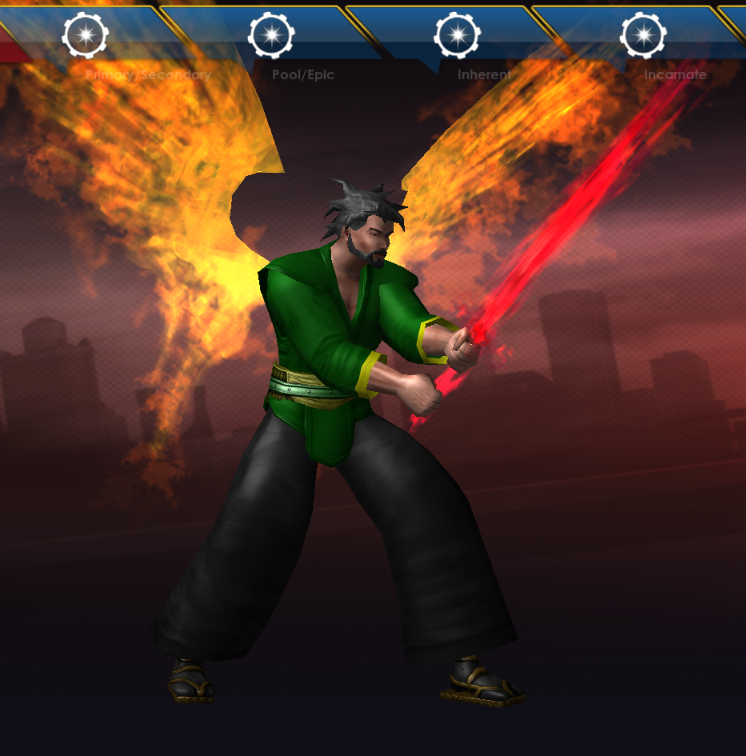
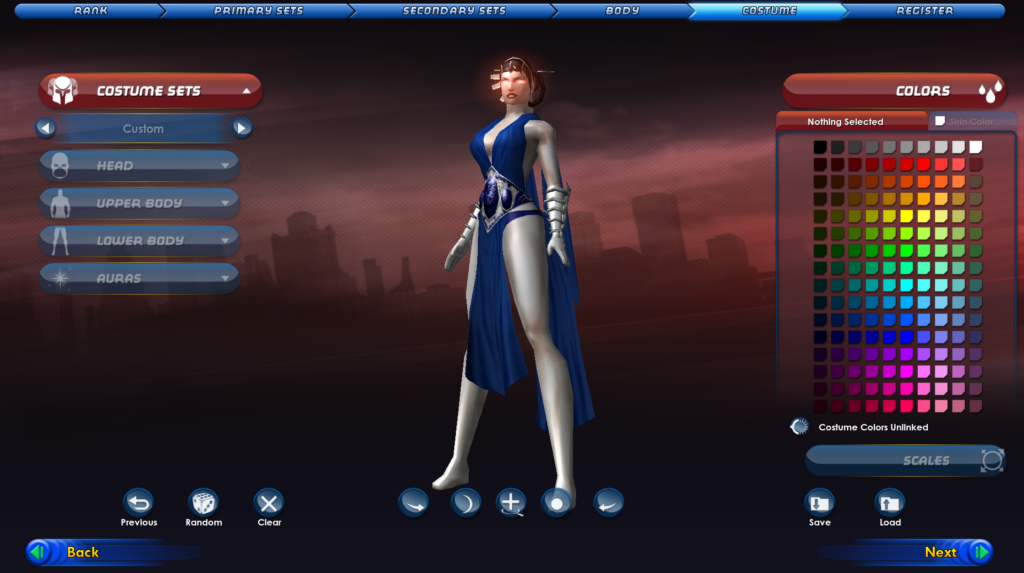
My approximation of the L5R shugenja Seikansha, featuring the Wings of Fire and Katana of Fire spells.

Alone, Seikansha knew he could not face all the enemy at once. But the language of heroes is universal. If the people here — however strangely dressed — seek to defend their home from the Shadowlands, they are no longer strangers, but brothers and sisters. It’s time for a team-up between samurai and superheroes.

“But wait, is this okay copyright-wise?”

Funny thing… yes. According to the guidelines of the current rights-holders of Legend of the Five Rings, Fantasy Flight Games, fans (such as myself) can create content so long as it is not sold for a profit. Since City of Heroes: Homecoming is entirely powered by volunteers and doesn’t charge for its services, no laws have been violated.

So… let’s rock!

Part 1: Face the Horde

Once the player starts the Architect Entertainment arc, it creates a hologram contact for the first mission.
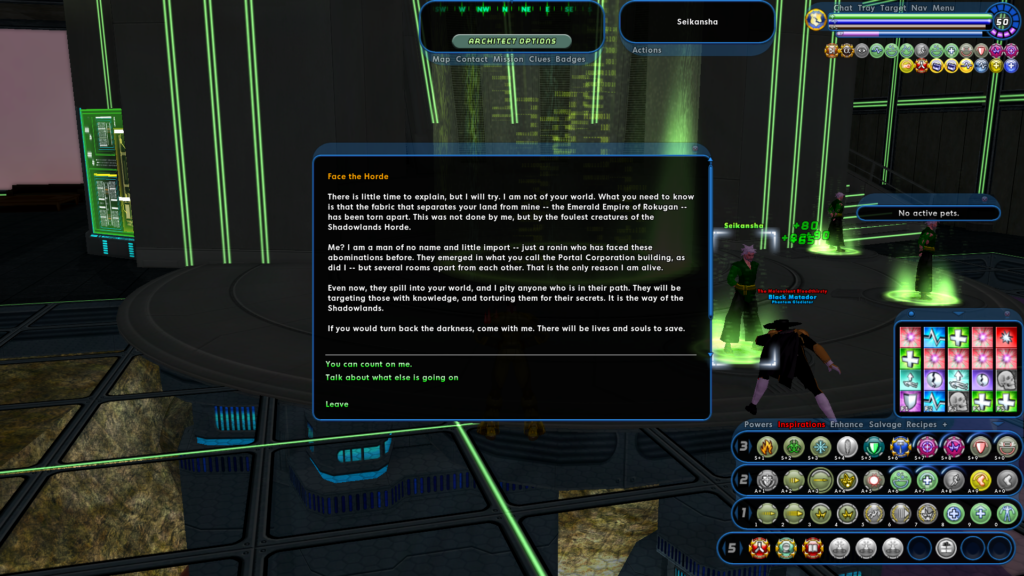
“If you would turn back the darkness, come with me. There will be lives and souls to save.”

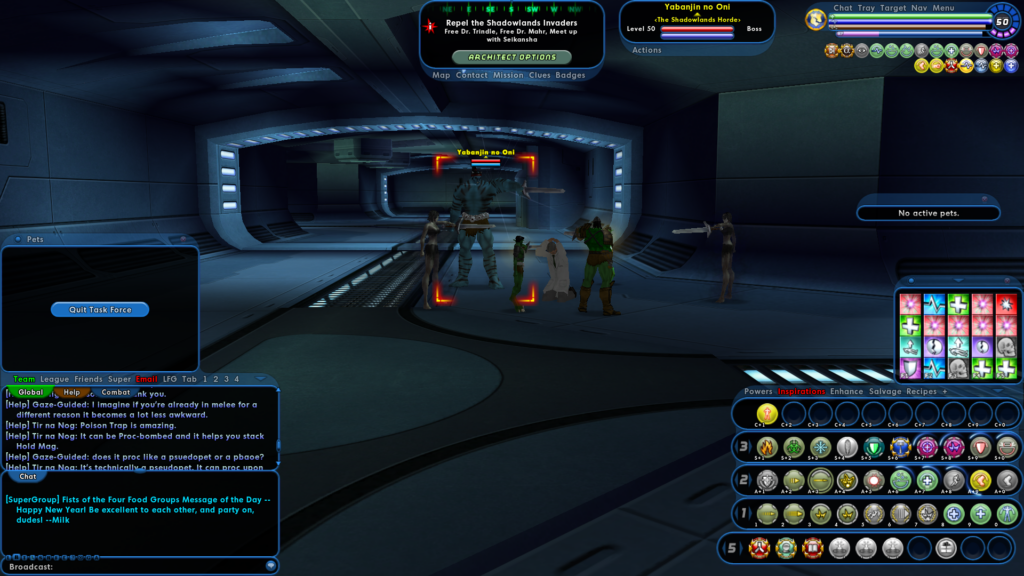
Here, the heroes retake the Portal Corporation building from the foot soldiers of the Shadowlands Horde. Since it’s just the first mission, I thought we’d ease into it with familiar enemies from L5R and a simple task: rescue the scientists of the Portal Corporation. The liberated scientists are eye-witnesses to the crime.
Who are we facing? Let’s zoom in on the bad guys with some beauty shots from the character creator!

Bakemono (goblins):
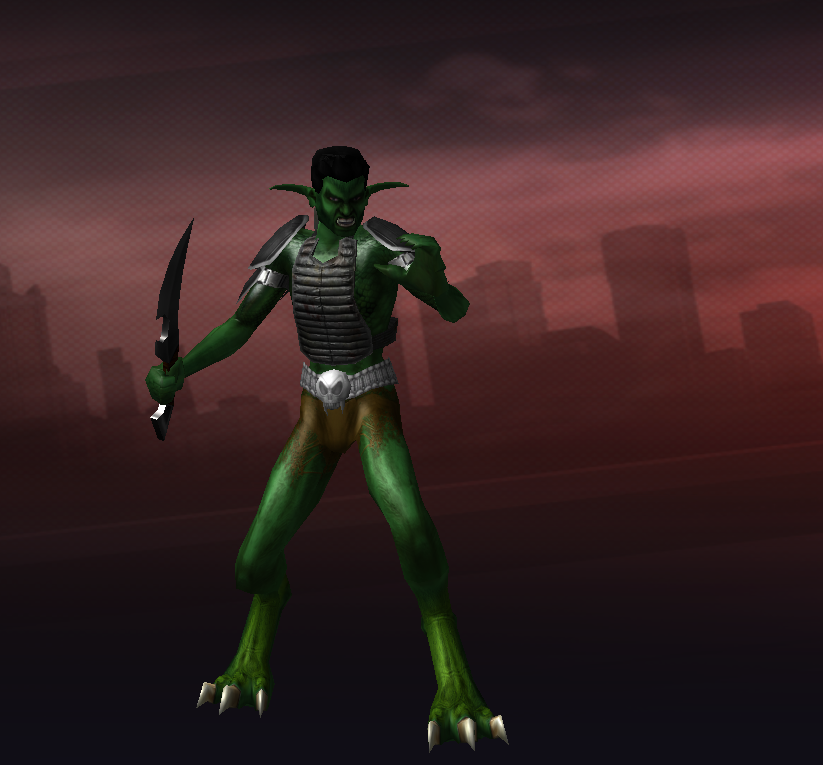
Bakemono Warmongers (goblin shock troops):
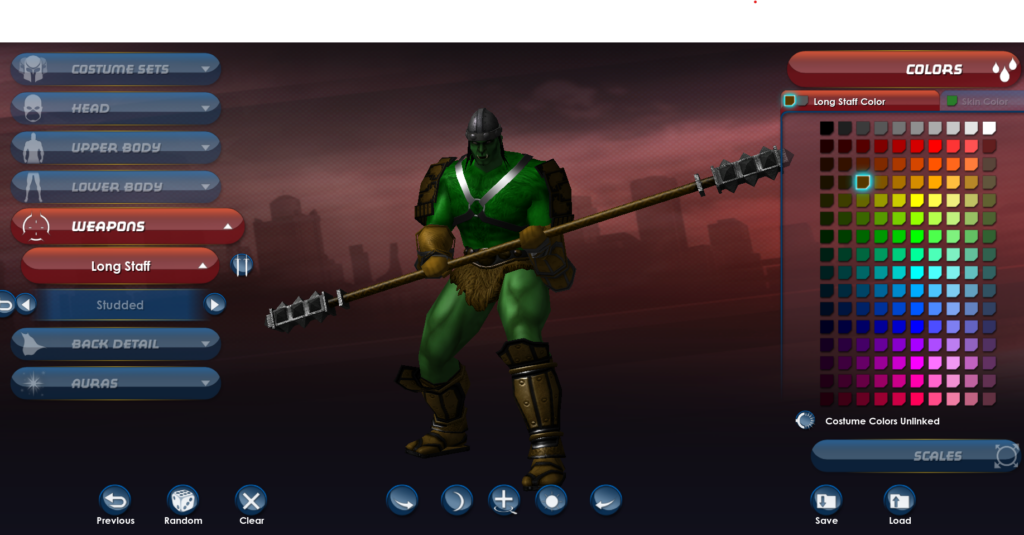
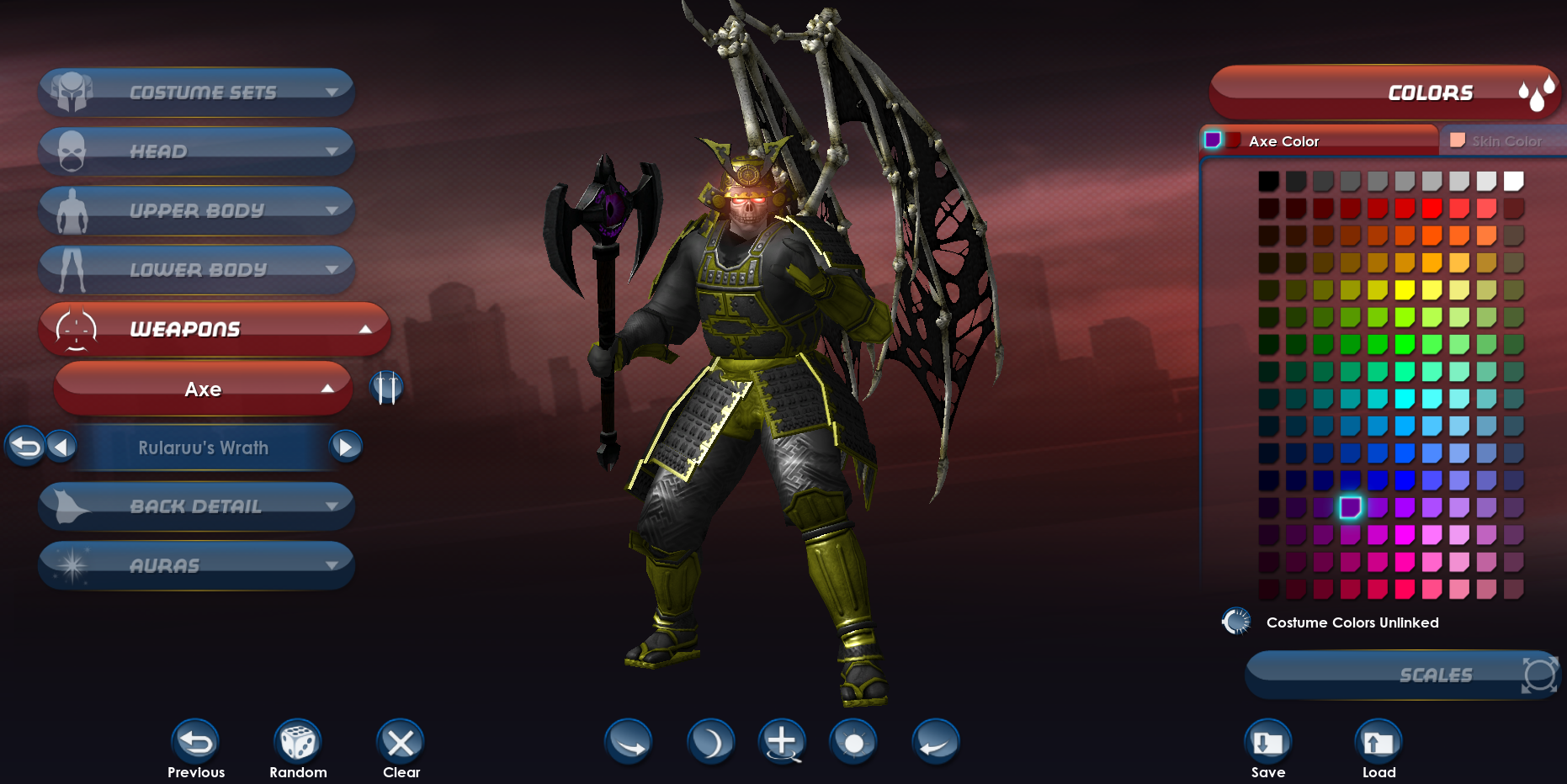
A shot of the City of Heroes character editor, showing a goblin with a double-headed staff.

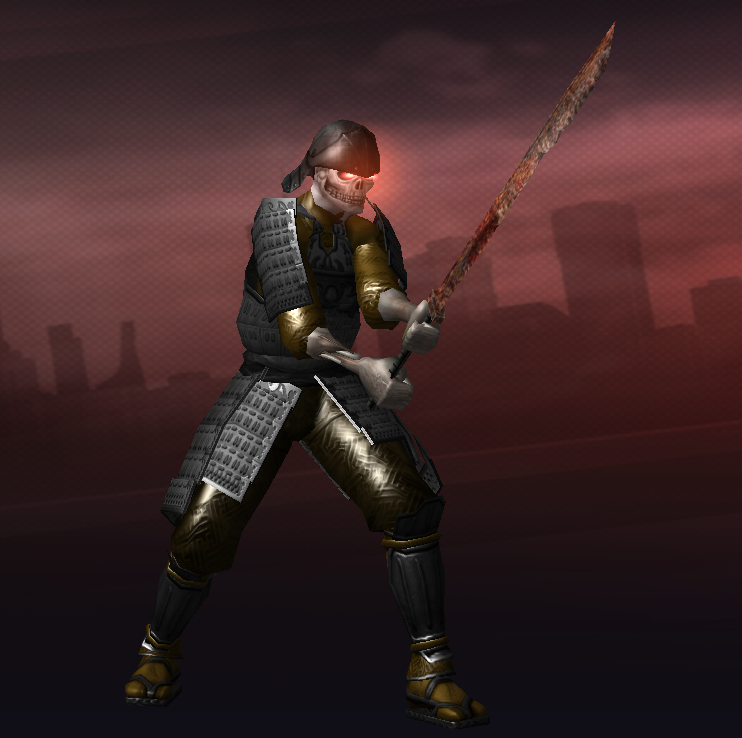
Hyakuhei: intelligent zombies of the Shadowlands that were once samurai. I particularly like the zombie bones in the hands and the rusty katana option.
For bosses, we have Rokugani ogres. Since “ogre” and “demon” both more or less translate as “oni” and they share a number of similarities in traditional Japanese mythology, I gave these brutes the name Yabanjin no Oni. Yabanjin means, roughly, “barbarian” or “savage person.”
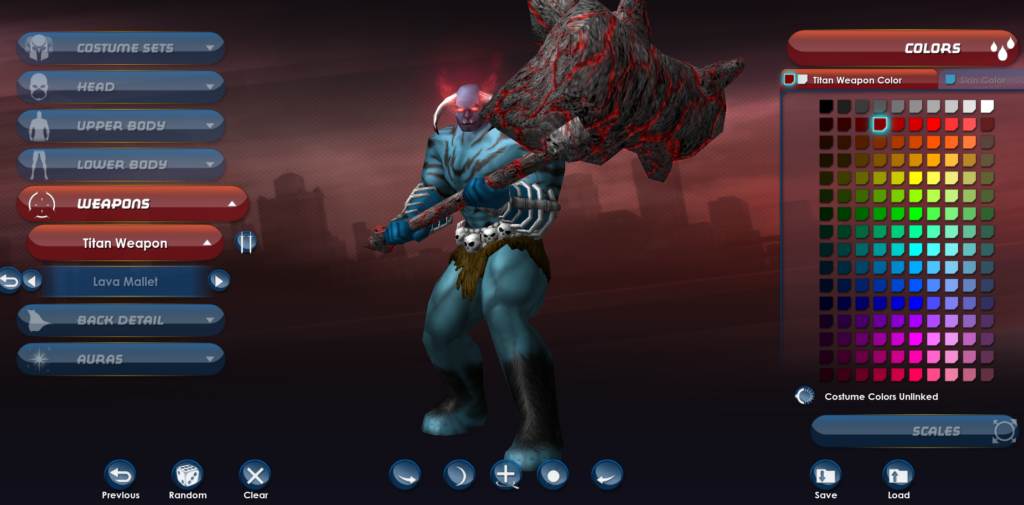
A blue-skinned, horned oni (Japanese demon) holding a hammer of molten rock.

A Missing Expert

Back to the action. The heroes rescue two researchers who are able to tell them what’s going on, only to find their supervisor is missing: Tina MacIntyre, Portal Corp’s key expert on alternate dimensions.

Where would they take her? Seikansha says when the Shadowlands needs to grow its power, the first place that maho-tsukai (blood sorcerers) go is to the local graveyard. There, they can animate the dead to fight for them. In Rokugan, this is less of a problem, as they cremate their dead. Surely a worldly civilization like Paragon City does the same?

“Um, yes, bad news…” says the player…

Part 2: Digging the Grave

The heroes head to Peregrine Island’s graveyard to rescue Tina MacIntyre. There, they find Rokugan’s worst nightmare. When Tina is freed, she says the oni and goblins snatched weapons from Portal Corporation’s security teams and the SWAT department of the local police who deal with superpowered beings.

In other words, that sound of approaching feet is going to give way to bursts of assault rifle fire, grenade explosions, and the zapping sounds of beam rifles. The Shadowlands Spec Ops team may not have a lot of experience with these weapons, but thanks to modern technology, they’re pretty much point-and-click.

Even the lowly shlubs have automatic weapons:
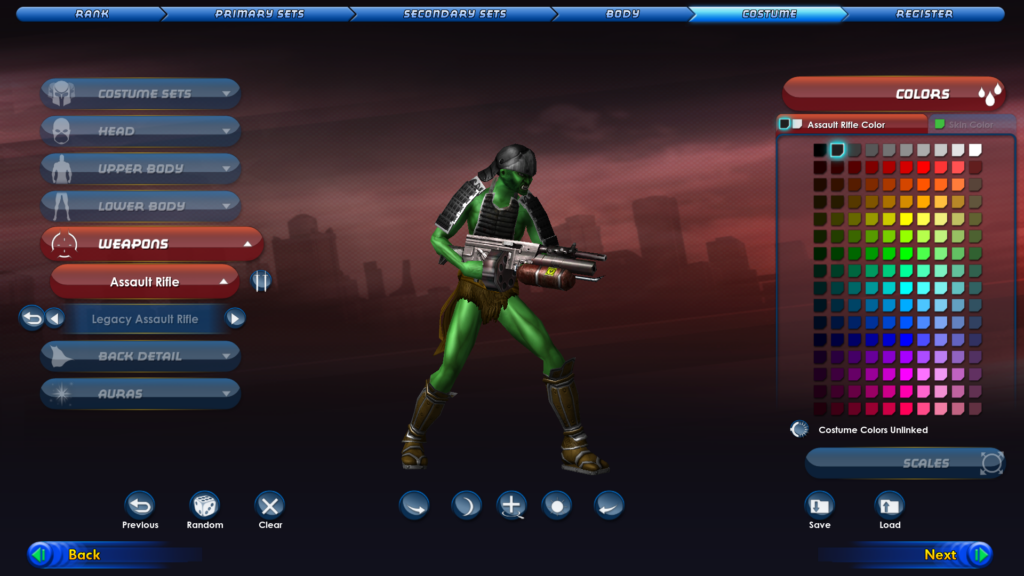
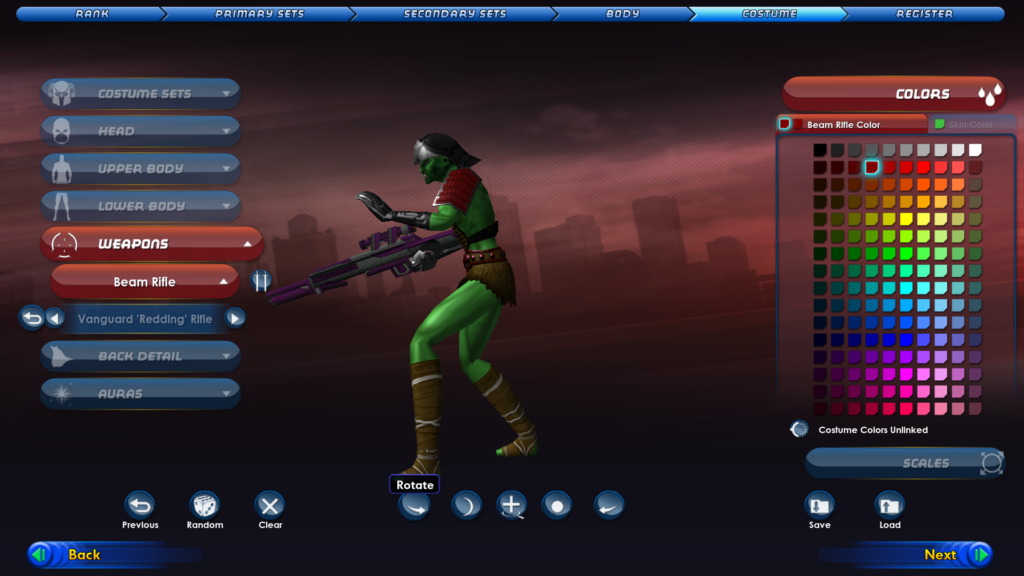
And their buddies pack beam rifles that can disintegrate their targets:
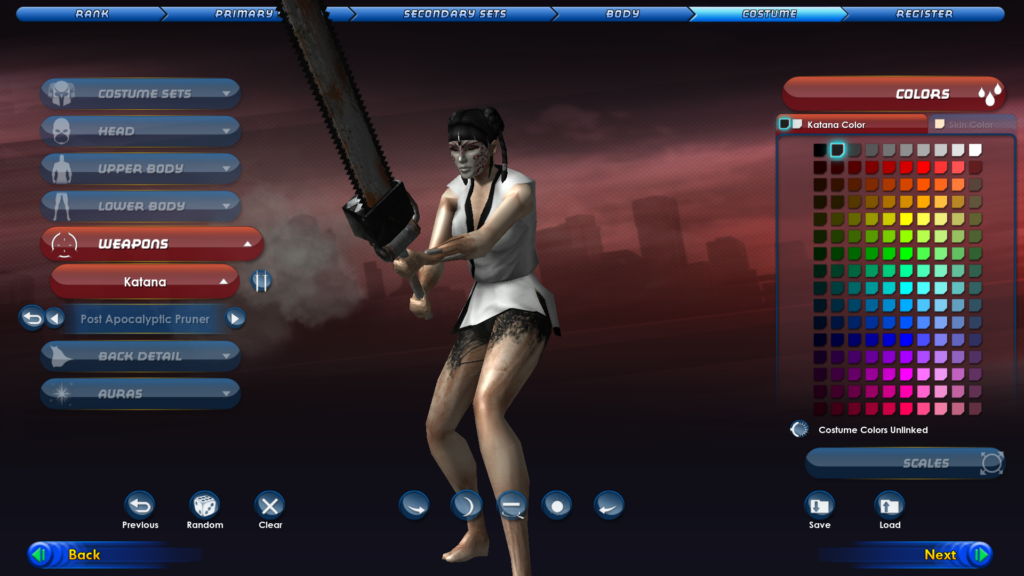
The zombies created by maho-tsukai have found themselves some chainsaw swords… and in this close-up, you can see the porcelain masks that let their bodies animate.
When the heroes rescue the Tainted Tina MacIntyre, she confirms their plan… they’ve taken a small army back to Rokugan… with weapons enough to devastate whatever medieval troops are in front of them.

Part 3: The Guns of Yojin

Those troops are in Yojin Province. In case you’re not up on your Rokugani geography, that’s the land immediately outside Otosan Uchi… the Imperial capital.

The good news? All seven Great Clans have soldiers stationed there. The bad news? Six out of the seven are blaming the Crab for failing to contain the Shadowlands threat.

Fight, Grab, and Rescue

The heroes have a threefold mission.

  1. Find and confiscate the stashes of weapons from Paragon City so the Horde can’t use them.
  2. Rescue the Crab scouts who were tracking the Horde and got caught by the Great Clans. There are six different Clans and six different Crab allies to free.
  3. Take the fight to the demon in charge, Hoshasen no Oni.

The weapons use City of Heroes’ “weapon stash” icons, which admittedly look out of place in the hills of pseudo-Japan, but they’re supposed to!
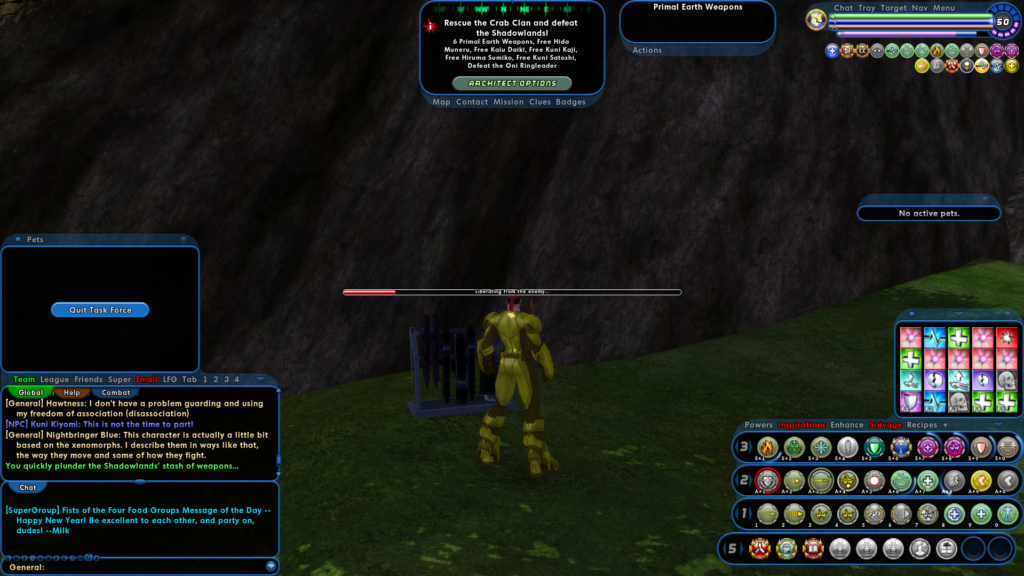
The scouts to rescue are from some of the samurai families of the Crab:

  • The Hida are known for tough shock troops.
  • The Hiruma, usually scouts.
  • The Kuni, often shugenja and witch hunters.
  • The Kaiu, known for engineers and battle-masters.
  • The Yasuki, who are mostly courtiers and merchants. They aren’t present here.
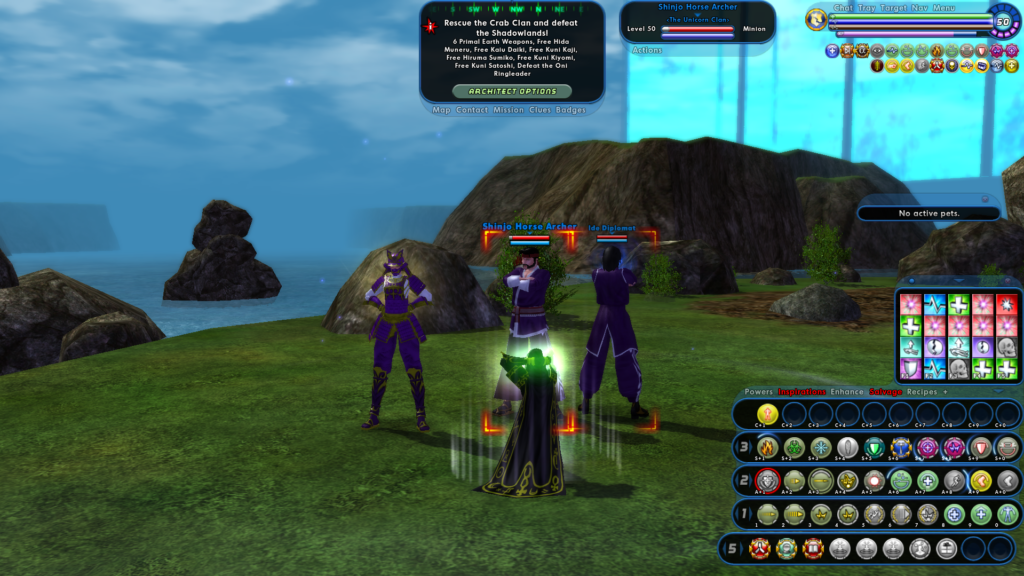
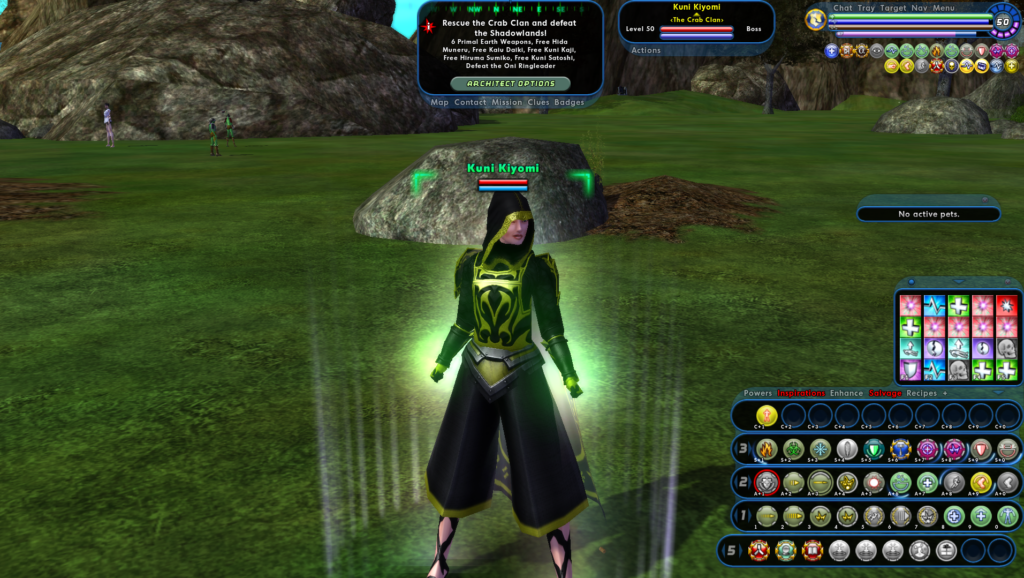
Here’s a Kuni, captured by the Unicorn (Ki-Rin) Clan. They have a mix of the samurai families of the Utaku, Shinjo, and Ide. The Utaku Battle Maiden is the armored one on the left, a literal girlboss. The Shinjo is an archer, and the Ide is a courtier who knows how to use a dao (Chinese broadsword). They’re minion-rank. As with all CoH adventures, the more players are in the team, the more enemies they will face. Since there’s only one player here, the mob is only three enemies.

After the Kuni is free, she joins the player and fights on their side.
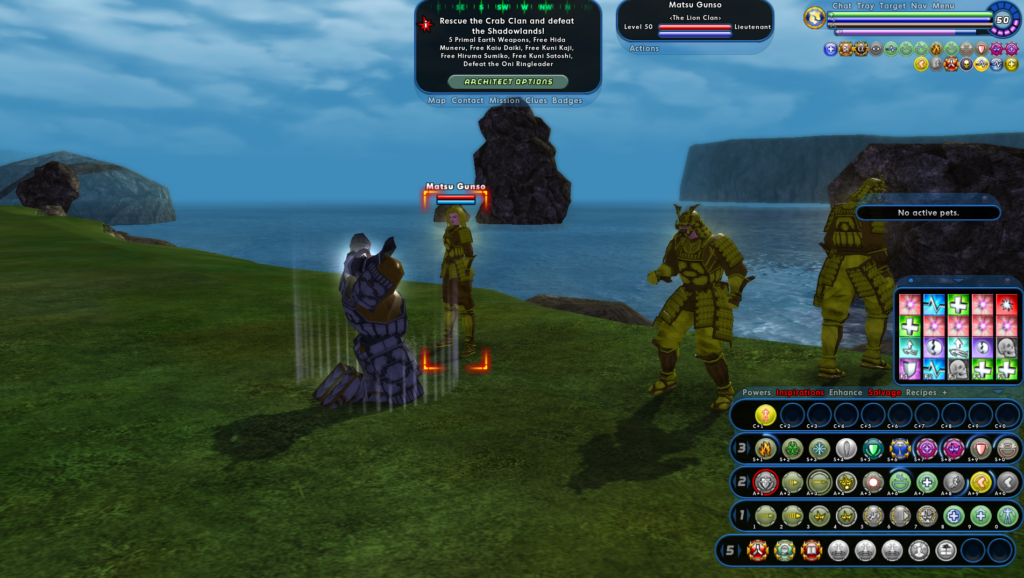
The Kaiu warrior, a big tanky type in heavy armor with a tetsubo, has been captured by the Lion Clan. The Matsu family form the minion and lieutenant ranks of this mob. The highlighted one is a gunso, or sergeant, who specializes in katana moves. The other two are ashigaru, foot soldier spearmen.

If there were more heroes in this mission, there would be more enemies. In that case, there’d be Kitsu family shugenja (priest/wizard) and a boss, the Akodo family tacticians.
But don’t forget the real enemy! Amid all the beating down of other Clans (Phoenix, Scorpion, Crane and Dragon are not pictured), there’s still plenty of Shadowlands enemies, none more notable than the Hashasen no Oni.
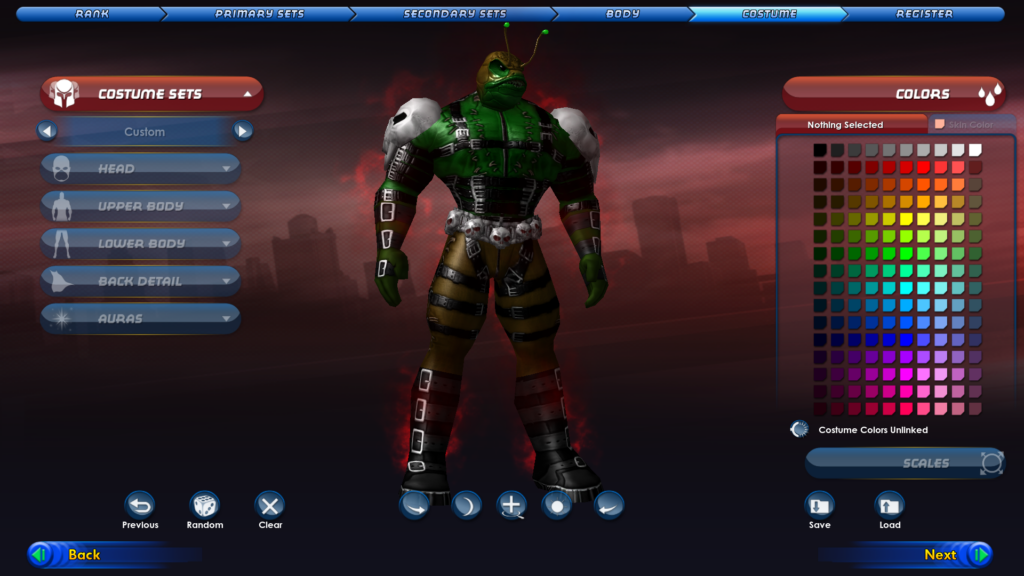
Pictured here in the character creator (because taking screenshots is chaotic while getting your butt kicked), the Hashasen fights using weakening energies. In the parlance of CoH, it’s radiation emission, but the description themes it as debilitating energies of the element of Corruption.

When it falls, the Hashasen no Oni tries to crawl in a specific direction… a tunnel opening leading far underground…

Part 4: Six Shaku Under

Seikansha and the players draw a logical conclusion — there were too many Shadowlands troops compared to the ones he saw in Paragon City. They had reinforcements, and they came from the tunnel beneath Rokugan. Does it go all the way to the Shadowlands? Or is the Horde using some other method than simply carving out a 200-mile tunnel? The player vows to find out.
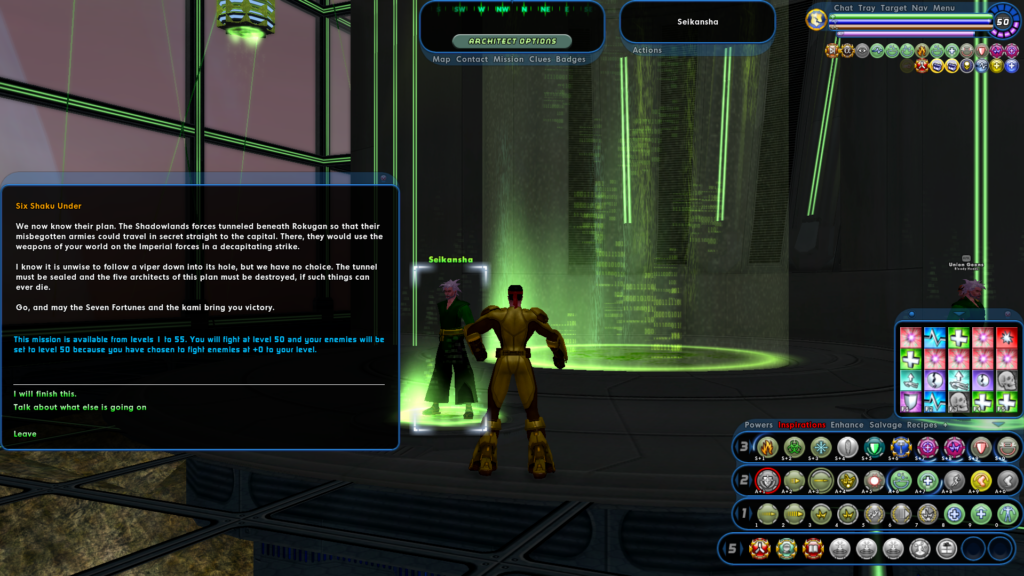
The Shadowlands have, of course, underestimated their enemy. Samurai are no great spelunkers, but if there’s one thing Paragon City knows, it’s fighting enemies in caves! The heroes set bombs throughout the tunnel system, wiring it to blow. Sure hope they wrote their final haiku before coming down here!
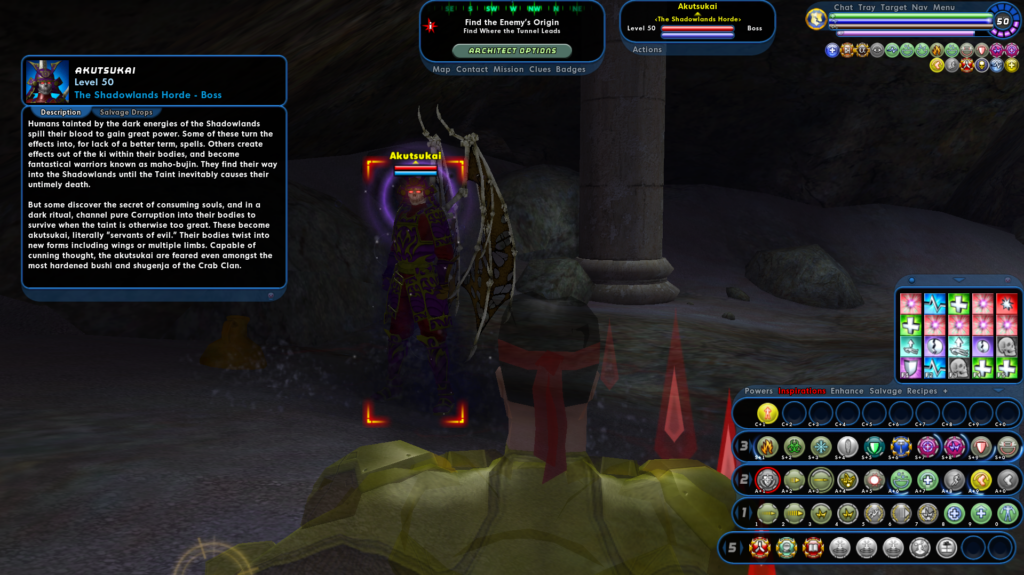
It turns out the enemy are guarding a ritual altar, and that spilling blood on it will create a gate… not between worlds, but to Jigoku itself.
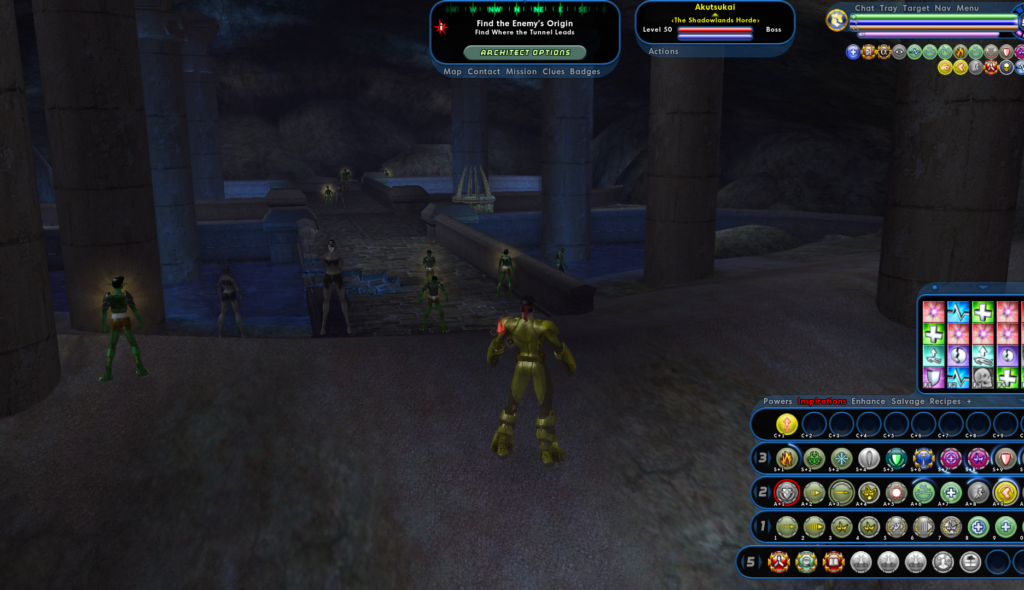
There, the five servants of Fu Leng responsible for this plan are known as the Star of Darkness. They must be destroyed, or the forces of Hell will continue to surface in the caves, and from there, assail Otosan Uchi until it falls.

Part 5: To Shatter a Star

The portal takes the players to Jigoku, a burning hell where the Star of Darkness has retreated to plot their contingency plans.
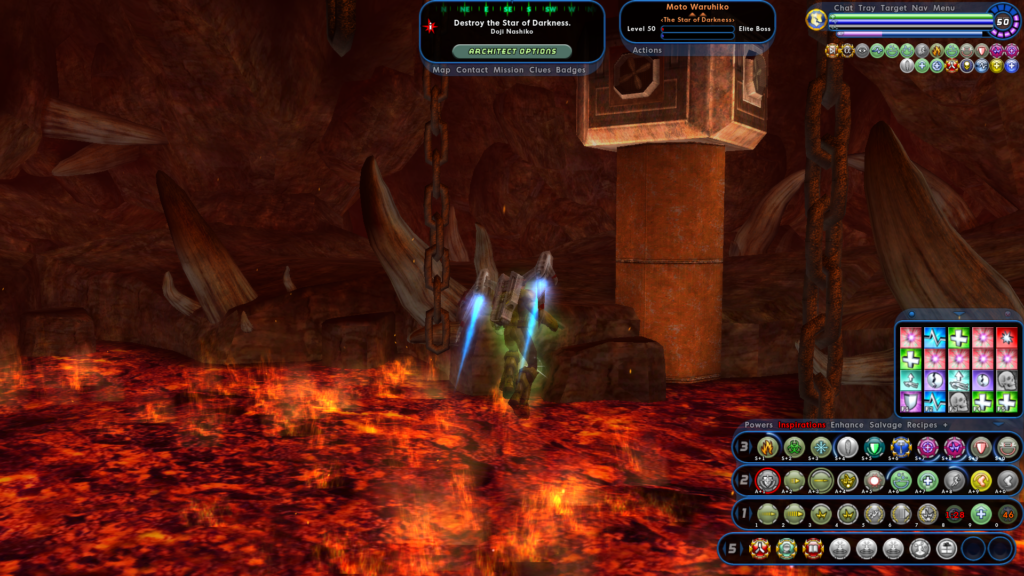
The heroes will find new enemies to face here, including dozens of minor oni not seen outside of Jigoku.
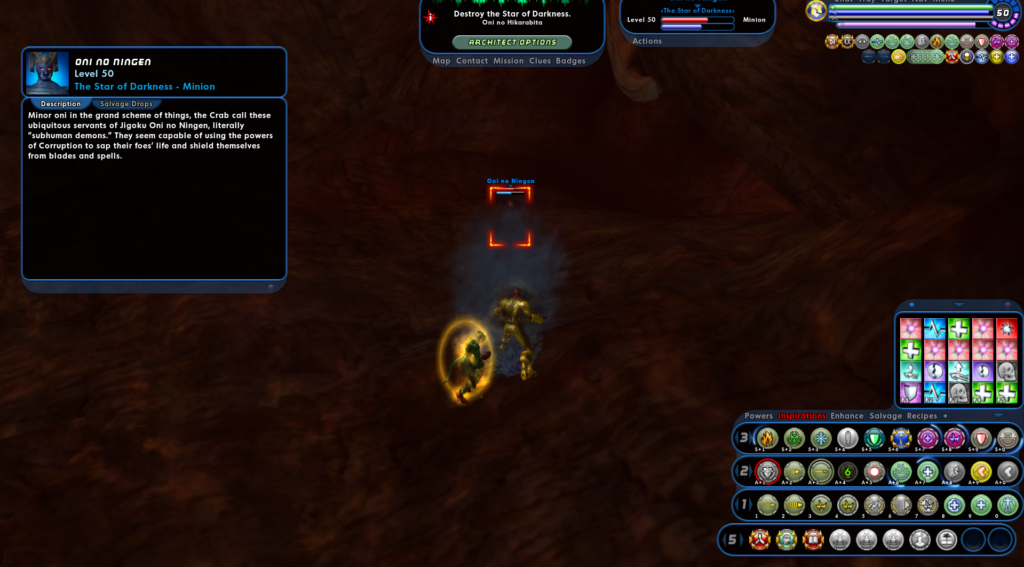
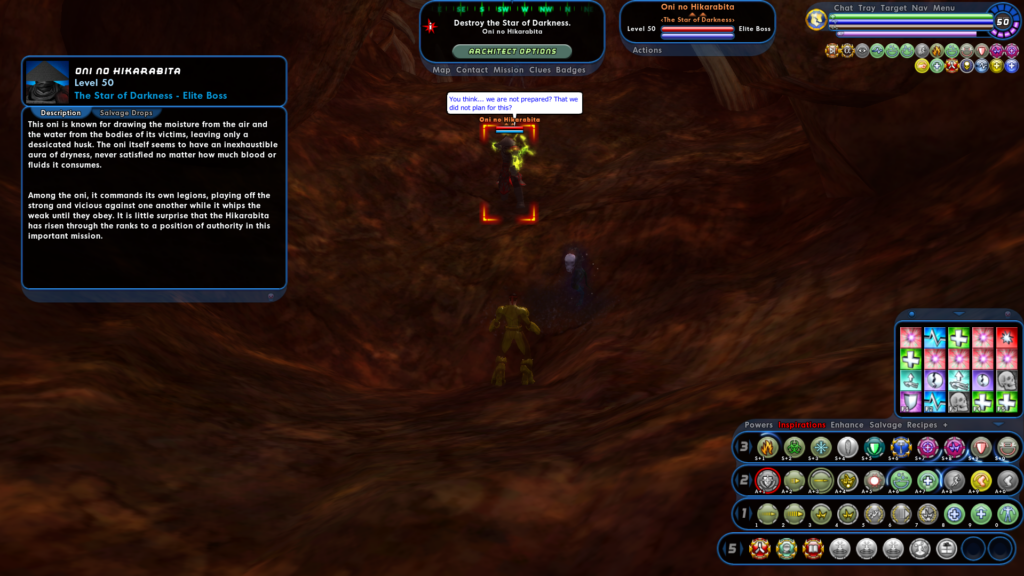
The stars of the show are the five points of the star. The Hikarabita no Oni lashes a burning whip and summons demons in an attempt to vanquish any foes who refuse to die. Using thermal powers, it sucks the moisture from its victims, leaving dessicated husks.
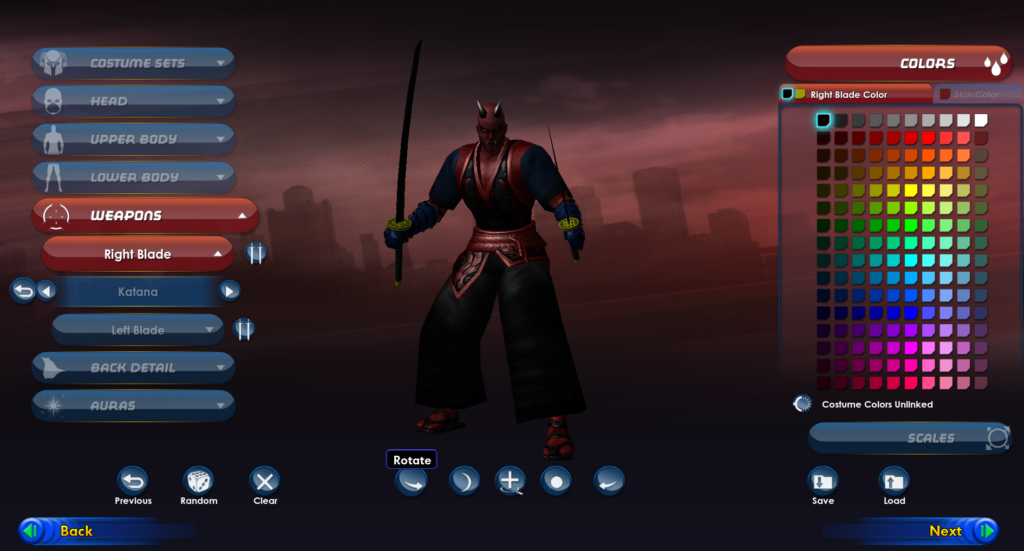
Genso no Oni mocks samurai by dressing and fighting like them, creating fear and darkness wherever it goes. Because City of Heroes adds on special effects with Dark Armor powers, fighting it is like fighting a cloud of darkness. I got a clearer picture of it in the character creator.
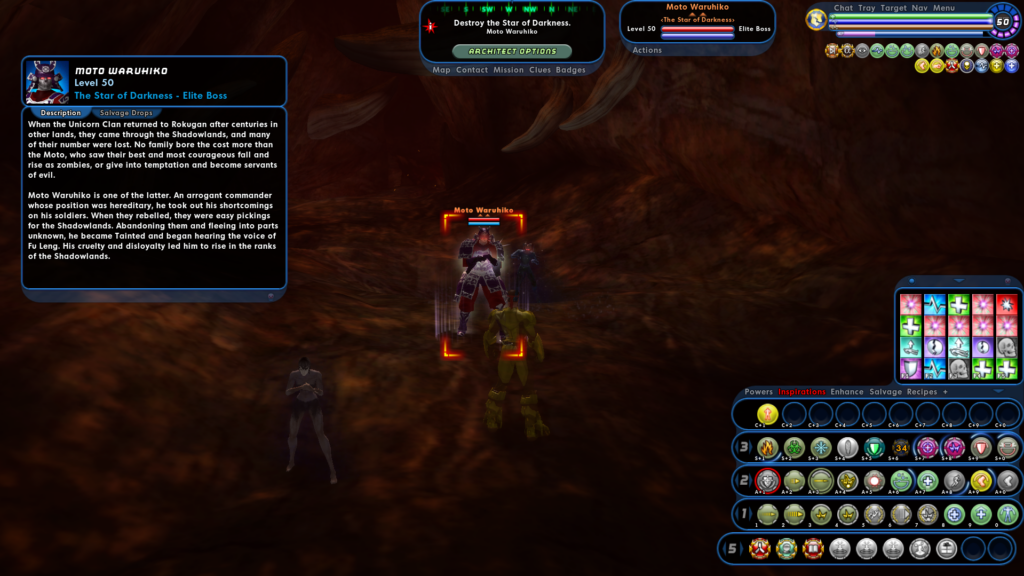
The other bosses include a fallen Moto samurai (a family of the Unicorn Clan largely taken by the Shadowlands).
Topping things off is, of course, the archvillain of this plan, the pale princess of the Shadowlands, Doji Nashiko.

Who’s that, you ask? Right-click on her to find out!
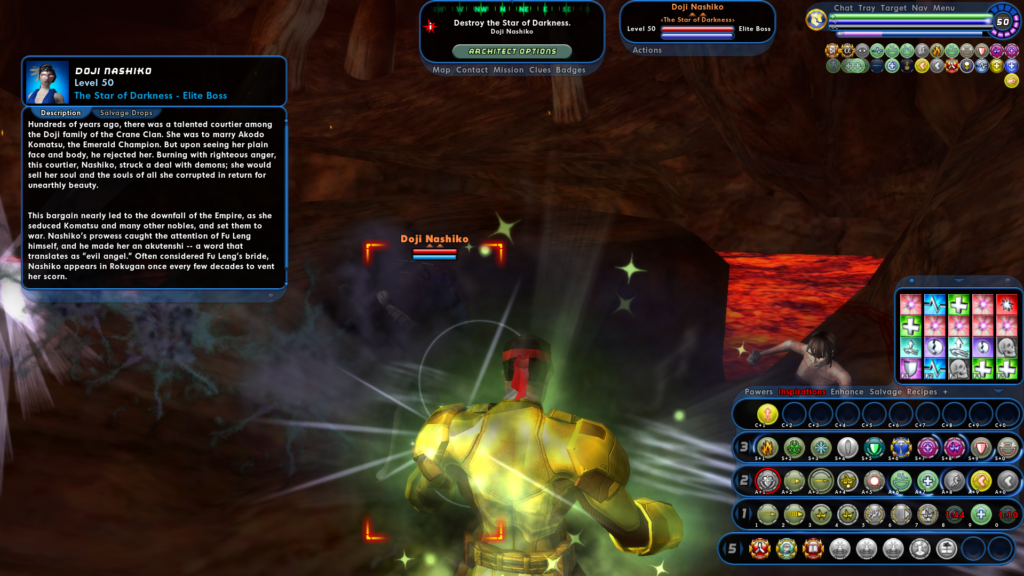
I tried to get a picture of her at rest, but she can see through invisibility, so I got one of her in action. Here she is fighting the 8-ton Longbow battle robot I used to keep her busy to get the screenshot.
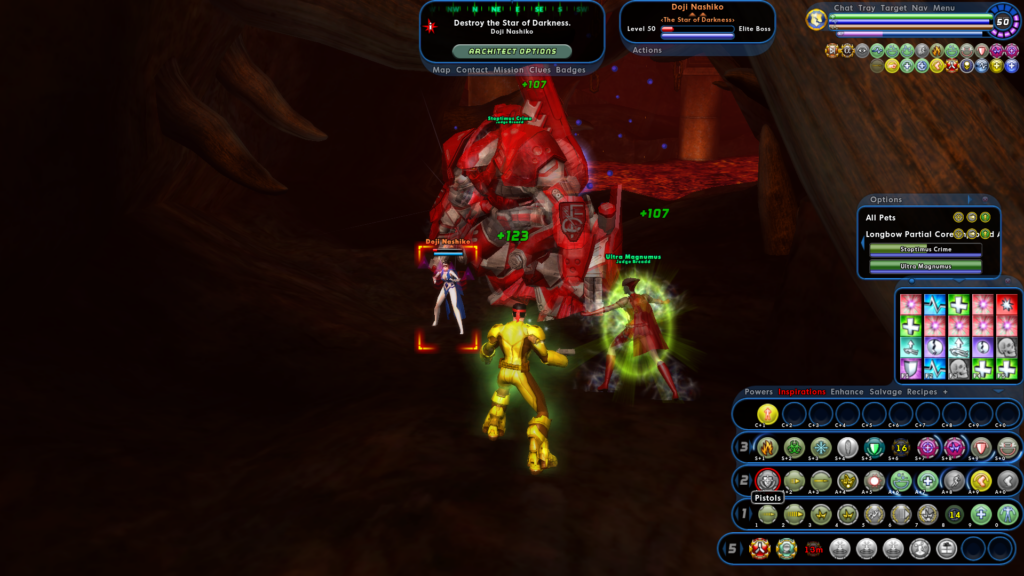
With Nashiko’s defeat, the players have driven the last nail into the coffin of this evil scheme. But now that Rokugan and Paragon City know of the other realms’ existence, who is to say what will happen next? Will the Emperor send diplomats or soldiers? Will they still remain isolated from all other lands when an existential potential threat to the Empire is just a portal away?

Create your own Architect Entertainment arc and let me know!
City of Heroes: Homecoming

In 2004, the massively multiplayer online role-playing game City of Heroes hit the shelves. A little awkward at first, it had a few laudable strengths. It wasn’t trying to compete in the same space as the innumerable fantasy MMOs. The costume generator kicked butt, assuring that ensured no two heroes looked exactly the same. It had mix-and-match power sets that made you feel like a superhero from the get-go. Who really wants to play a level 1 peasant with “tattered cloth armor” as your starting equipment every time? And, importantly, it continued to constantly improve with every new patch (or, as the game called them, “issues”).

One of these improvements was the capability to design your own player-created content. Using the “Mission Architect” system, players could create up to five missions in an arc. Each could use pregenerated maps, normal or customizable enemies, a selection of mission goals, and NPC dialogue they could enter themselves.

A shot of the City of Heroes character editor, showing a goblin with a double-headed staff.

Choose Build Your Own Adventure

Two notable types of adventures resulted. The first type was players designing the missions’ enemies for maximum experience gain. They ground out levels and loot as fast as humanly possible. Useful for condensing the time you spent getting levels, but overall, nothing amazing.

The second type of adventure unleashed the creative energy of thousands of players, as they spent hours polishing their virtual baby until it shone. I saw adventures where you descend into the Paris catacombs to fight the Phantom of the Opera. You could battle archvillains themed to the major arcana of tarot cards. One that I found particularly hilarious had you take the job of the Fashion Police, dueling enemies with the most garish costumes imaginable.

And Then the “Thanos Snap” Happened

Despite the love and money of a sizeable fan base, City of Heroes was shut down in 2012 by its parent company, NCSoft.

Unknown to NCSoft, however, a Secret Cabal of Reverse Engineers (names obscured to protect the criminals) absconded with the game’s source code and played in private for the following seven years. In 2019, their secret came out and they opened the servers up to players. Coming home was remarkably like the citizens of Marvel’s Earth-616 after their five-year absence.

A year or two later, NCSoft, who had moved on to other ventures, eventually gave the servers an official blind eye. As long as the private servers didn’t attract attention with bad (read: legally liable) behavior, they could operate and even create their own new content.

Due to differences in philosophy and general drama, several different teams managing their own servers have popped up. I use the Homecoming servers. Homecoming doesn’t try to preserve the game exactly as it was in 2012. Instead, it adds content for a better user experience. Though I haven’t tried to create official content for them, I have made use of their Mission Architect to create stories I think players could love.

So, Get to the Game Already!

So far, I’ve written two Architect arcs, each with five missions:

Dr. Aeon and the Wrath of Achilles (AE #31899)

The player tries to stop Arachnos’ obnoxious super-science expert from going back in time to change the course of the Trojan War. The heroes battle Trojans, Amazons, Aethiopian allies, a river god, and Arachnos soldiers with a certain… mythological edge.

Big Trouble in Little Rokugan: (AE #71669)

The Portal Corporation opens up a wormhole to the land of the samurai RPG Legend of the Five Rings. The oni of the Shadowlands steal weapons from Paragon City and intend to use them to conquer the Emerald Empire. It will take heroes from both worlds to stop them!

In Which I Get (Not Go) Viral

It’s time for a sequel update! While many, many things have been coming at me (COVID, house problems, new car!), I have indeed been making time for Civil Blood‘s sequel. Of course, I’ve also been de-stressing with my favorite game, City of Heroes. But in a strange coincidence, both converged, in an unexpected and delightful way.

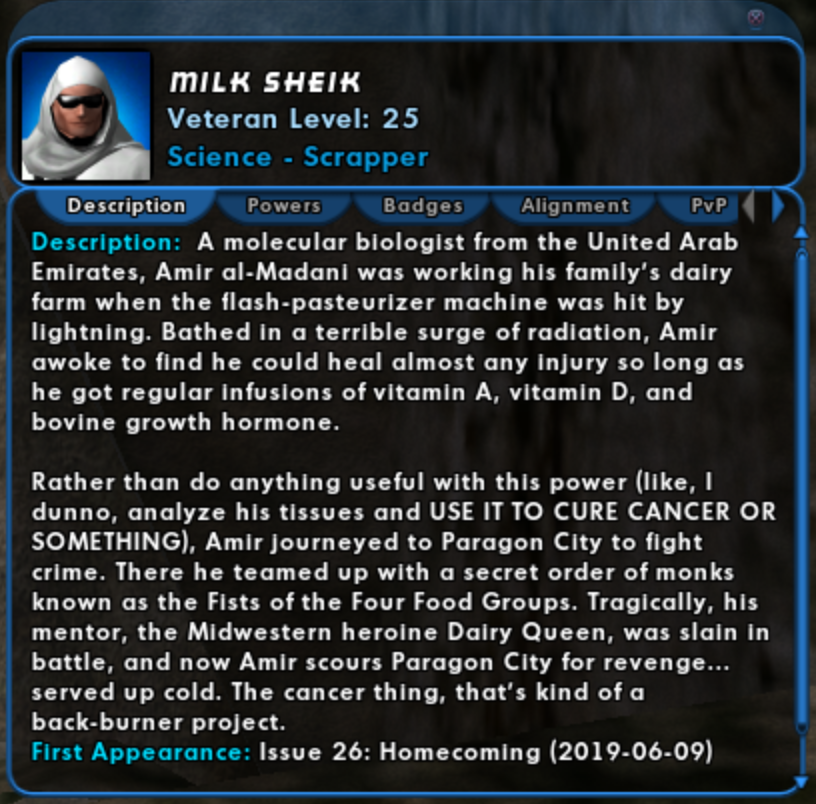
A little background: one of my characters is Amir al-Madani, also known as the Milk Sheik. He made an appearance in Unidentified Funny Objects 8 (shameless plug!), but before that he was just a character I fooled around with on the live servers. In his biography window, I mention that he’s a microbiologist from the United Arab Emirates, who got his regenerative powers through radiation and can heal any injury as long as he gets to drink milk, sort of like Popeye and his spinach but less macho.

One night I was hanging out before a raid, and a player called “Pulsar Kitty” pinged me and essentially said, “Hey, I read your bio. Are you a molecular biologist in real life?”

I replied “No, I just write a lot and have some friends who are doctors,” and so forth. But what she said next surprised me: “Drat. I’m actually a microbiologist, and I work on viruses all the time, and I was hoping to find someone to talk to.”

“Oh.” I said, my interest piqued. It was time to converse with the catgirl! “Well, I wrote a novel involving a vampire virus, and I’m always willing to blab about it.” I figured since she was playing a superhero MMORPG she’d be cool with fantasy and science fiction.

It turned out, not only had she read about vampire viruses, she’d read a Shadowrun novel featuring HMHVV, the Human-Metahuman Vampiric Virus, which of course I knew about because of my time writing Shadowrun. (Long story there.) So we even had a common point of reference. I e-mailed her a copy of Civil Blood, and we got started discussing the sequel. Particularly the worldbuilding surrounding qi-positive European Bat Lyssavirus-4, the cause of Virally Induced Hematophagic Predation Syndrome. Because it’s similar to, but emphatically not HMHVV.

Some writers would just say “it’s magic, it works how I want it to.” That’s their prerogative. But it’s not how I like to do things. So I started kicking the tires on my world and asking the questions I needed to ask. Questions like:

  1. How long would it be before a vampire who had to feed once every 10-14 days or so and had a practically guaranteed infection each time managed to contaminate a serious chunk of the population?
  2. Can a virus provide amazing benefits like super strength and healing to the human body without being tailored to do so? If so, how could it naturally occur?
  3. How could a virus this infective not shape human history in an obvious way, if it existed before qi (magic) was proven to exist?
  4. Is it possible for an accident to release this virus on the world, or does it need some kind of retconned conspiracy and nefarious motives just to be plausible?

Well, Dr. Kitty went to town on the manuscript. And I was pleased to find out that my story held up okay. I thought I’d share some of the answers here, because, well, they’re neat.

Question 1: How Fast is the Vampocalypse?

As some of my beta readers pointed out, in a straight-up 100% rate of infection every 10 days, the numbers create a lot of doubling. First one vampire bites another, then two have to feed in the next 10 days, then four, then eight. You end up in the billions after about 32 weeks. It’s even worse if there are some vipes addicted to blood who become superspreaders.

Nope. Not doing this. For lots of reasons.

Fortunately, the situation in Civil Blood allows for a slower pandemic. There are several factors at play.

Imprecise Numbers: Infinity got about eleven days off of one notable bite in Civil Blood, and she might have lasted two full weeks if she pushed it. There’s also a line in the chapter where she reads BRHI’s experimental notes that say “subject went torpid after thirty-two days without blood” indicating that a vipe could survive more than twice as long in extremes, though they would probably be miserable doing so. While that would not be the norm, every day counts in a massive population boom like this.

Bullets: After a month or so (only 4-8 infections) , someone at the Benjamin Rush Health Initiative did the math and started putting together the Forced Protection team to stop the spread. Somewhere around 16-32 vipes, they started nipping them in the bud, first with capture and restraints, then with targeted killings. Though this started in the D.C. area, it expanded eventually to other cities. BRHI has made a lot of bodies by the end of the first novel. Ranath is said to have “dropped the hammer more times than John Henry.”

When the media break the story four years after Patient Zero, police start being able to recognize vipes for what they are and imprison or kill them. Citizens form vigilante gangs for self-protection, which may cut down on feeding or lower the vipes’ numbers through straight-up murder. A very small percentage of vipes might be lost to cases of individual victims defending themselves. An equally small number might be lost to attrition if they take their cues from popular culture, think they’re immortal, and try to survive a jump off a bridge or some similarly stupid stunt. Again, every vipe taken off the board counts.

Psychology: Many vipes feed first on those closest to them when they lose control, and this can be incredibly traumatizing if the victim is a family member or friend. Some vipes will refuse to drink blood again, instinct be damned. This means they might go comatose and starve to death, or commit suicide. I don’t know exact numbers, but the number of people who’d take themselves out would be much higher than the general population, more on par with active shooters or incarcerated felons.

Jessica’s Old Multi-Bite Trick: Jessica introduces Infinity and Morgan to a technique for vipes feeding off of one another. Sure, it has diminishing returns, but it helps greatly. When Infinity came home after feeding, she could lose blood enough to feed about six other vipes without permanent damage. Since they drank from her wound and not a fresh victim, this slows the number of new infections. Morgan and Jessica, who maintained contact with networks of vipes, no doubt publicized this method in the hopes of minimizing harm.

Question 2: Viruses With Benefits

So, can a virus, with a little magical boost, naturally cause bone ossification and muscle growth so a vipe is strong like a human-sized chimpanzee? “Well, heck,” says Dr. Kitty, “Why don’t we take a look at HERV-K?”

Fun fact: there are viruses in your DNA. Yes, yours. Right now. At various points in human evolution, viruses infected us and used something called reverse transcriptase to insert their RNA into the DNA of our genome. But if they don’t kill the host, and they don’t impair them enough to prevent reproduction, and also if the body can’t stop the infection, sometimes the virus gets integrated into us, like a rude guest who gets adopted. This has happened so often throughout human history that about 8% of our genome is virus code. Like HERV-K.

HERV stands for Human Endogenous Retrovirus — the “K” is a label for which one, since there are a lot of them. “Endogenous” means it’s a part of us now. It entered our genome when we were primates about 30 million years ago, before we were even Homo sapiens. In some cells, if HERV-K turns active, it’s very dangerous and can cause problems like testicular cancer. But during reproduction, if it’s working right, it allows a woman to safely grow a placenta. This is naturally occurring… well, natural as of 30 million years ago. It was selected for. No nefarious genius with a laboratory needed.

So… do you think viruses can have complex benefits? Because one made you possible.

Question 3: How Come We Haven’t Seen EBL-4/VIHPS Before?

This was a thorny one, because the world of Civil Blood is not like the tabletop RPG Shadowrun. There is no great cycle of magic that infuses the world, disappears, and comes back. Qi, in Civil Blood, is a supernatural science that had a breakthrough and though it has always been there, humans can now measure it and manipulate it clearly. But… there’s a way for the virus to be old and yet new at the same time.

In prehistory, EBL developed a super-infective strain. But just because something is super-infective doesn’t mean it’s going to spread all around the world. It could have appeared in isolated communities, or spread like wildfire and then burned out, because it comes with a limitation — a vipe needs to drink blood fresh from the wound of another living, squirming human. If they don’t, they get aggressive after a couple of weeks and then their body starts to suffer. By 14 to 32 days, they start getting lethargic and comatose. (Ask me about unstable antitoxins and stable toxins in selfish genetic sequences. G’wan, I dare you.)

So if they don’t have a food supply, the epidemic is going to fizzle out. And in a time period before cities, highways, and even the domestication of horses, a lot of vipes are going to keel over before they find enough prey to keep the cycle going. It’s much more of a supercharged pandemic in the modern day. In prehistory? It might not even show up in the fossil record.

Question 4: So How Did Ulan Release the Plague?

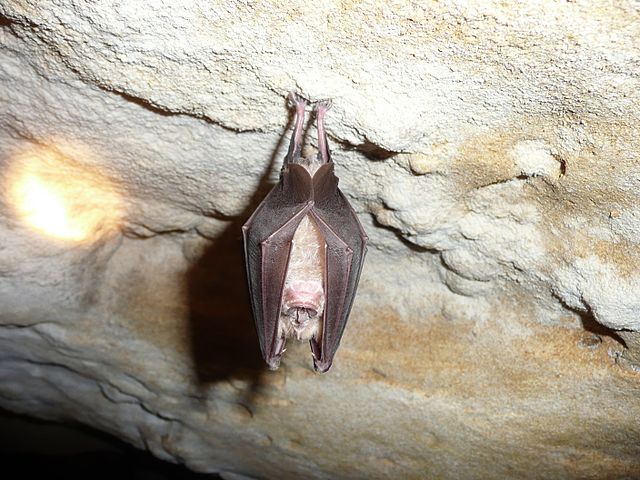
Horseshoe bat (Credit: Marie Jullion)

So it’s possible the progenitor to EBL got into humans, and over time, adapted to them. One strain could have mutated into a less infective version but stayed in the human germline, giving resistance to the nastier version until the vipes all died out. With no selective pressure to change, the virus would stay in humans until some could have transferred over to European bats, some of whom could eat trash covered in human saliva. The bats are where Dr. Ulan found European Bat Lyssavirus-4, and she could have, in the process of collecting data on the virus and taking out portions with targeted bombardments of yin qi, recreated the original sequence.

Recreating the original sequence is bad.

Bang. Super-infective qi-positive EBL-4 is back, and the clock starts with her as Patient Zero.

So When’s the Novel Coming Out?

That’s a question I don’t think I’ll answer. There’s going to be a lot more to the sequel than this, but it’s been a long time since I gave a substantive Civil Blood update. Here’s hoping I whetted your appetites.

Drink up. And cheers!

In Which I Announce Unidentified Funny Objects, Volume 8!

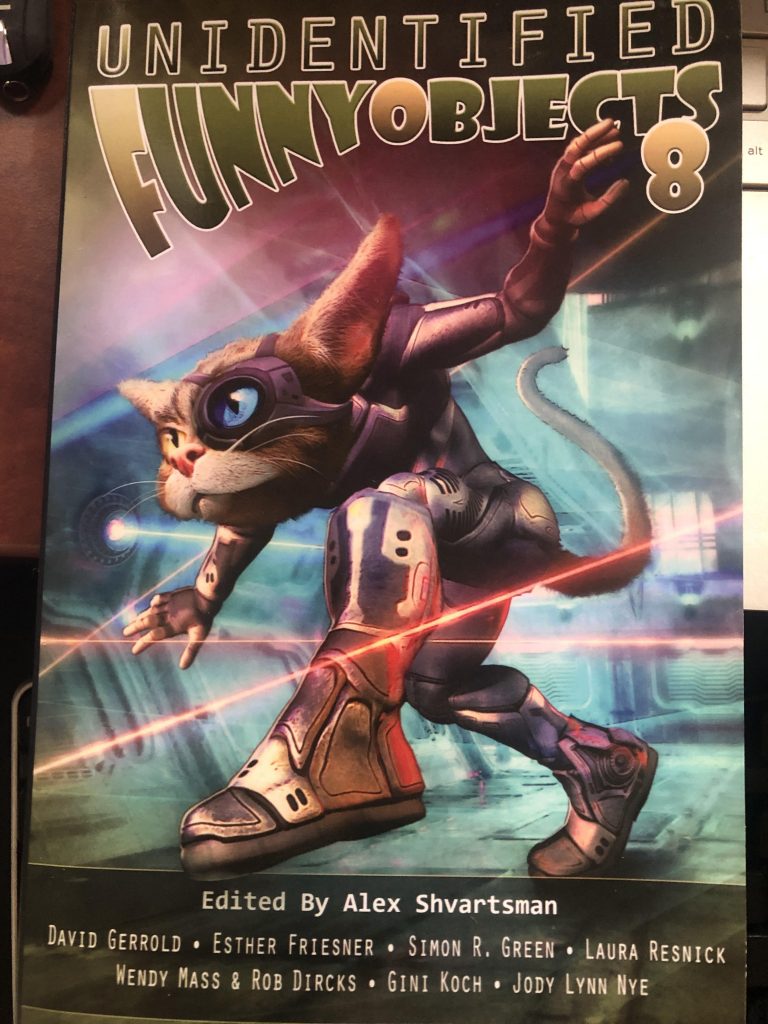
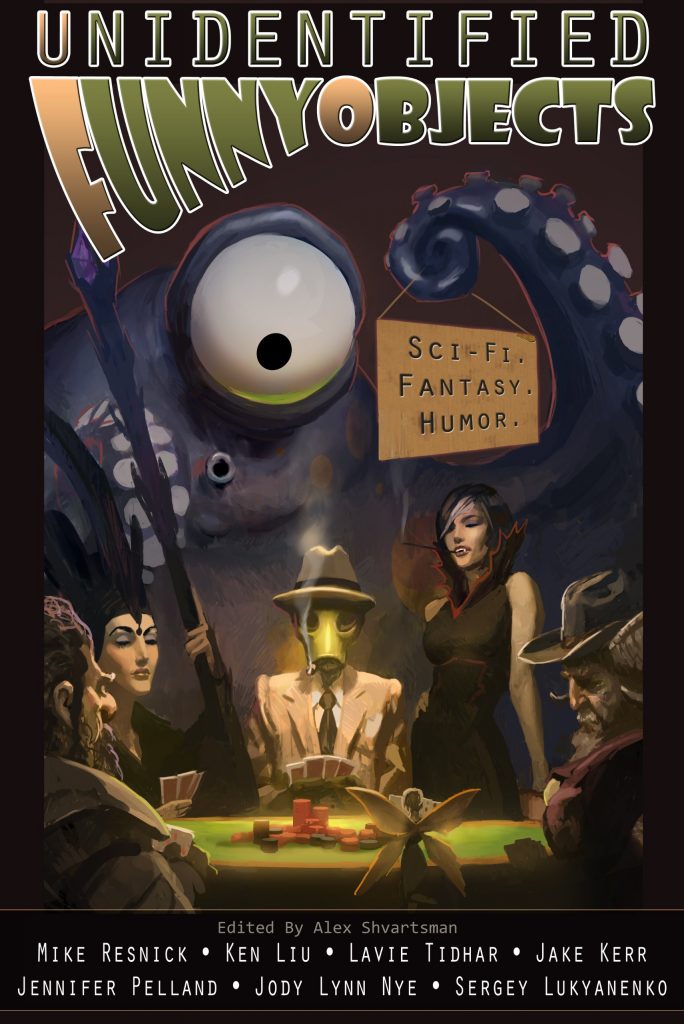
In May, I had a short story accepted to the annual science fiction and fantasy humor anthology, Unidentified Funny Objects. Currently in its eighth year, UFO has featured a lot of famous writers, and this year it features such luminaries as David Gerrold (he created the Tribbles for Star Trek) Jodie Lynn Nye (who’s published more than 50 books) and of course Esther Friesner, who has probably written more humorous short stories than Alexander Hamilton wrote essays.

When I submitted the story, I wasn’t expecting to have my story be the first one in the book. But there it is, doing its duty to make a first impression. “The 10:40 Appointment at the NYC Department of Superhero Registration” starts the volume off, followed by 23 more lighthearted romps. There’s grandmotherly golems, cybernetic cats, a daring quest inside the living room couch, and more.

The book is now available in print and Kindle, and it seems to be getting a bit of acclaim on Goodreads (for some reason, there aren’t nearly as many Amazon reviews as of this writing).

From my desk to yours. (The cyber-cat-burglars are on page 133.)

“The 10:40 Appointment” follows the hapless Dr. Amir al-Madani, a newly-empowered vigilante who gave up his job in the United Arab Emirates and moved to New York to fight crime. Problem is, New York is full of superheroes, so the Department of Superhero Registration is basically that cantina in Star Wars except with more teenage deities and nuclear-powered mutants. Amir’s only superpower is regeneration, which is really the worst power to bring to the heroic equivalent of the DMV.

Why? Because to register his super-ness, he’s got to demonstrate its capabilities in a road test… which, for regeneration, means a proctor in power armor beats the living snot out of him.

Amir triumphs… but not in the way you might expect. The story is goofy, but it also tries to encapsulate a lesson about what makes a real hero. I’m pretty proud of the story, so by all means, check it out here:

Unidentified Funny Objects, vol. 8, on Amazon.

“The 10:40 Appointment” is not my only light-and-fluffy superhero short story. Keen-eyed observers of this site may note that I’ve had heroes on the brain for a few months. I’ve actually got five or six stories in the works, all in the same universe as “The 10:40 Appointment.” None are quite ready for prime time yet: they’re all in various stages of creation, editing, and submission to various magazines and markets. If any of them score a bullseye, I’ll let you know.

In the meantime, check out the book for a laugh, and if you like it, feel free to leave a review. And kids, remember to drink your milk, because someday your superpowers might depend on it.

Excelsior!

In Which I Announce Something New For a Change

After about six months of unemployment and about seven months of no new writing-related news, I felt like I was hitting a wall. I fully expected my wife to break into that song from the School of Rock musical, “Give Up Your Dreams,” but of course she stayed super supportive. Then, finally, in the same week, I got two bits of good news.

The first bit of news is that I have another video game gig. It’s slated to take 8-10 weeks, so by the time you read this, I will hopefully be shaved, dressed, and reporting in to a source of gainful employment. I don’t think I’m free to talk about the details yet, but hey, maybe this game will go somewhere, and take us along for the ride.

The second bit of news has been cleared by the publisher as good to go for social media announcement. I’ve got a short story accepted by the comedy science fiction and fantasy anthology series “Unidentified Funny Objects.”

UFO is an anthology with a nice pedigree. Apparently it has had stories from George R.R. Martin, Neil Gaiman, and (to my complete lack of surprise) the Hamster Queen herself, Esther Friesner. I don’t know if any of those three are in this year’s volume (the submissions are still being edited), but I’m stoked about it nonetheless.

The story that got accepted was “The 10:40 Appointment at the NYC Department of Superhero Registration,” which is a brief look into one story at the hero equivalent of the Department of Motor Vehicles, because frankly there’s so many of them nowadays that they can take a number. It makes a strong argument why regeneration is the worst superpower to have… and also, the best.

Unidentified Funny Objects #8 has a theoretical launch date of sometime in October. When I know more, I’ll tell you.

Until then… up, up, and away.

In Which I Succumb to Capitalism but Not Despair

I’ve been holding off on this announcement for a while, but it’s really past time. My employer, Seasun Inc., had a bad quarter with one of its flagship products not doing as well as expected. That meant that upper management had to cut costs to show they were doing something, and that meant layoffs. I am now out on the street and looking for a day job.

It hasn’t been too rough a ride so far. I managed to score a contract gig for about a week with Otherside Entertainment, which took the edge off. I’ve also had lots of interviews and writing tests. This has led me to revise my Writing Tour page to include samples, since I’ve applied to everything from RPGs to interactive romance novels to trivia quiz games.

I’ve got a little routine going — during the day I search for a main job, and at night I write and submit short stories. As I mentioned in a previous post, I’ve got a few I’m sending out, with the intention being that the proceeds get put in a separate pot dedicated to financing the self-publishing of Civil Blood‘s sequel. Great plan, right?

Well, as with all plans, this one hasn’t really survived first contact with the enemy.

Selling short stories, to misquote Han Solo, ain’t like dusting crops. Many markets are closed to submissions except for certain times of the year. Then there’s the matter of taste, and the fact that I’m not bringing a bajillion readers to the table like some of my competition is. The long and short of it is, the stories haven’t sold yet.

So, what’s a writer to do? Well, the first step is to keep writing. I’ve got that down. Besides the three pieces I wrote about last time, I’m working on a story called “The Needs of the Client” which is meant to be more lighthearted superhero fare in the vein of “The 10:40 Appointment.” I could use some positivity about now, and I bet you could, too.

For the second step, I’m finally joining all the other pro freelancers who have set up a Ko-Fi button on their webpage. Ko-Fi is a service where a reader can effectively buy a writer a coffee via PayPal. It takes small donations of about $3.00 each. And since the website offers a spot to create goals, I hit upon the idea of trying to use Ko-Fi to finance my short story habit.

If I can raise enough money — not much, say, $50, a token payment of about $0.01 a word — through Ko-Fi, I’ll publish one of the short stories here on my website rather than continuing to submit it in the longer, slower process of traditional publishing. You get a story, I get closer to my goal, my website gets more content — everyone wins.

To recap, the stories I have kicking around are:

  • “Stopping the Bleeding,” an election-year story in the Civil Blood universe with a new protagonist.
  • “Infection in Everything,” a Civil Blood universe story about Infinity and the woman who taught her jiujutsu.
  • “The 10:40 Appointment at the NYC Department of Superhero Registration,” a lighthearted story about a would-be superhero fighting bureaucracy and enduring one heck of a road test.
  • “The Needs of the Client,” a story about what it’s like to work in an IT department when your client is a superhero group similar to the Justice League.

I should emphasize that I’m not on the brink of starvation over here, as many artists are. My immediate family are in decent health so far (knock on wood here until my hand breaks off). Honestly, if anything, I might survive the Coronapocalypse longer than some of the publications I’m submitting stories to, since some of their staff may have day jobs that can’t be done remotely. That’s no slam on them — it’s just part of the scary world we live in now.

But since the plan is to hunker down and never go outside, this seems like an opportune moment to get more writing done. And in case you’re a fan and want to see more of my work, I’ve now made it a bit easier to do so.

That’s all. I’m sure I’ll post more about the Black Plague of the 2000s in detail soon enough. Stay safe out there.

Blog