“This Thing of Darkness”

Napoleon supposedly said, “To understand a man, you must know the world he lived in when he was twenty.” And to understand this story, that’s not far off.

It was the 1990s, never mind the exact year. The cyberpunk future loomed, but it was at least a generation away. I was reading The Tempest in a class themed around the colonization of the New World. I encountered a phrase that stuck with me: Two of these fellows you must know and own; this thing of darkness I acknowledge mine.

Pretentious, of course, to quote Shakespeare’s Prospero, but I was young, and referencing him seemed like a natural outgrowth of my favorite pulp subgenre, RPG fiction. I wrote up a short story told in a film-noir-like tone, a la Blade Runner. It was about a hired killer battling the inner monster of cyberpsychosis. I got a pretty good grade on it, and before I consigned it to the bin, I noticed that the Isaac Asimov Awards for undergraduate fiction were looking for submissions.

“Well, crap,” I said to myself. “I might not be able to compete with the pros writing The Magazine of Fantasy and Science Fiction, or even Cyberpunk 2020 and Shadowrun, but I’ve seen the stuff people my age crank out. I could compete with them, easy.” So, I submitted “This Thing of Darkness,” and won an honorable mention. Got a T-shirt and a little certificate I could put on my wall. The story didn’t get into a magazine or an anthology or anything cool like that, unless you count our campus science fiction club fanzine. I chalked it up as a minor success and filed it away on my hard drive, never to be looked at again.

Except…

I had a habit. Whenever I got a new computer, I transferred over all my old writing, even my high school fanfic. Then I got my first laptop, and did it again. And again. I converted the files to more recent formats when they started getting incompatible with current versions. And I just kept them in a folder, stored away, just in case.

Fast-forward to the fall of 2025. I was focused. I was writing away on Civil Blood‘s sequel, determined that this year I’d finish its rough draft. But Raconteur Press had a call for stories to be put into a book called Pinup Noir: High Class Muscle. They wanted heroes with a moral code, men (no ladies… their stories were in the previous Pinup Noir collection) who were good but definitely not harmless. Detectives, bouncers, bodyguards, hitmen.
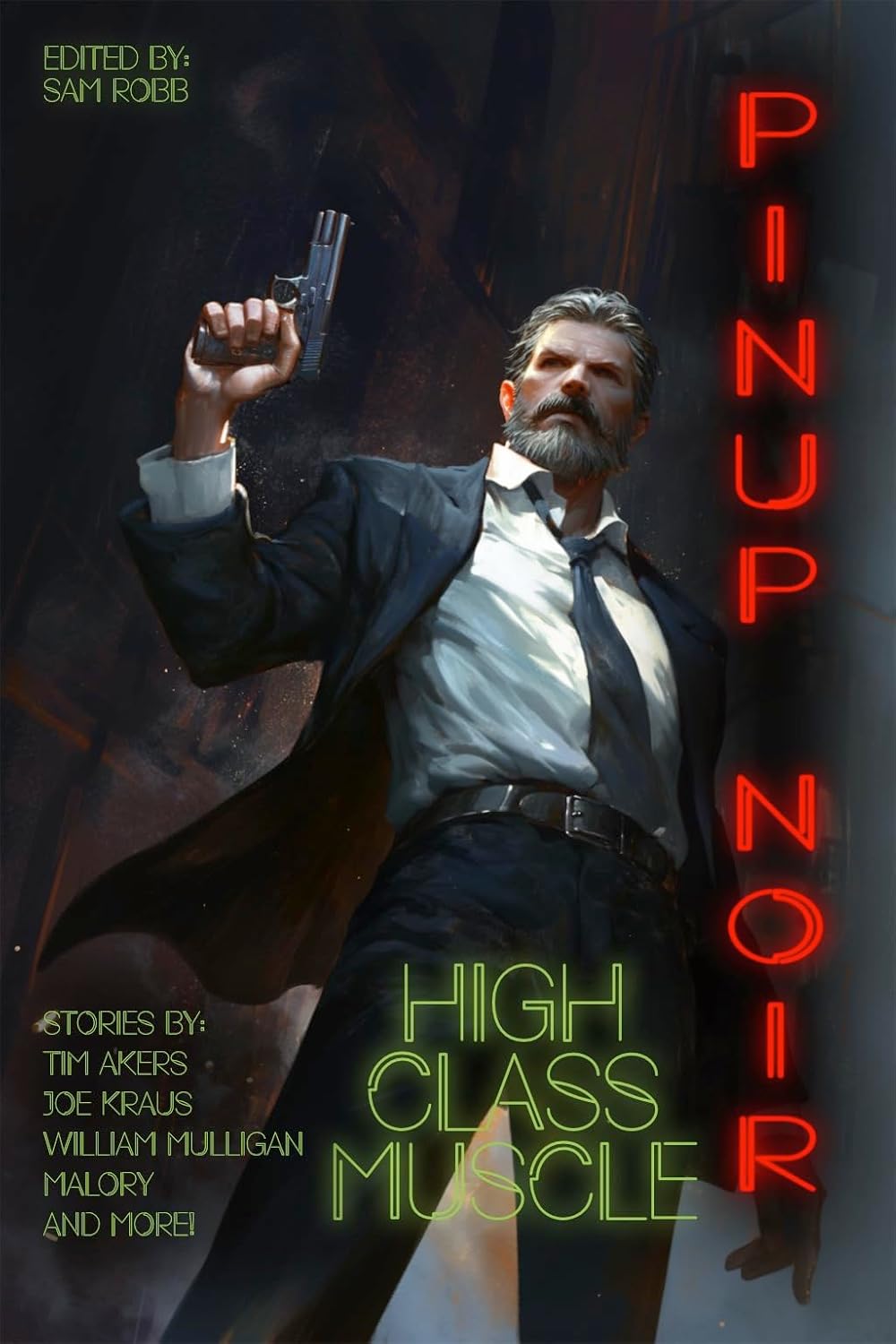
A bearded bodyguard with a gun takes center stage on the cover of "High Class Muscle."

The writing prompt reminded me of my old story. I didn’t want to take time away from the Civil Blood universe… but would it be that much to revise and submit one story I’d already written?

Turns out my hunch was right. I dug out the file I hadn’t seen in decades (inconveniently labeled “Introduction to Fiction and Poetry Assignment #8”). I fixed up the grammar, punctuation, and spelling mistakes that a student might tolerate but that modern me never would. Ran it past a writer’s workshop. It went over pretty great.

I edited away lines about being a brooding antihero because they’re an overdone trope now, and laughed at the descriptions of cellular phones that treated them like a novelty. But the core story was there: a murderer who must acknowledge the darkness, because it won’t stop with just him.

And, some thirty-ish years later, “This Thing of Darkness” has found a home. Pinup Noir: High Class Muscle is available in paperback and on Kindles via Amazon, here.

We’re well past 2020 and living in cyberpunk’s disposable future. But sometimes you can do okay clinging to the past.

In Which “Salem’s Lot” Meets “Law and Order”

[Want the “too long, didn’t read” version? My novel’s now available here.]

Once upon a time at a university, I took a class called “Making Monsters.” It was about teratology, the study of monsters and the history of medical aberrations. We read about hoaxes where women supposedly gave birth to rabbits, documents about feral children like the Wild Boy of Aveyron, and read the diary of Hercule Barbin, a French hermaphrodite.

The class’s focus was on medical cases, but I managed to persuade my professor that I could do a term paper on the myth of the vampire. After all, I nerdily pointed out, the word “monster” is from the same Latin root as “demonstrate,” monstrare or “to show.” And in my paper, I was going to show off the societal uses of whipping up fear and exorcising it to reassure the citizens that monsters will be slain.

Fun fact, vampires as a myth evolve with what the audience has historically feared. Originally, they were ruddy-faced, bloated corpses like a peasant might find in a coffin that was being exhumed. Along the way, they gained powers and limitations here and there until we ended up with the pale, misunderstood superheroes we have today. In the 1990s, vampirism was being written about like it was a disease, and the AIDS crisis was never far from any reader’s mind when reading about a sexy lover who you want so badly, but oh, they might just kill you.

That’s when I got the idea for a novel. Because my experience was just slightly different than the fiction I was reading and the games I was playing.

This is because while I was taking that course, my wife was in another one on constitutional law. And it detailed a case of a woman who was clinically diagnosed with sex addiction. She had been involuntarily confined in a mental ward for treatment. The doctors wanted to hold her there indefinitely. She was suing for her release.

Why hold her over that? Well, she was HIV-positive. There was no doubt in the doctors’ minds that if they let her out, she’d infect people, probably without telling them of her condition. That qualified as a “danger to herself and others,” enabling them to keep her imprisoned as long as they wanted.

So my wife and I debated this scenario. Was it violating this woman’s civil rights to keep her locked up? Or should she be, for public safety? Is her addiction voluntary enough that she can be trusted to manage it?

Naturally, in the United States, we have a presumption of innocence until a person is proven guilty, but once they’ve infected once, and *are* guilty, where do you draw the line when trying to reform them? Do we make laws and policies expecting the worst of people, or the best?

I think you’re guessing where I’m going with this. Because those questions never really left my mind. Whenever I was frustrated at my day job, I went home and scratched away at the keyboard, working on a novel. It’s a story about vampires and what we fear in the modern day, and the dominant fear I see is of becoming a permanent political underclass.

And now, after many years, that novel, Civil Blood, is finished and available for you to read.

It’s a cross between a legal thriller and an urban fantasy, a little bit Salem’s Lot, a little bit Law and Order and a little Shadowrun. It’s set in Washington, D.C., where you can’t do anything without a doctor or a lawyer present, vampire hunting included.

The back cover copy and first two chapters are on the Civil Blood page here.  You can pre-order the Kindle version now — it will be delivered on the official book birthday of June 21. I intend to hype the book regularly until then and have a little launch event on Twitter the day it arrives. However, due to a quirk of Amazon’s Createspace publishing, you can order the print version right now (no pre-order, just plain order) and get it as soon as it can be shipped.

I’ve been fleshing out the book’s universe on this site, visible on the “propaganda” page. Reading the page isn’t necessary to read the book, but if you’re going to make a world, you should really show it off a little bit.

It’s what the word “monster” is all about.

Showtime.