The old Legend of the Five Rings tabletop RPG made great use of flavor text. One of the ones I remember was a sidebar in the basic book filled with sayings of Shinsei, the teacher who brought religion to the Emerald Empire. The religion was a pastiche of Shinto, Zen Buddhism, Taoism and even had a story about reincarnation from Hinduism — the writers grabbed anything a gamemaster could lean on to get the vibe of an Eastern fantasy warrior culture. Some of it was probably cribbed from Western aphorisms, too, but dangit, GMs wanting to roleplay wise old sages could do a lot worse.
One saying was, “The hunter who chases two rabbits will lose both.” This always struck me as pretty good advice. If you’re going after something complicated, or have limited time, splitting your focus means you may end up accomplishing nothing. Unfortunately, right now I don’t have much of a choice, because…
Oh, By the Way, My Industry Collapsed
The video gaming industry is not in a good place. Over the past three years or so, countless studios have been closed, and many others have chosen to lay off staff. It’s not so much a “We can replace the writers with AI!” kind of scenario, because they can’t, really. But they sure can say, “We can close down this entire game studio and focus on AI instead because that’s what makes the stock price go up!”
Narrative jobs in particular have an unemployment rate around 22-25%, which is about what the Great Depression had (24.9%) at its height in 1933. Many of the remaining jobs are not remote, or they’re based many time zones away in Europe, or other considerations that rule me out.
If you want an in-depth analysis of why the industry is the way it is (and a dark prediction for its future), a BioWare alumni friend of mine, Georg Zoeller, has one here. If you’re in the industry and want hard data backing up the trends, this slide deck by Matthew Ball covers a whole lot more.
Surprising no one, I’ve been taking a mixture of freelance gigs with indie studios and yes, jobs outside the games industry. The indie games have yet to ship. Hedging my bets, I’ve been retraining myself by taking night classes in the field of cybersecurity. As of last week, I graduated a 9-month program affiliated with San Diego State University.
Would I take a job in the gaming industry if I spotted a good fit? Absolutely. Would I take a job in tech to learn new skills and deliver on what I know? Also yes. I found out during my exams that while I’m not as 1337 as the students with actual CS degrees, I can explain concepts and write detailed reports for clients, so my skills actually complement one another reasonably well.
So… What’s the Take-Away?
If you’re a fan, you may be asking, “What does this mean for Chris’s writerly schedule?” It’s not a very big change, unless you were hoping for a shipped video game from me very soon. I’ve been writing short stories and the novel sequel on evenings and weekends for much of the past year anyway. I have recently signed a contract for another short story, but when and where it will be published has yet to be announced.
If you’re in the cybersecurity field looking at this website and asking “What is all this?” — well, consider it my secret origin story. I got sick of scammers trying to phish me with fake movie deals or trying to brute-force my website’s password. I took matters into my own hands, and now I have a better understanding of network configuration, hacking, incident response, digital forensics, and a whole lot of other cybersecurity concepts.
As for the rabbit problem… we’ll see if the split focus is harmful or helpful. Sometimes the most successful people are ones that can marry concepts from two separate disciplines.
One of the other L5R sayings was, “When you eat, just eat. When you read, just read. When you eat and read, just eat and read.”
The worst job in the samurai fantasy nation of Rokugan belongs to the Crab Clan, who must maintain the Kaiu Wall to keep out the demonic armies of the Shadowlands. One particularly disagreeable duty is to scout out the blasted wastes and spy upon the enemy. When the ronin Seikansha sought this out, he discovered a portal to what he thought was Jigoku — Rokugan’s Hell.
This was not the case. When he followed a strike team of misshapen creatures into this distortion of time and space, he emerged in the laboratories of Paragon City’s Portal Corporation. The oni, goblins, and other servants of evil had no clue where they were — but wasted no time kidnapping the local humans to gain their secrets.
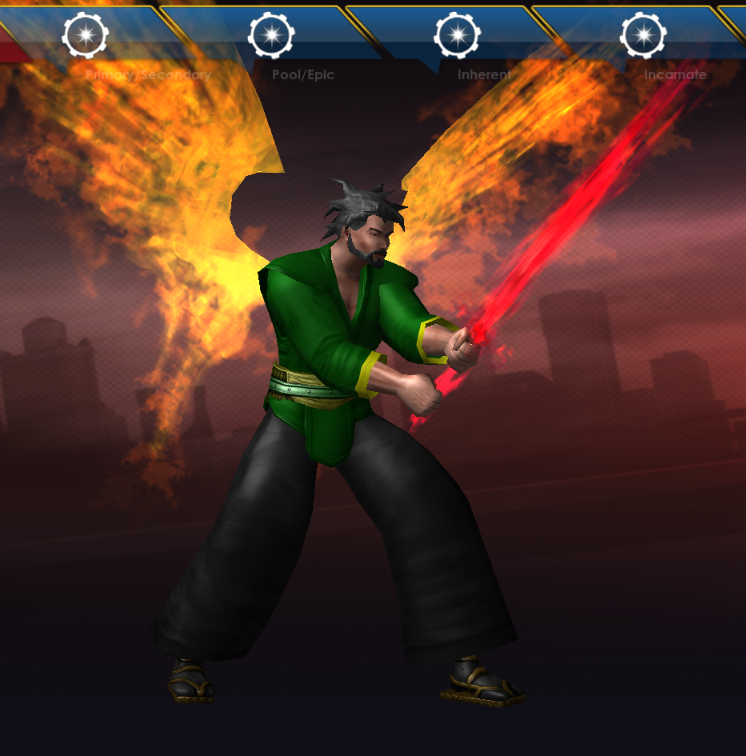
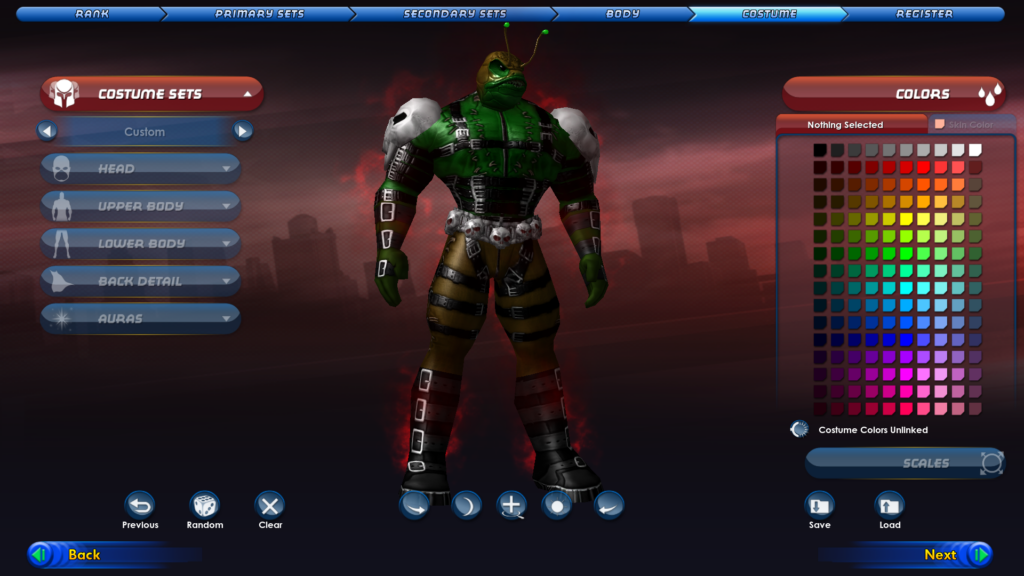
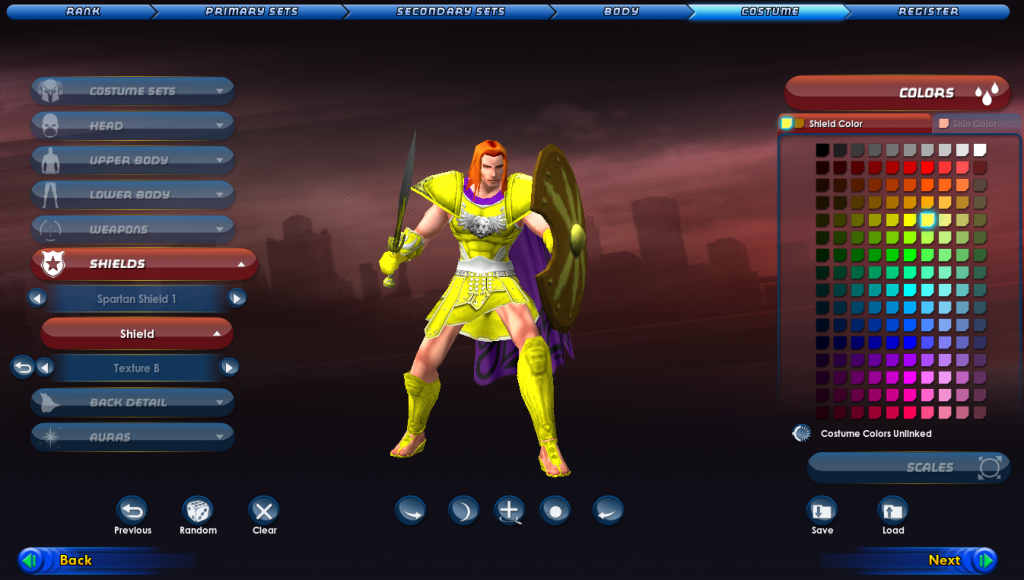
My approximation of the L5R shugenja Seikansha, featuring the Wings of Fire and Katana of Fire spells.
Alone, Seikansha knew he could not face all the enemy at once. But the language of heroes is universal. If the people here — however strangely dressed — seek to defend their home from the Shadowlands, they are no longer strangers, but brothers and sisters. It’s time for a team-up between samurai and superheroes.
“But wait, is this okay copyright-wise?”
Funny thing… yes. According to the guidelines of the current rights-holders of Legend of the Five Rings, Fantasy Flight Games, fans (such as myself) can create content so long as it is not sold for a profit. Since City of Heroes: Homecoming is entirely powered by volunteers and doesn’t charge for its services, no laws have been violated.
So… let’s rock!
Part 1: Face the Horde
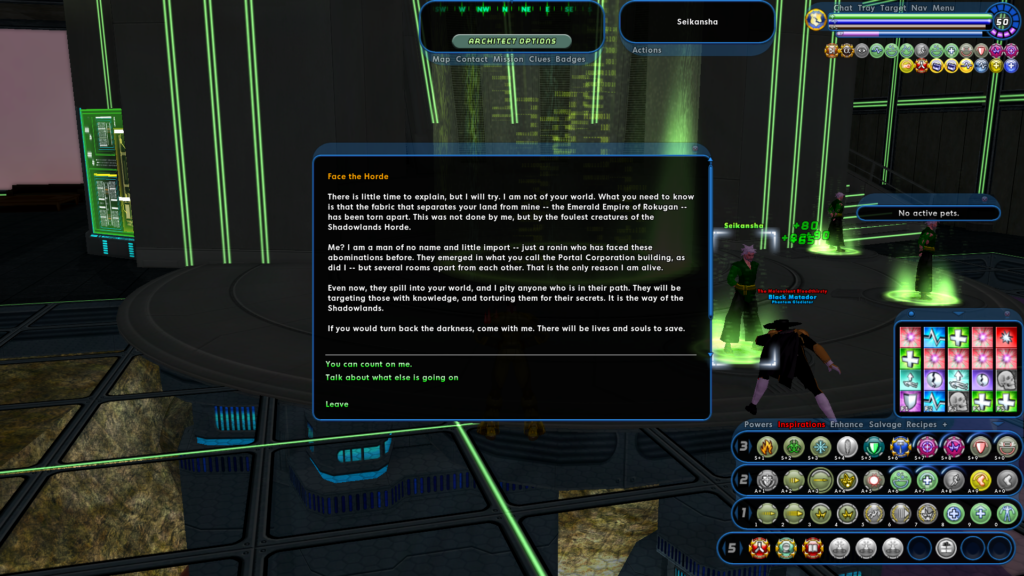
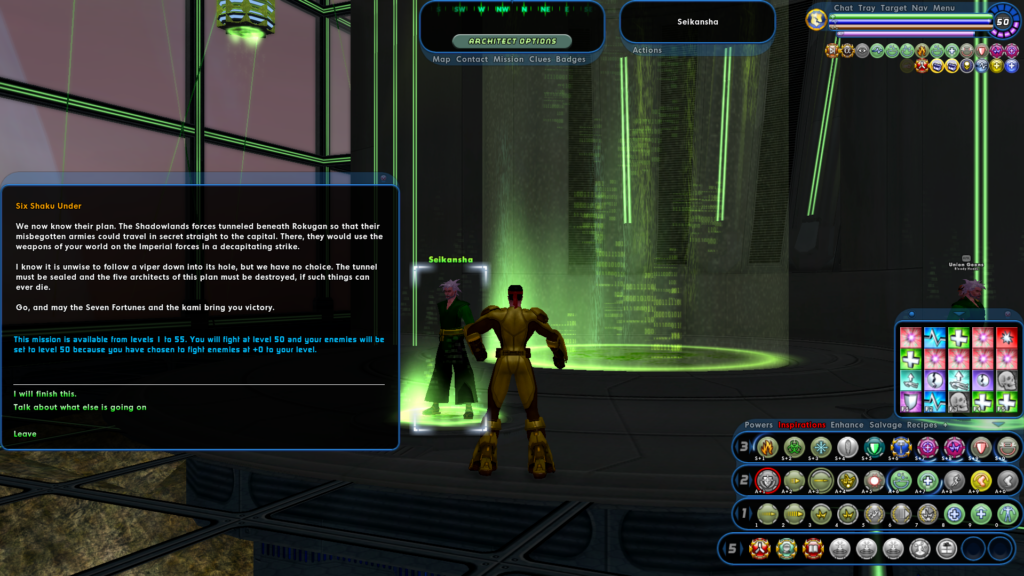
Once the player starts the Architect Entertainment arc, it creates a hologram contact for the first mission.
“If you would turn back the darkness, come with me. There will be lives and souls to save.”
Here, the heroes retake the Portal Corporation building from the foot soldiers of the Shadowlands Horde. Since it’s just the first mission, I thought we’d ease into it with familiar enemies from L5R and a simple task: rescue the scientists of the Portal Corporation. The liberated scientists are eye-witnesses to the crime.
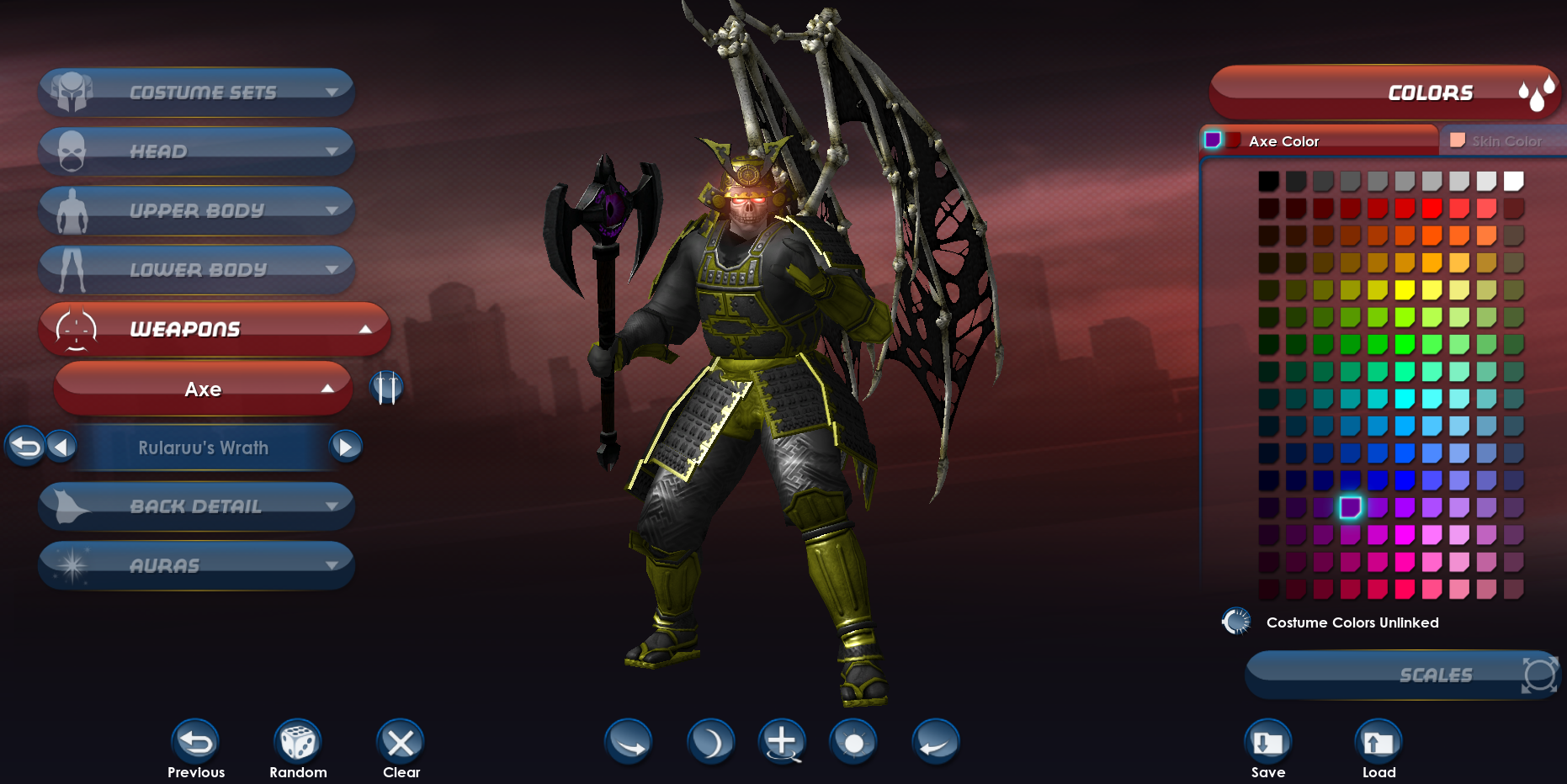
Who are we facing? Let’s zoom in on the bad guys with some beauty shots from the character creator!
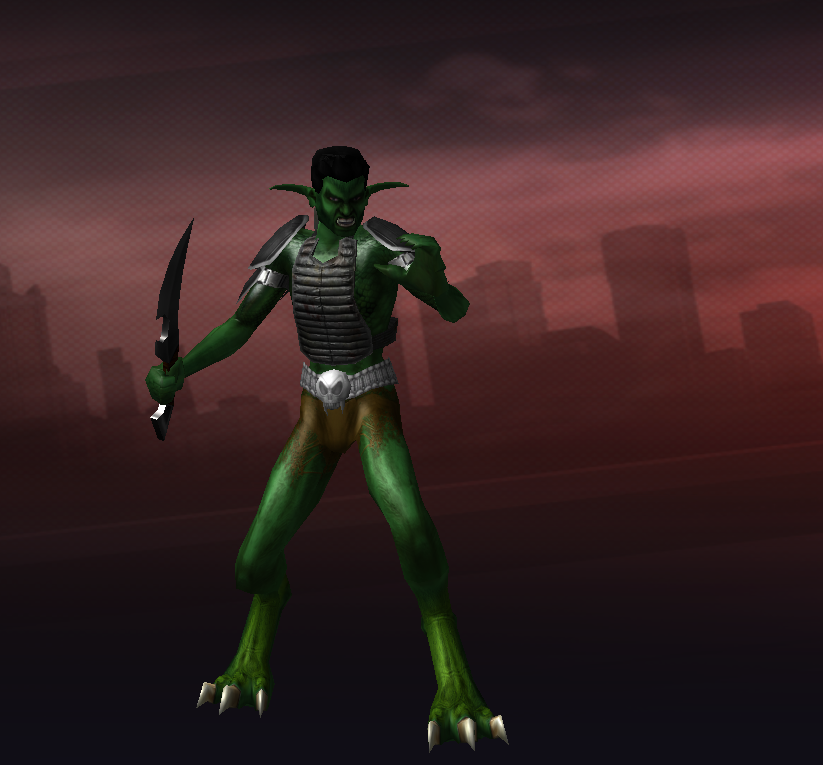
Bakemono (goblins):
Bakemono Warmongers (goblin shock troops):
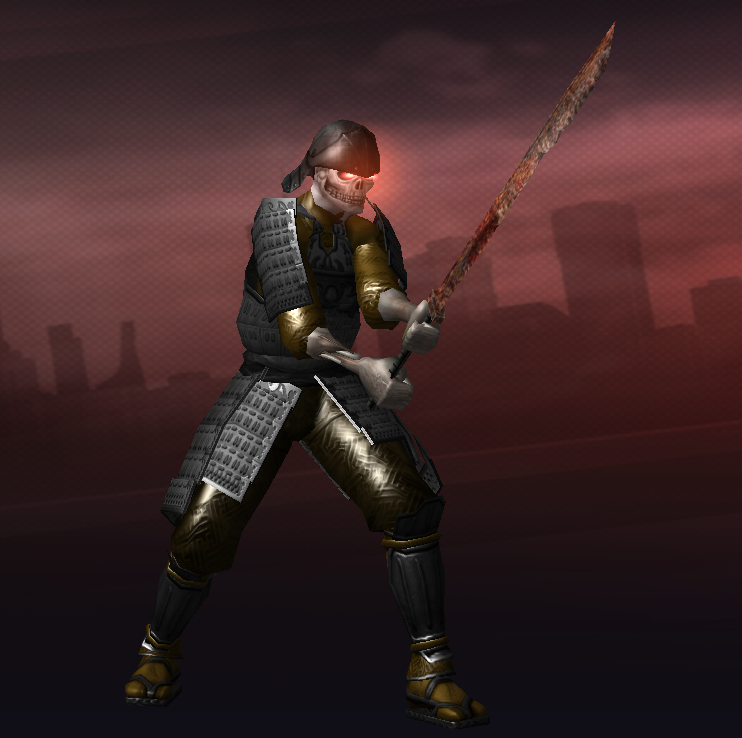
Hyakuhei: intelligent zombies of the Shadowlands that were once samurai. I particularly like the zombie bones in the hands and the rusty katana option.
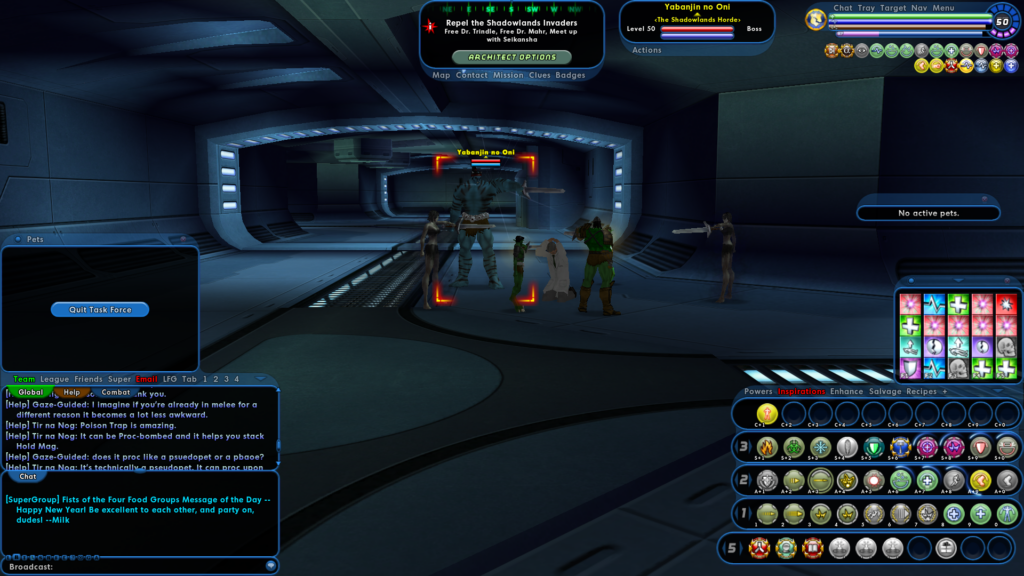
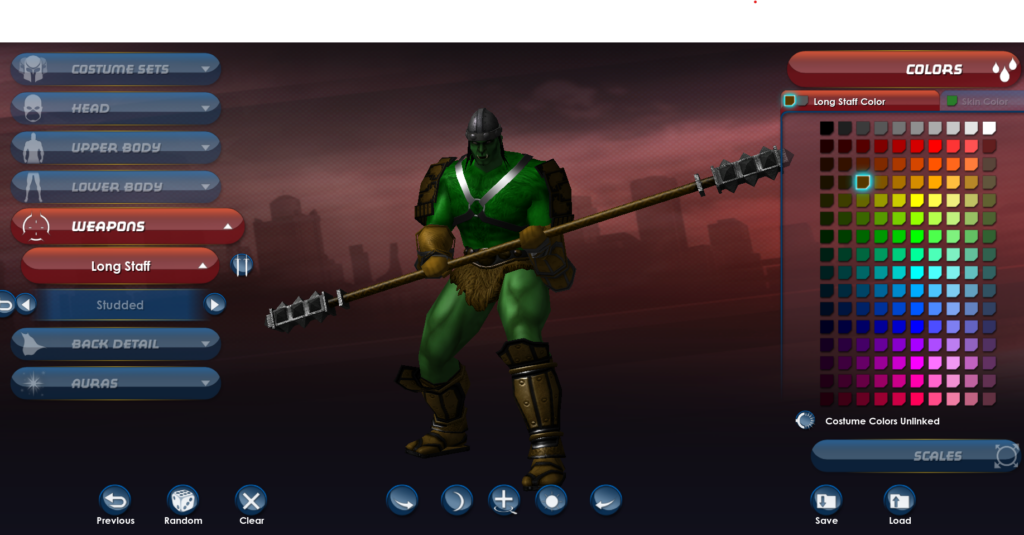
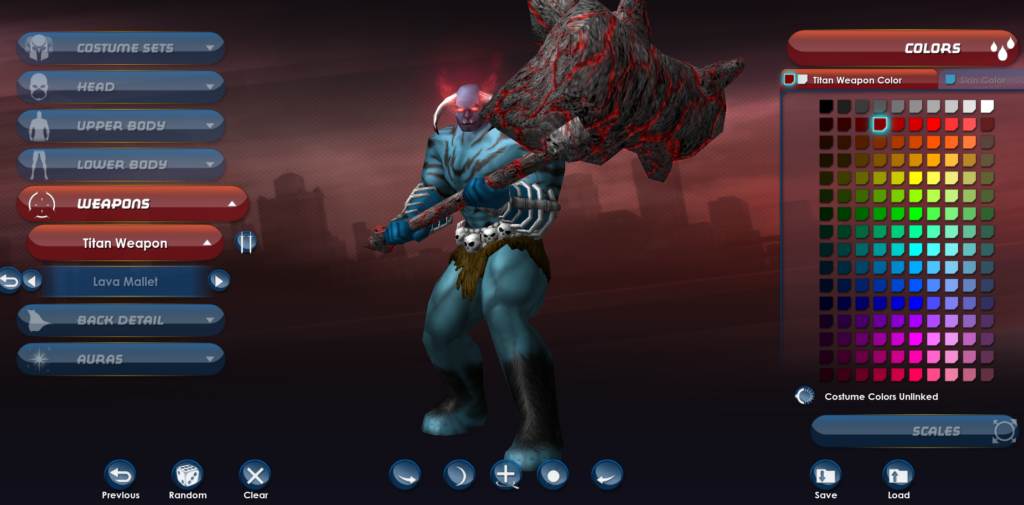
For bosses, we have Rokugani ogres. Since “ogre” and “demon” both more or less translate as “oni” and they share a number of similarities in traditional Japanese mythology, I gave these brutes the name Yabanjin no Oni. Yabanjin means, roughly, “barbarian” or “savage person.”
A Missing Expert
Back to the action. The heroes rescue two researchers who are able to tell them what’s going on, only to find their supervisor is missing: Tina MacIntyre, Portal Corp’s key expert on alternate dimensions.
Where would they take her? Seikansha says when the Shadowlands needs to grow its power, the first place that maho-tsukai (blood sorcerers) go is to the local graveyard. There, they can animate the dead to fight for them. In Rokugan, this is less of a problem, as they cremate their dead. Surely a worldly civilization like Paragon City does the same?
“Um, yes, bad news…” says the player…
Part 2: Digging the Grave
The heroes head to Peregrine Island’s graveyard to rescue Tina MacIntyre. There, they find Rokugan’s worst nightmare. When Tina is freed, she says the oni and goblins snatched weapons from Portal Corporation’s security teams and the SWAT department of the local police who deal with superpowered beings.
In other words, that sound of approaching feet is going to give way to bursts of assault rifle fire, grenade explosions, and the zapping sounds of beam rifles. The Shadowlands Spec Ops team may not have a lot of experience with these weapons, but thanks to modern technology, they’re pretty much point-and-click.
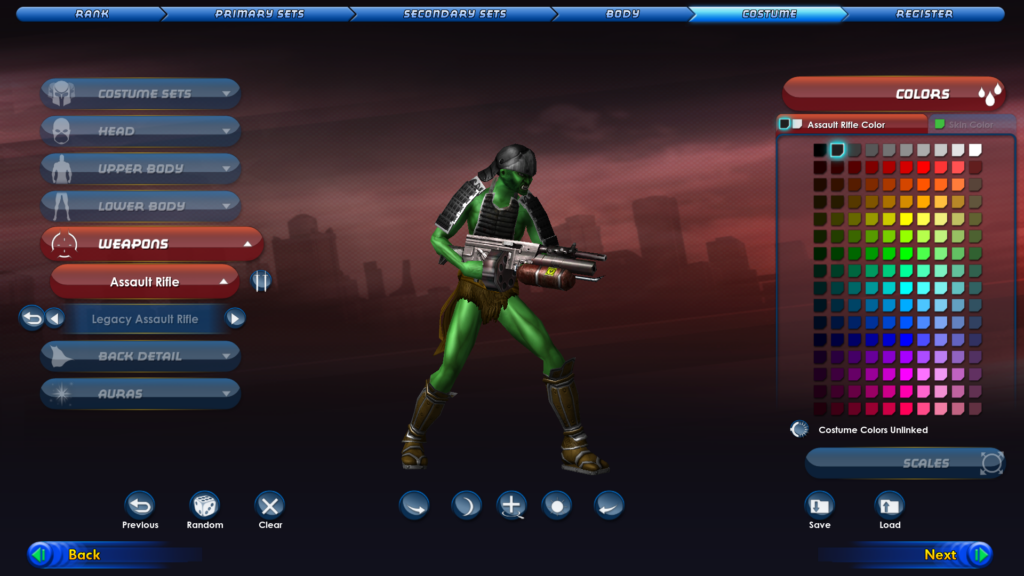
Even the lowly shlubs have automatic weapons:
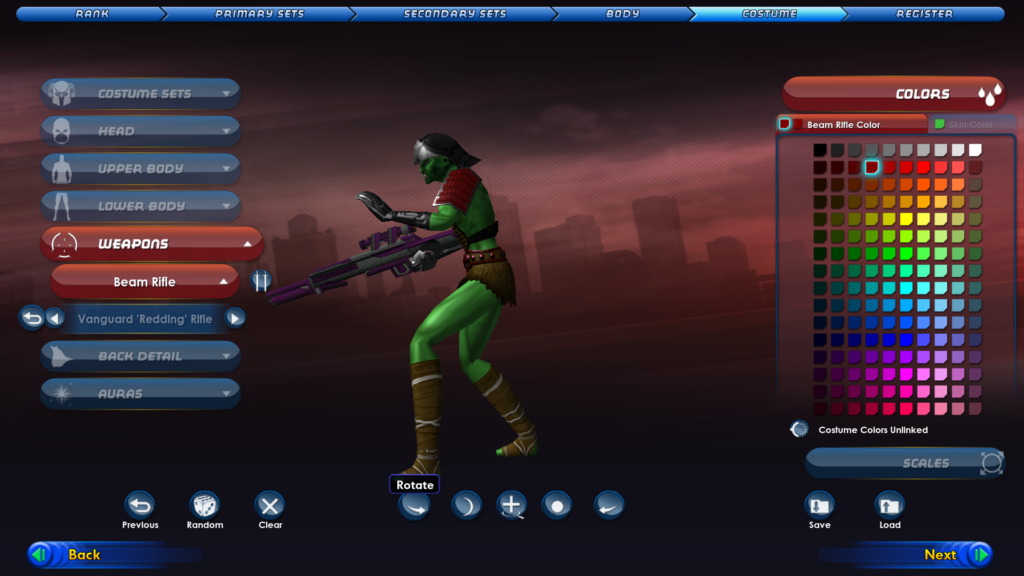
And their buddies pack beam rifles that can disintegrate their targets:
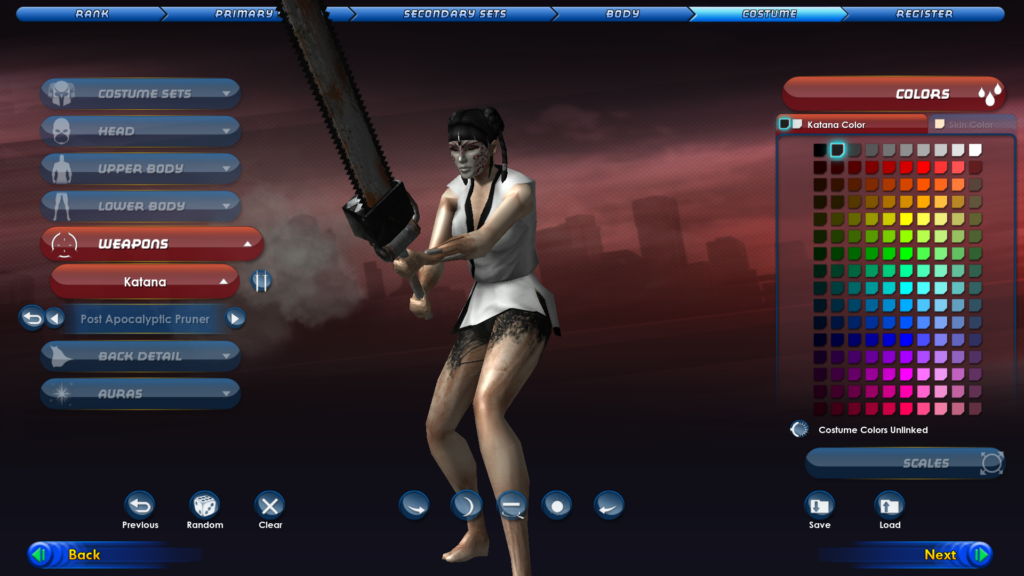
The zombies created by maho-tsukai have found themselves some chainsaw swords… and in this close-up, you can see the porcelain masks that let their bodies animate.
When the heroes rescue the Tainted Tina MacIntyre, she confirms their plan… they’ve taken a small army back to Rokugan… with weapons enough to devastate whatever medieval troops are in front of them.
Part 3: The Guns of Yojin
Those troops are in Yojin Province. In case you’re not up on your Rokugani geography, that’s the land immediately outside Otosan Uchi… the Imperial capital.
The good news? All seven Great Clans have soldiers stationed there. The bad news? Six out of the seven are blaming the Crab for failing to contain the Shadowlands threat.
Fight, Grab, and Rescue
The heroes have a threefold mission.
Find and confiscate the stashes of weapons from Paragon City so the Horde can’t use them.
Rescue the Crab scouts who were tracking the Horde and got caught by the Great Clans. There are six different Clans and six different Crab allies to free.
Take the fight to the demon in charge, Hoshasen no Oni.
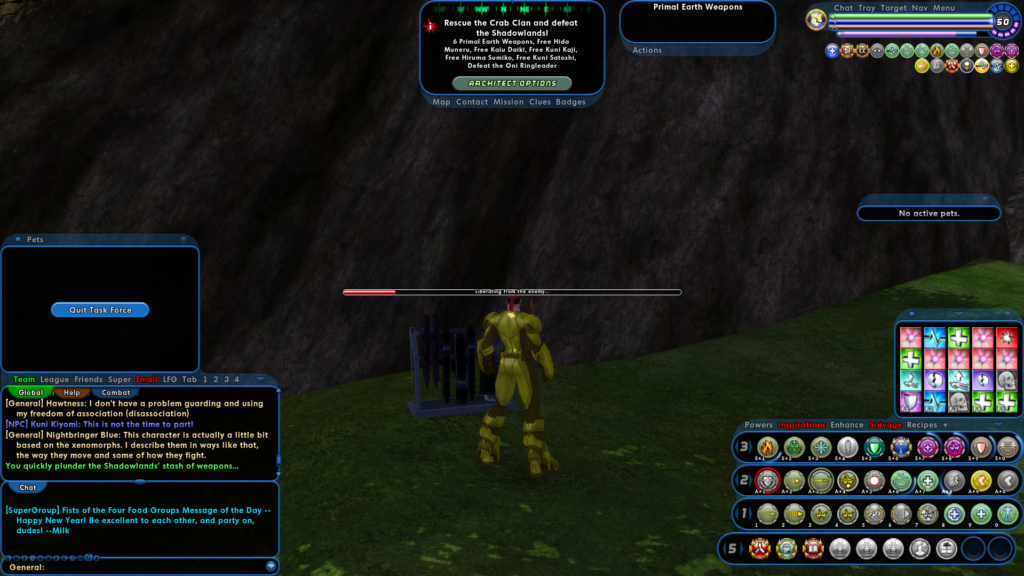
The weapons use City of Heroes’ “weapon stash” icons, which admittedly look out of place in the hills of pseudo-Japan, but they’re supposed to!
The scouts to rescue are from some of the samurai families of the Crab:
The Hida are known for tough shock troops.
The Hiruma, usually scouts.
The Kuni, often shugenja and witch hunters.
The Kaiu, known for engineers and battle-masters.
The Yasuki, who are mostly courtiers and merchants. They aren’t present here.
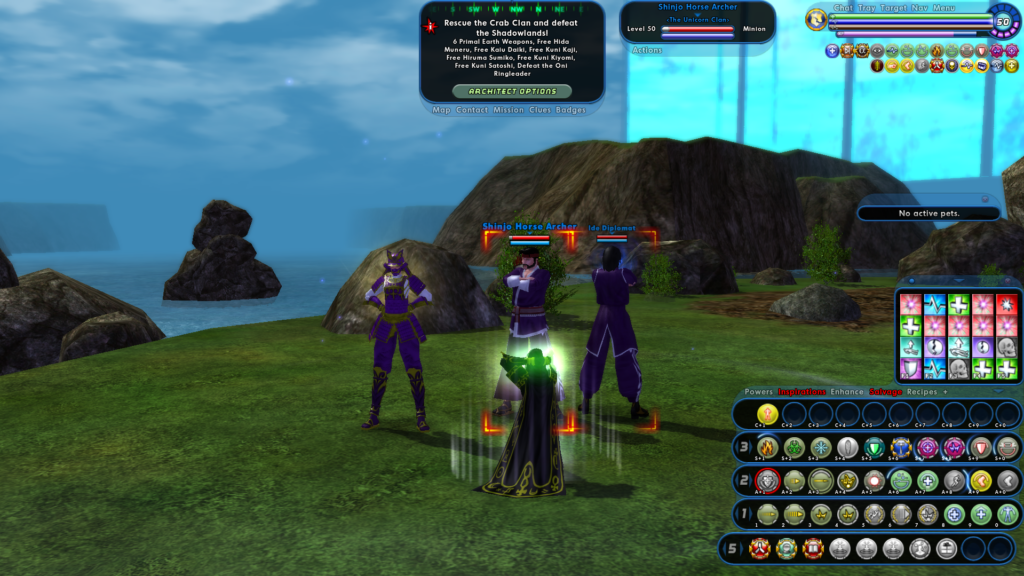
Here’s a Kuni, captured by the Unicorn (Ki-Rin) Clan. They have a mix of the samurai families of the Utaku, Shinjo, and Ide. The Utaku Battle Maiden is the armored one on the left, a literal girlboss. The Shinjo is an archer, and the Ide is a courtier who knows how to use a dao (Chinese broadsword). They’re minion-rank. As with all CoH adventures, the more players are in the team, the more enemies they will face. Since there’s only one player here, the mob is only three enemies.
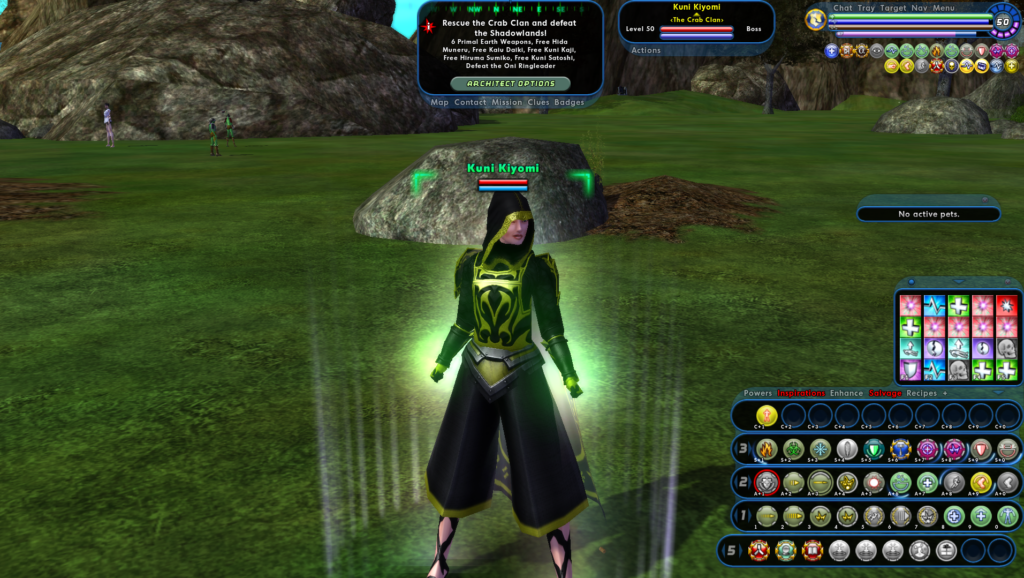
After the Kuni is free, she joins the player and fights on their side.
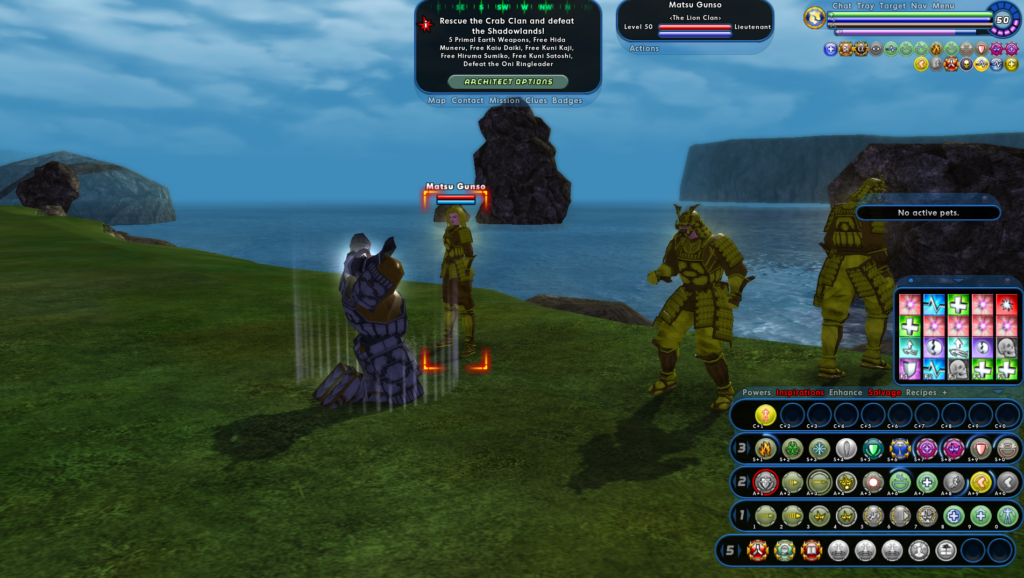
The Kaiu warrior, a big tanky type in heavy armor with a tetsubo, has been captured by the Lion Clan. The Matsu family form the minion and lieutenant ranks of this mob. The highlighted one is a gunso, or sergeant, who specializes in katana moves. The other two are ashigaru, foot soldier spearmen.
If there were more heroes in this mission, there would be more enemies. In that case, there’d be Kitsu family shugenja (priest/wizard) and a boss, the Akodo family tacticians.
But don’t forget the real enemy! Amid all the beating down of other Clans (Phoenix, Scorpion, Crane and Dragon are not pictured), there’s still plenty of Shadowlands enemies, none more notable than the Hashasen no Oni.
Pictured here in the character creator (because taking screenshots is chaotic while getting your butt kicked), the Hashasen fights using weakening energies. In the parlance of CoH, it’s radiation emission, but the description themes it as debilitating energies of the element of Corruption.
When it falls, the Hashasen no Oni tries to crawl in a specific direction… a tunnel opening leading far underground…
Part 4: Six Shaku Under
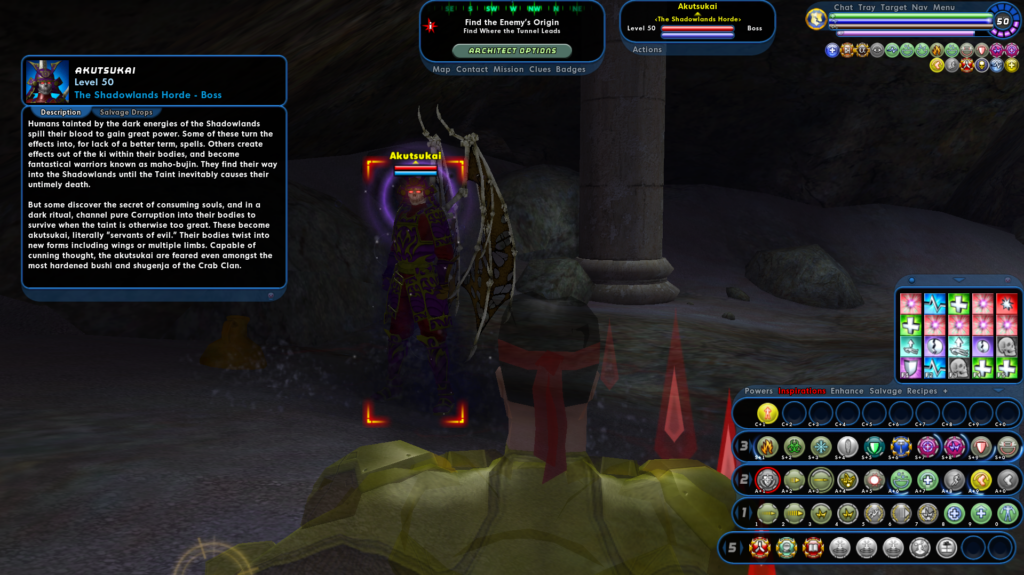
Seikansha and the players draw a logical conclusion — there were too many Shadowlands troops compared to the ones he saw in Paragon City. They had reinforcements, and they came from the tunnel beneath Rokugan. Does it go all the way to the Shadowlands? Or is the Horde using some other method than simply carving out a 200-mile tunnel? The player vows to find out.
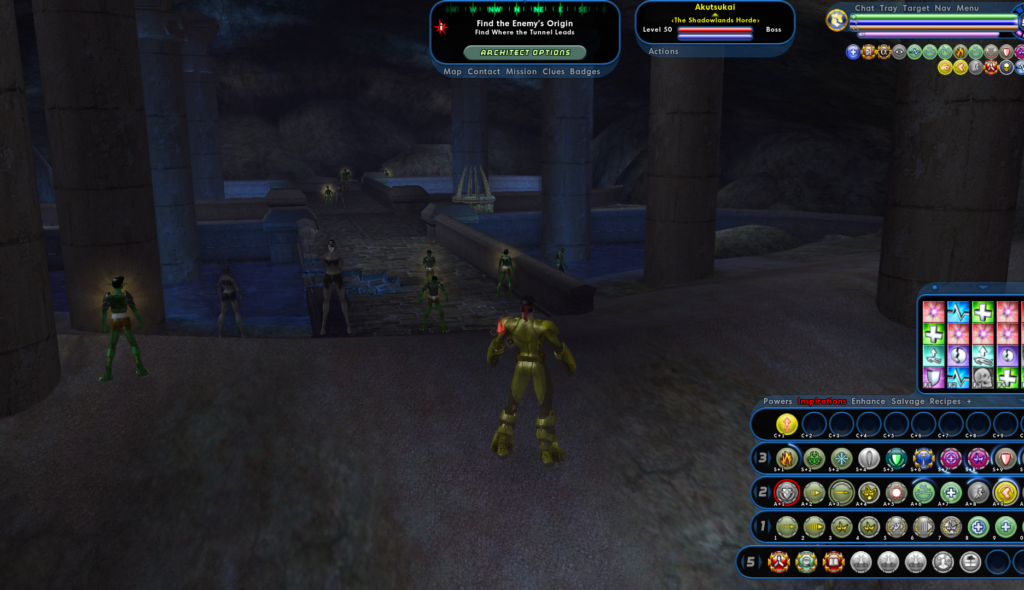
The Shadowlands have, of course, underestimated their enemy. Samurai are no great spelunkers, but if there’s one thing Paragon City knows, it’s fighting enemies in caves! The heroes set bombs throughout the tunnel system, wiring it to blow. Sure hope they wrote their final haiku before coming down here!
It turns out the enemy are guarding a ritual altar, and that spilling blood on it will create a gate… not between worlds, but to Jigoku itself.
There, the five servants of Fu Leng responsible for this plan are known as the Star of Darkness. They must be destroyed, or the forces of Hell will continue to surface in the caves, and from there, assail Otosan Uchi until it falls.
Part 5: To Shatter a Star
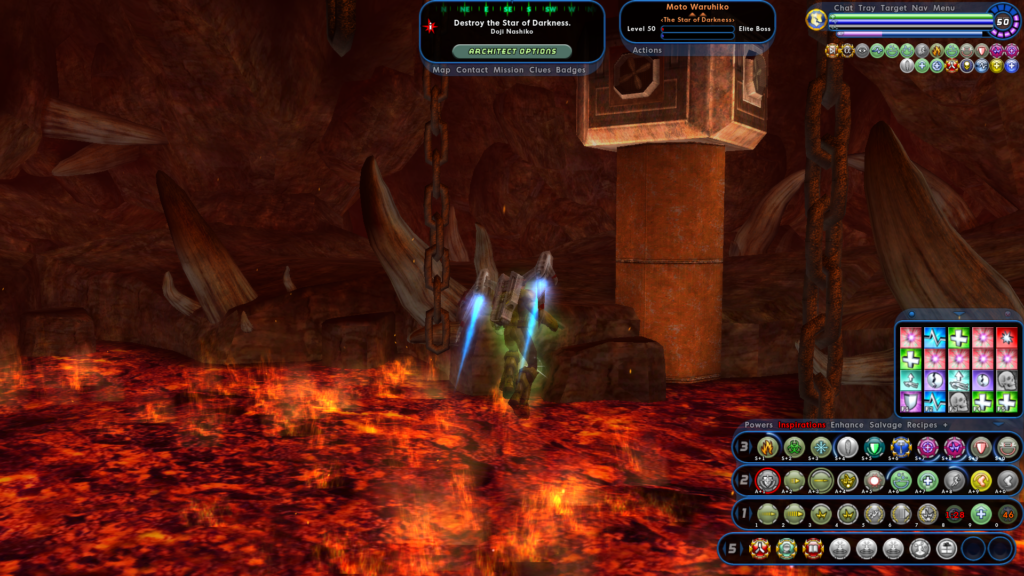
The portal takes the players to Jigoku, a burning hell where the Star of Darkness has retreated to plot their contingency plans.
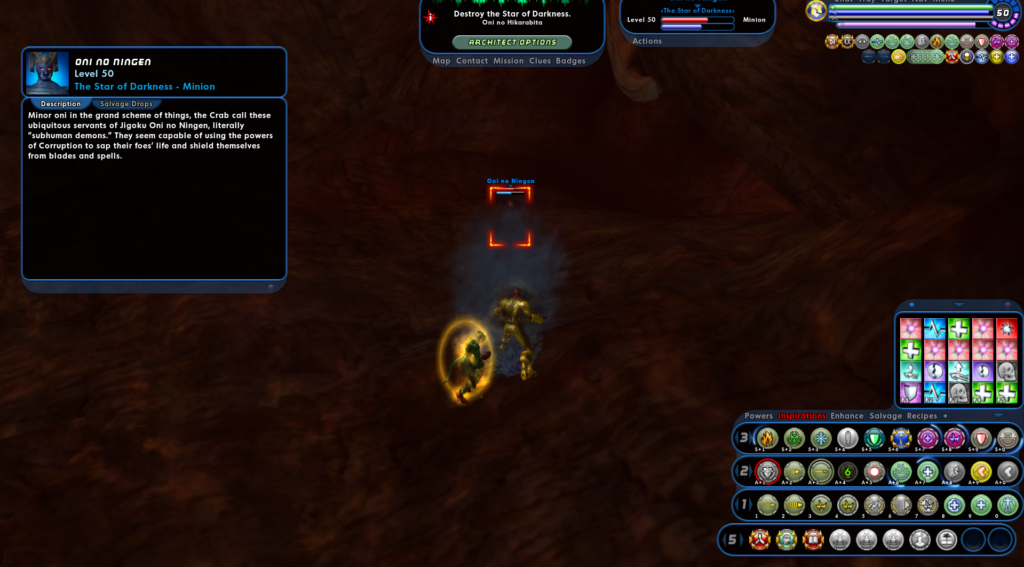
The heroes will find new enemies to face here, including dozens of minor oni not seen outside of Jigoku.
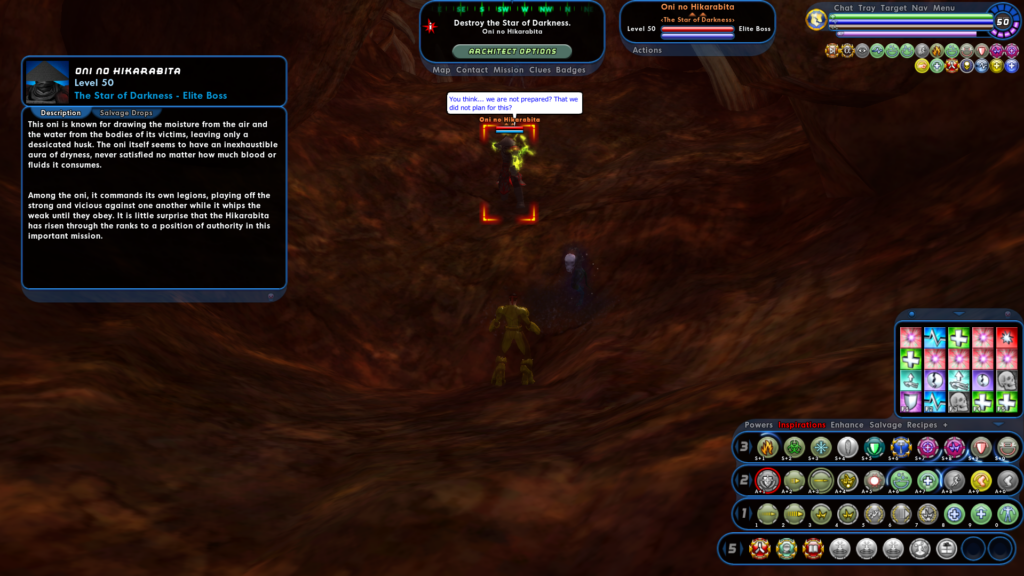
The stars of the show are the five points of the star. The Hikarabita no Oni lashes a burning whip and summons demons in an attempt to vanquish any foes who refuse to die. Using thermal powers, it sucks the moisture from its victims, leaving dessicated husks.
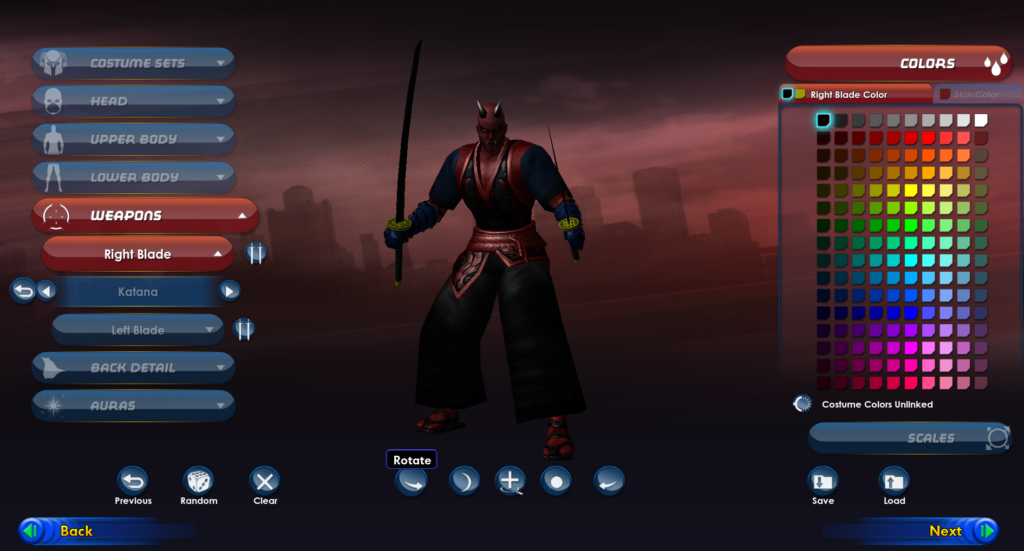
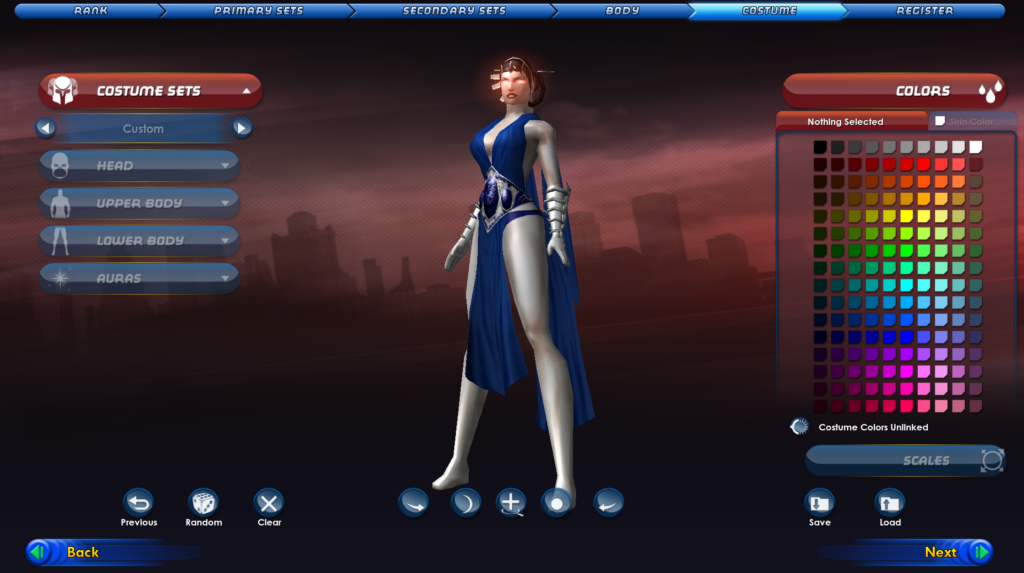
Genso no Oni mocks samurai by dressing and fighting like them, creating fear and darkness wherever it goes. Because City of Heroes adds on special effects with Dark Armor powers, fighting it is like fighting a cloud of darkness. I got a clearer picture of it in the character creator.
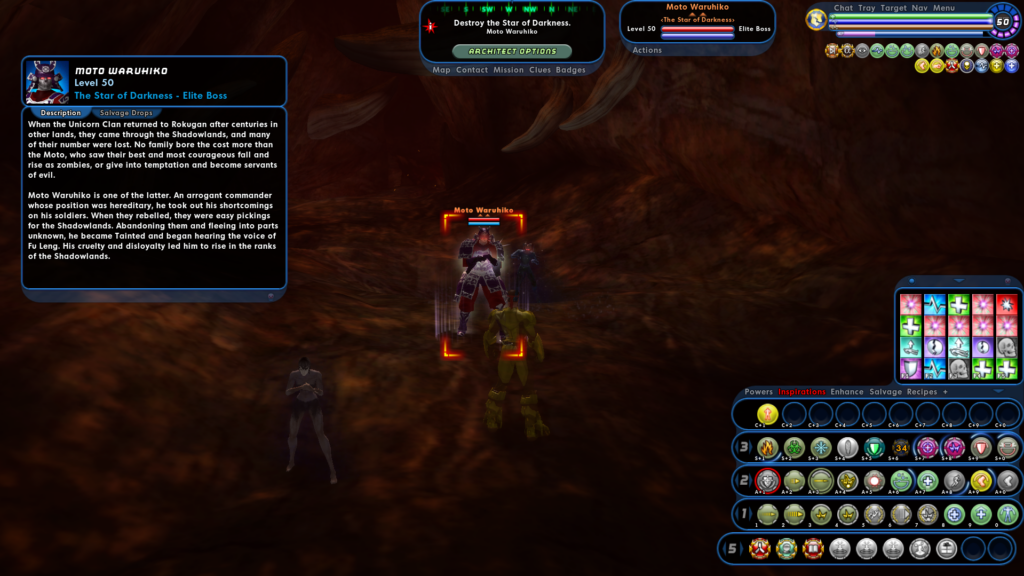
The other bosses include a fallen Moto samurai (a family of the Unicorn Clan largely taken by the Shadowlands).
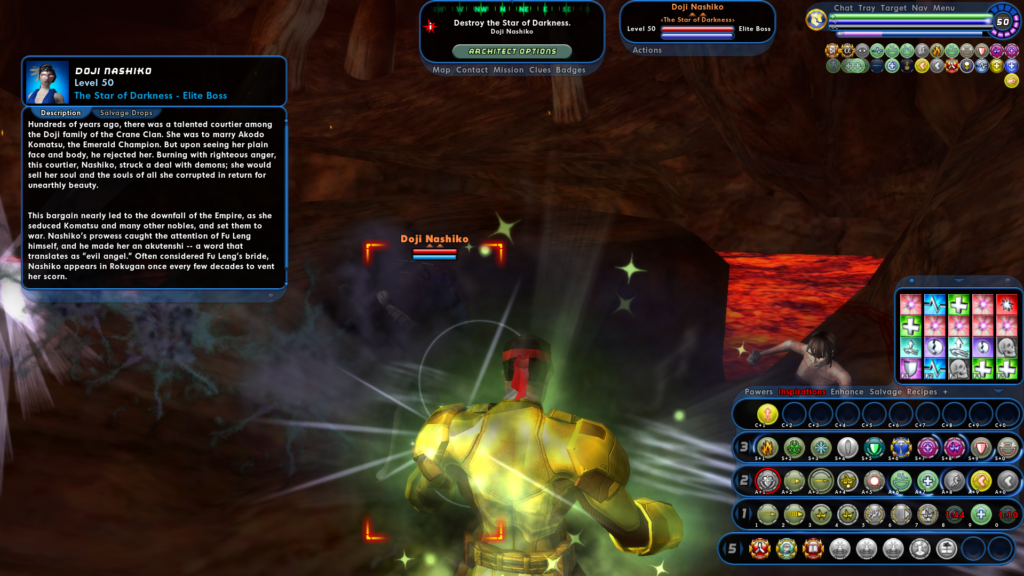
Topping things off is, of course, the archvillain of this plan, the pale princess of the Shadowlands, Doji Nashiko.
Who’s that, you ask? Right-click on her to find out!
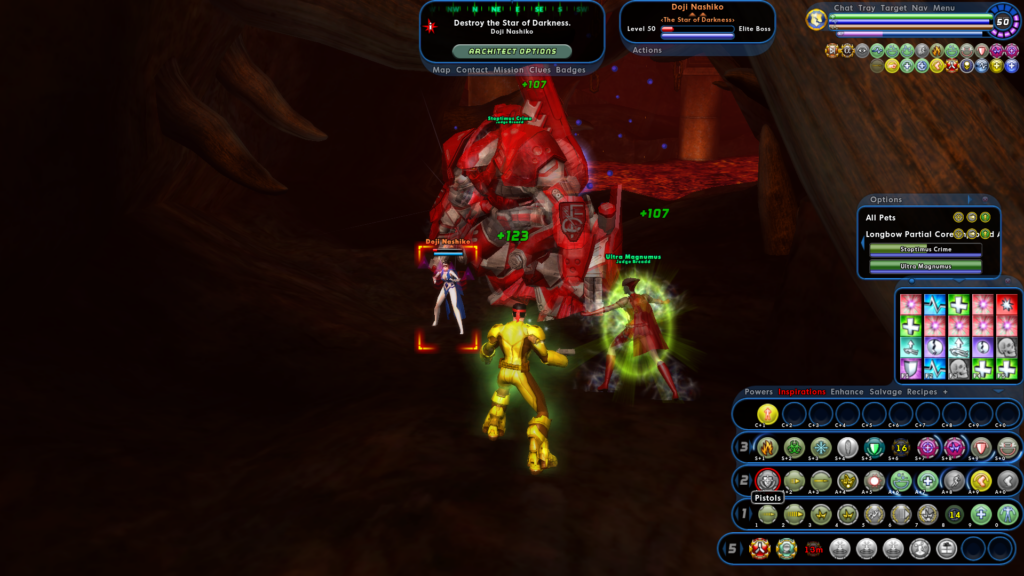
I tried to get a picture of her at rest, but she can see through invisibility, so I got one of her in action. Here she is fighting the 8-ton Longbow battle robot I used to keep her busy to get the screenshot.
With Nashiko’s defeat, the players have driven the last nail into the coffin of this evil scheme. But now that Rokugan and Paragon City know of the other realms’ existence, who is to say what will happen next? Will the Emperor send diplomats or soldiers? Will they still remain isolated from all other lands when an existential potential threat to the Empire is just a portal away?
Create your own Architect Entertainment arc and let me know!
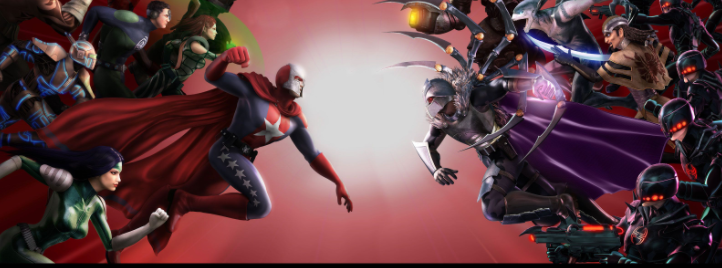
In 2004, the massively multiplayer online role-playing game City of Heroes hit the shelves. A little awkward at first, it had a few laudable strengths. It wasn’t trying to compete in the same space as the innumerable fantasy MMOs. The costume generator kicked butt, assuring that ensured no two heroes looked exactly the same. It had mix-and-match power sets that made you feel like a superhero from the get-go. Who really wants to play a level 1 peasant with “tattered cloth armor” as your starting equipment every time? And, importantly, it continued to constantly improve with every new patch (or, as the game called them, “issues”).
One of these improvements was the capability to design your own player-created content. Using the “Mission Architect” system, players could create up to five missions in an arc. Each could use pregenerated maps, normal or customizable enemies, a selection of mission goals, and NPC dialogue they could enter themselves.
Choose Build Your Own Adventure
Two notable types of adventures resulted. The first type was players designing the missions’ enemies for maximum experience gain. They ground out levels and loot as fast as humanly possible. Useful for condensing the time you spent getting levels, but overall, nothing amazing.
The second type of adventure unleashed the creative energy of thousands of players, as they spent hours polishing their virtual baby until it shone. I saw adventures where you descend into the Paris catacombs to fight the Phantom of the Opera. You could battle archvillains themed to the major arcana of tarot cards. One that I found particularly hilarious had you take the job of the Fashion Police, dueling enemies with the most garish costumes imaginable.
And Then the “Thanos Snap” Happened
Despite the love and money of a sizeable fan base, City of Heroes was shut down in 2012 by its parent company, NCSoft.
Unknown to NCSoft, however, a Secret Cabal of Reverse Engineers (names obscured to protect the criminals) absconded with the game’s source code and played in private for the following seven years. In 2019, their secret came out and they opened the servers up to players. Coming home was remarkably like the citizens of Marvel’s Earth-616 after their five-year absence.
A year or two later, NCSoft, who had moved on to other ventures, eventually gave the servers an official blind eye. As long as the private servers didn’t attract attention with bad (read: legally liable) behavior, they could operate and even create their own new content.
Due to differences in philosophy and general drama, several different teams managing their own servers have popped up. I use the Homecoming servers. Homecoming doesn’t try to preserve the game exactly as it was in 2012. Instead, it adds content for a better user experience. Though I haven’t tried to create official content for them, I have made use of their Mission Architect to create stories I think players could love.
So, Get to the Game Already!
So far, I’ve written two Architect arcs, each with five missions:
The player tries to stop Arachnos’ obnoxious super-science expert from going back in time to change the course of the Trojan War. The heroes battle Trojans, Amazons, Aethiopian allies, a river god, and Arachnos soldiers with a certain… mythological edge.
The Portal Corporation opens up a wormhole to the land of the samurai RPG Legend of the Five Rings. The oni of the Shadowlands steal weapons from Paragon City and intend to use them to conquer the Emerald Empire. It will take heroes from both worlds to stop them!
It’s been another long dearth of posts, but I assure you, it’s for a good reason. When we last left our intrepid writer, he was modifying Civil Blood‘s sequel to match up with real-world molecular biology. What’s been going on since then?
Writing. Lots of it. By day, I’m working away on Wayfinder for Airship Syndicate. I recently graduated from contract writer to full-time senior writer, and the game is closing in on its Early Access date. Therefore, for the first time in a few years, you might be able to play a game and see my dialogue and text, out in the wild.
By evening, I’m writing the second installment of the Skia Project, the technical name for the world of Civil Blood. I’m not a fast writer, but I’ve gotten up to about 38,000 words, with a target goal of 100,000 to 130,000. That’s about the same size as Civil Blood, which clocked in around 129,000 and fit into just under 400 pages. Naturally, just because I reach the end of the novel doesn’t mean I click on Amazon’s buttons and hit “upload” right away. I put Civil Blood through about ten drafts before I felt it had the punch it needed: pacing, stakes, beautiful turns of phrase. The sequel might not take quite as many drafts, but I don’t want to skimp on quality. The “too long, didn’t read” here is that I’m making good progress, and I’m committed to it.
But oh, are there other projects percolating in my brain. I’ve had not one, but two dreams — literal dreams — about Shadowrun projects that made me wake up and say, “Huh. Could I write that?” It turns out independent authors have been invited to contribute to the game’s universe with a profit-sharing deal, and the temptation is strong. I will probably focus on my own universe for the foreseeable future… but never say never.
And then there’s my daily shot glass of nostalgia. This year has hit me hard with good memories of tabletop roleplaying games. Let me break down just how much TTRPGs have meant to me this year:
1) I play an MMO in which I run into TTRPG gamers all the time. On the Everlasting server in City of Heroes: Homecoming I met up with the players who play Vampire: The Masquerade and Legend of the Five Rings characters. This got me telling stories of the best V:TM tabletop campaign I was ever in, and I thought, “You know, that’d make for an okay series of blog posts, both to amuse the players and help Storytellers with some basic principles.” So I’m posting that ASAP.
2) The Dungeons & Dragons: Honor Among Thieves movie came out, and it was everything I wanted the 2000s D&D movie to be. I wish it had been more profitable, but I’ll take what I can get.
3) I ended up following some topics on Quora, Reddit and Twitter, and the trifecta means I end up reading conversations about the TTRPG scene, which I haven’t been in for a long time. Doesn’t matter that most of the talk is about D&D and not my preferred games, I still grok the language, and have nothing against the big dog.
4) My son is getting to be an age where his friends are starting to play. We had a boffer-stick LARP birthday party for him, and it was highly successful — no crying, no excluded kids, the teams were even, a generally great experience. Our family tried Werewolf: The Apocalypse during the pandemic quarantine as a way to pass the time without interacting with other kids, but that’s a distant memory now. He’s going to try D&D later this summer.
5) Some of the Bioware fans have found me on Twitter and they ping me with Codex questions and the like, so I’m not escaping that world any time soon, either.
6) Wayfinder is a fantasy RPG that reminds me of some of the high school AD&D games I used to play in. One of the main writers is Keith Baker of Eberron fame, so fantasy RPGs are in the DNA of everything we do.
So, with all that said, I’m going to walk down memory lane with the Shot Glass of Nostalgia page. Because while I have new stories to tell, there is value in the old ones. And to all those who have never heard them… perhaps they will smile as well.
We will start with a vampire buffalo. Or, at least, a would-be vampire buffalo, and why my wife was Prince of a city and never got deposed.
Many years ago in Los Angeles, I was up late at night watching the Independent Film Channel. This was around the time of the breakout success of the Blair Witch Project. It being October, the traditional horror month, the IFC showed the original Texas Chainsaw Massacre. By way of introduction, they asked some film expert why he thought indie horror films spawn stories of phenomenal success. Studio films like those of Alfred Hitchcock in his ’60s oeuvre were carefully crafted, but indie horror, particularly in the ’70s to ’90s, had many stories where the not-very-cerebral flicks were made on shoestring budgets and still became wildly popular.
The expert said, “Well, when you watch an Alfred Hitchcock horror movie, you’re in suspense because you’re in the hands of a master. When you watch an indie horror movie, you’re in suspense because you’re in the hands of a f**ing maniac.”
It is with that spirit that I present to you a bit of roleplaying game writing my wife and I did long ago. Because I liked gamemastering samurai horror, and it wasn’t because I was Hitchcock.
I dug these out of the vaults, as it were. There’s three adventures, all tournaments for the samurai fantasy tabletop roleplaying game Legend of the Five Rings. They put the players through their paces with roleplaying challenges, a little mystery, and combats. They were playtested in gaming tournaments at the Origins and Gen Con conventions, over the course of three separate game sessions apiece.
I doubt I’d ever call what I did in tabletop games “wildly popular,” but some fans liked the work enough to archive the original versions of these adventures on the L5R fan site Kaze No Shiro. To add a little value here, I’ve cleaned up the old versions’ visual presentation and added a few sections based on fan feedback.
Curious gamemasters can read “Mirror, Mirror,” “Fortunes Lost,” and “Hindsight” here. Curious players who wanna read ’em can get off their duffs and become curious gamemasters.
The adventures are free to download and play. I don’t have a tip jar or Patreon or anything like that. If you liked the games, maybe you’d like my novel.
This is is where I show off promotional materials, excerpts from books, links to published or produced works, and so forth. My LinkedIn page covers my specific responsibilities for the collaborative projects.
(Writing samples are at the bottom — just scroll down.)
I have also spoken at the Game Developers’ Conference on the topic of writer research skills. If you’re an attendee, you can find my 2016 lecture “What Wikipedia Doesn’t Know Can Hurt You,” in the GDC Vault.
A choose-your-own-adventure in interactive prose. “A Hell of Heaven” is in the vein of Cyberpunk, Shadowrun, or similar games that occur twenty minutes into the future. The story asks, if technology allows our brain to be edited by others, what makes our decisions ours?
To demonstrate my skills with short, urgent dialogue (more so than the BioWare or Wayfinder samples) and to throw in a little level design, I added this documentation, adapted from a timed writing test. All names have been changed to protect the guilty.
I headed up a lot of unglamorous-but-essential lore-building text on the Mass Effect Trilogy. (I helped a little bit on ME1, and took over for ME2 and ME3.)
The gameplay of the rest of the adventure, including the twist at 10:34 and decision/quest turn-in at 18:31. Total dialogue time is about 5 more minutes.
Stomping giant insect-like Colicoids? You’re gonna need a bigger boot.
I wrote the Normandy’s Enhanced Defense Intelligence companion character in ME3. She says this early on in her Mass Effect 3 dialogues, so a lot of fans are familiar with this joke.
Hey, EDI, you do remember how Shepard died in ME2, right? Juuuuust checking.
Companion Character: EDI and Liara ~ 30 seconds Mass Effect 3 took into account a metric ton of choices made over the trilogy. This ME3 scene plays if you never completed one particular ME2 DLC.
EDI goes through a lot: her installation in a human-like body prompts many questions about mortality and human behavior. It ultimately leads her to decide that destroying the Reapers is worth her own death. Here’s a supercut of many of her conversations.
For cinematics and third-person-shooter gameplay samples, we have Kai Leng’s first appearance, a showdown with the Virmire Survivor, and finally a use for those Citadel elevators. (Mayhem. Mayhem is the use.)
The variant lines possible in the Virmire Survivor face-off are quite complex under the hood.
In a break from doom and gloom, I wrote gaming’s equivalent of the Hallmark Christmas Special, in which Lord Halar tries to assist his scientist granddaughter Avala during the winter holiday. The emotional beats at the end are all the more poignant if you know Avala is an Echo… in other words, like the player, she died and has returned to live an uncertain existence. The first mission is 15 minutes, but if you want the full 47-minute tour, I had my hands on every bit of dialogue in the patch.
I briefly wrote for I Got Games/AVGLife’s interactive romance novels, and would welcome the chance to revisit the romance genre. Twine makes it easier to simulate the flow of an interactive piece without starting my own studio.