Dr. Aeon and the Wrath of Achilles (#31899)

The players are summoned by Mender Lazarus, one of the guardians of the time stream, who says the balance of power in the player’s timeline is, was, or will be upset. Dr. Aeon, the chrononaut mad scientist for City of Heroes‘ premier villains, Arachnos, went back in time to the Bronze Age, to interfere in the course of the Trojan War. Why is he siding with the Trojans and assailing the Greeks with his high-tech weaponry? Therein lies the mystery.

What follows is a lot of fighting, because hey, it’s an MMO. You beat up everything from Trojan soldiers and a river god to super-soldiers with mechanical spider legs coming off their back like Doctor Octopus’s tentacles. In an ideal world, I’d post video from City of Heroes to YouTube, but you’re not allowed to make ad revenue on the game for legal reasons. So I’m posting screenshots.

Mission 1: The Strange Case of Dr. Hamilton

Mender Lazarus, one of the guardians of the time-traveling society Ouroboros, has much to explain to the player. But the full details will have to wait. He wants the heroes to look into a break-in at Paragon City University’s Steel Canyon campus. If you’re thinking this sort of thing is below the pay grade of Ouroboros, you’re absolutely right. Except… it’s not.

The superheroes rush over to PCU to find Arachnos have kidnapped… a mythologist?
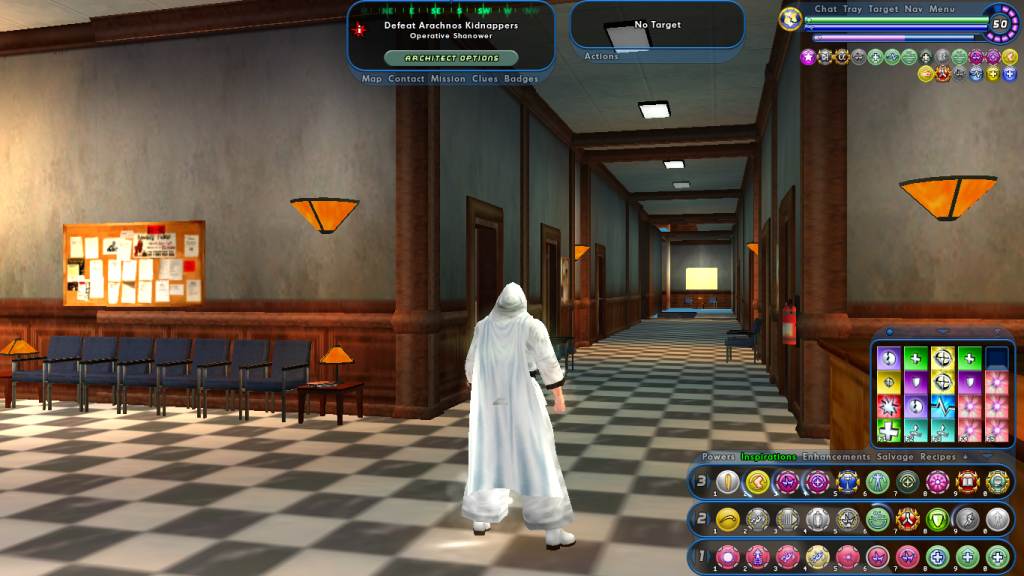
An Arabian superhero heads down the marble-floored halls of Paragon City University. No enemies are present yet.

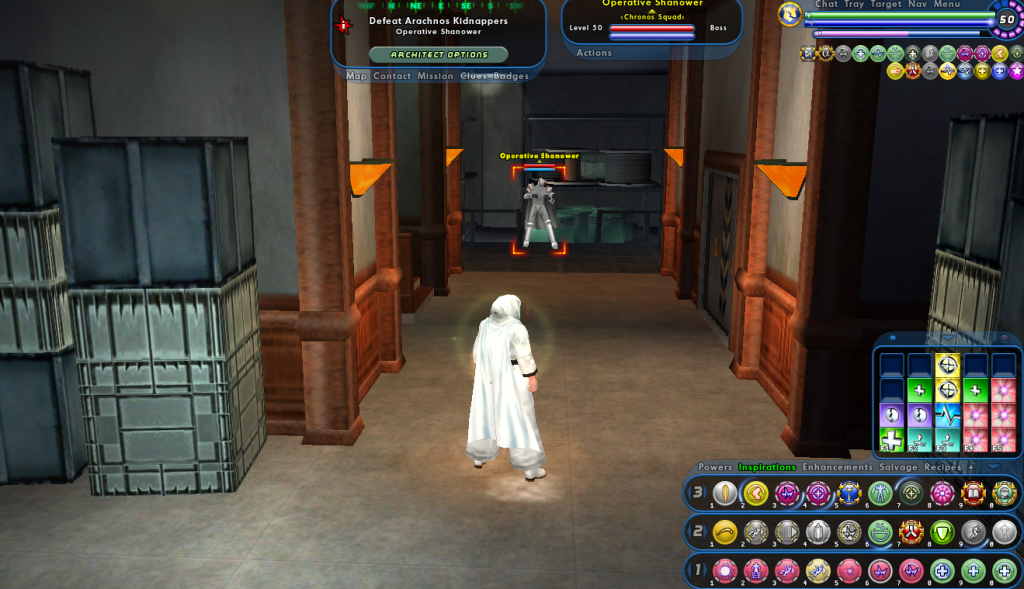
In the basement is an Arachnos arbiter, left behind to cover the spidery villains’ tracks. Bonus points if you know the comic book reference of Operative Shanower!
Mission 2: Evening the Odds

Dr. Aeon has gone back in time, using the mythologist Dr. Hamilton as a guide. Mender Lazarus has tracked him to the battlefield outside of Troy (the Troad). It’s at the point in the war where Achilles has abandoned the fight. (I use the spelling closer to the Greek, “Akhilleus.”) The Greeks, or Akhaians, as they were then known, are getting captured by Arachnos and interrogated for what they know.

The heroes drop down into the Troad and fight their way through the Trojan ranks to reach the best fighters amongst the Greeks. It’s an all-star cast that Arachnos has captured: Menelaos, Odysseus, Great Aias (a.k.a. Ajax), and Makhaon, the Greeks’ healer.
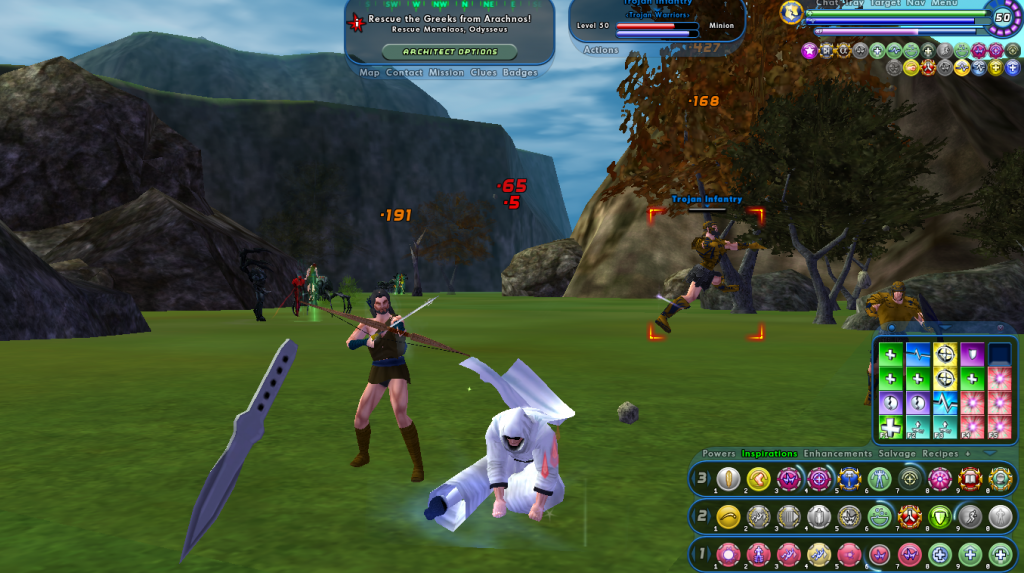
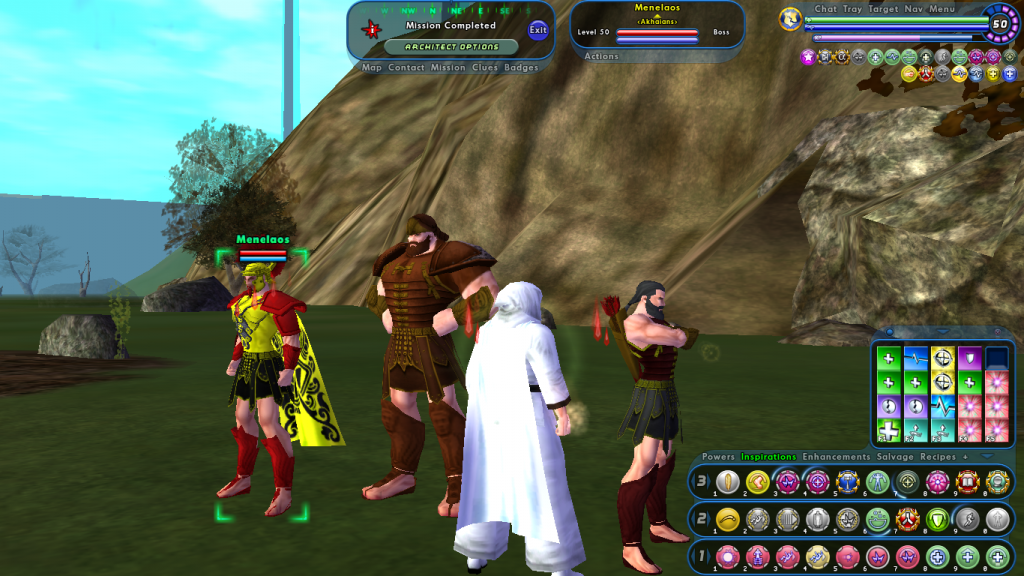
(Nothing like a good foot sweep to knock down a Trojan archer.)
(Menelaos, Great Ajax, and Odysseus, as well as our hero in white.)

Mission 3: The Heroes Strive With Gods

The balance of the fighting has shifted. Aeon tries to keep the Greeks hard-pressed, but the gods themselves are influencing this war, and more champions take the field. The heroes rescue Diomedes, who warns the player about the chief enemy on the field today: Aineas, the son of Aphrodite.
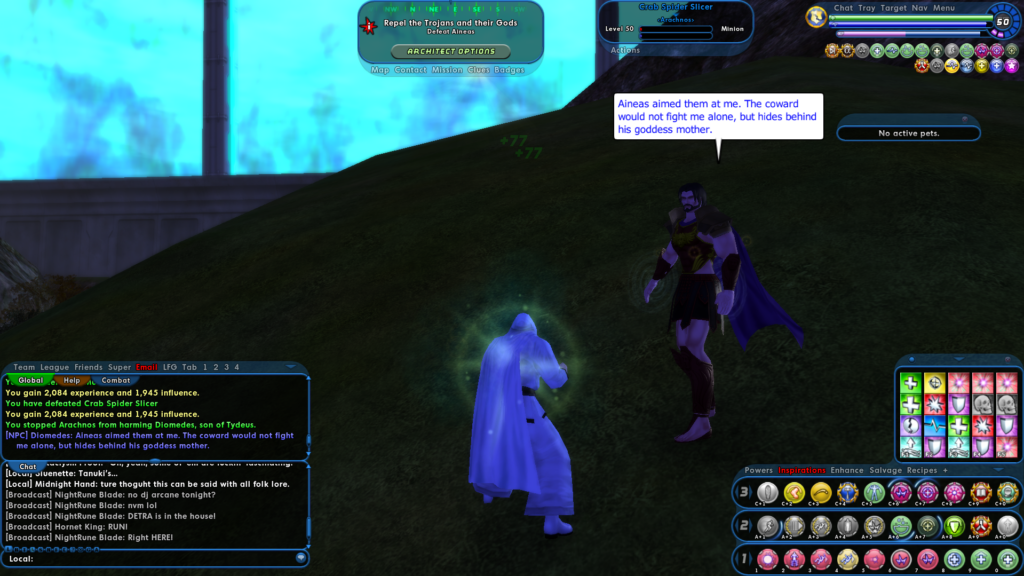
The player takes on Aineas! Surely a demigod can’t be too tough.
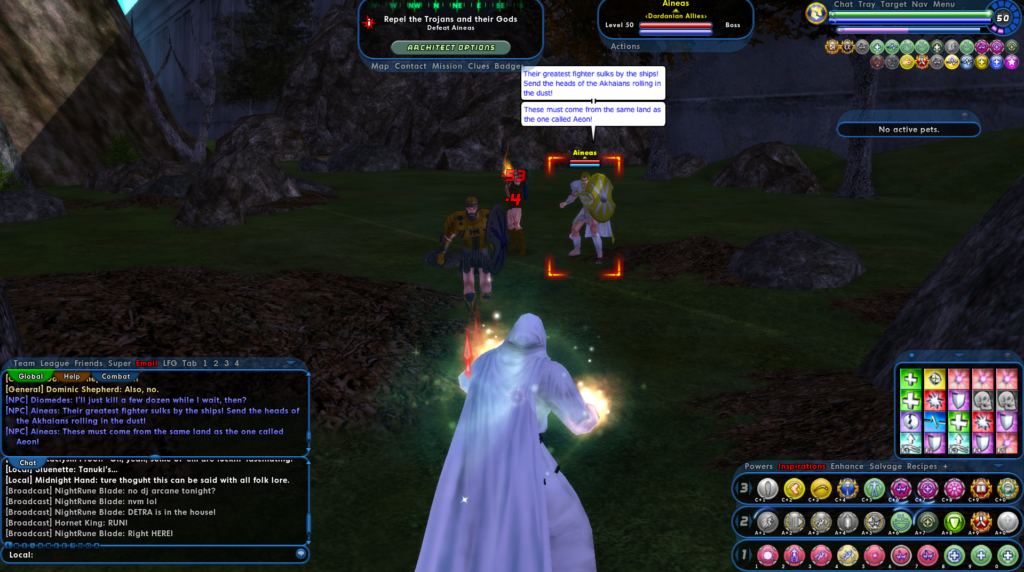
When he’s low on health, Aineas’ mother attempts to save him. If the team is big enough to fight an archvillain, Aphrodite herself appears.
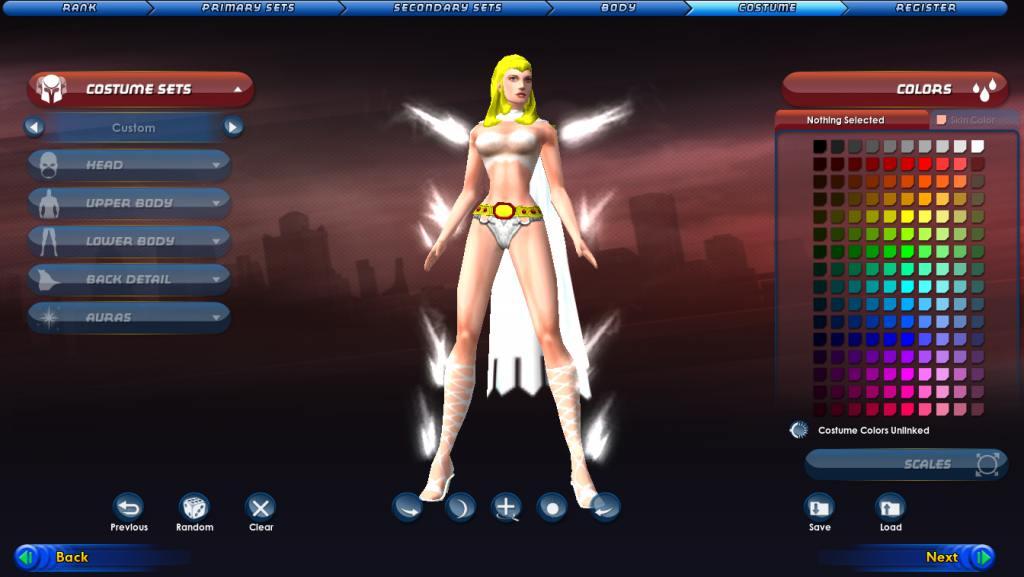
(Aphrodite, goddess of love, sex, and sea foam. The sparkles animate.)

If the team is smaller, she sends her handmaidens, pictured here.
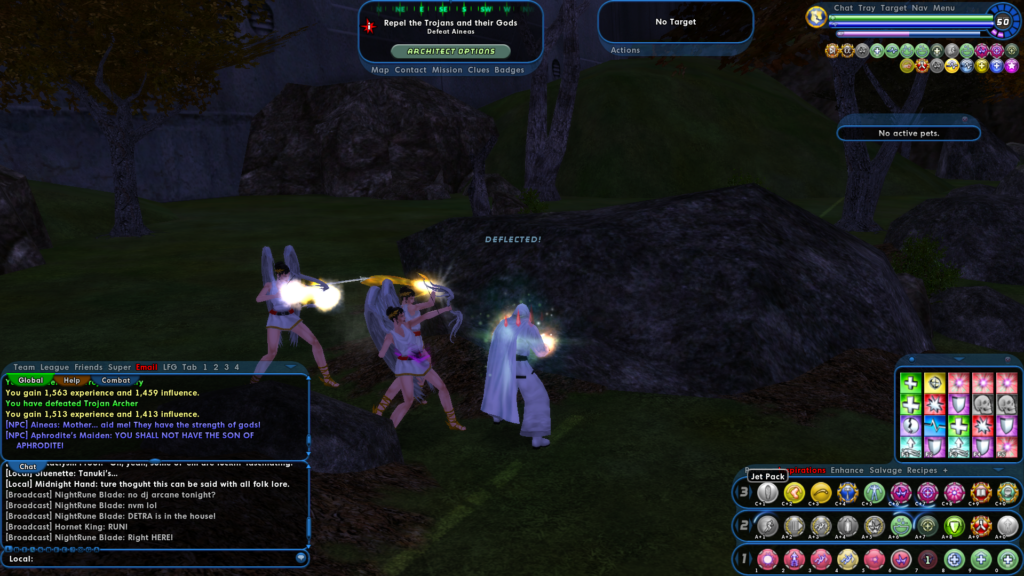
Amid all the fighting, Dr. Aeon has killed Patroklos, Akhilleus’s cousin, best friend, and in many interpretations, his lover. Akhilleus loses his freakin’ mind and starts on a rampage.

Mission 4: The Clash of Man and River

The rampage is cut short by Dr. Aeon, who has placed temporal disruptors around the battlefield in order to change history. Arachnos captures Akhilleus temporarily, though as the dialogue indicates, he’s about to break free when the heroes rescue him.
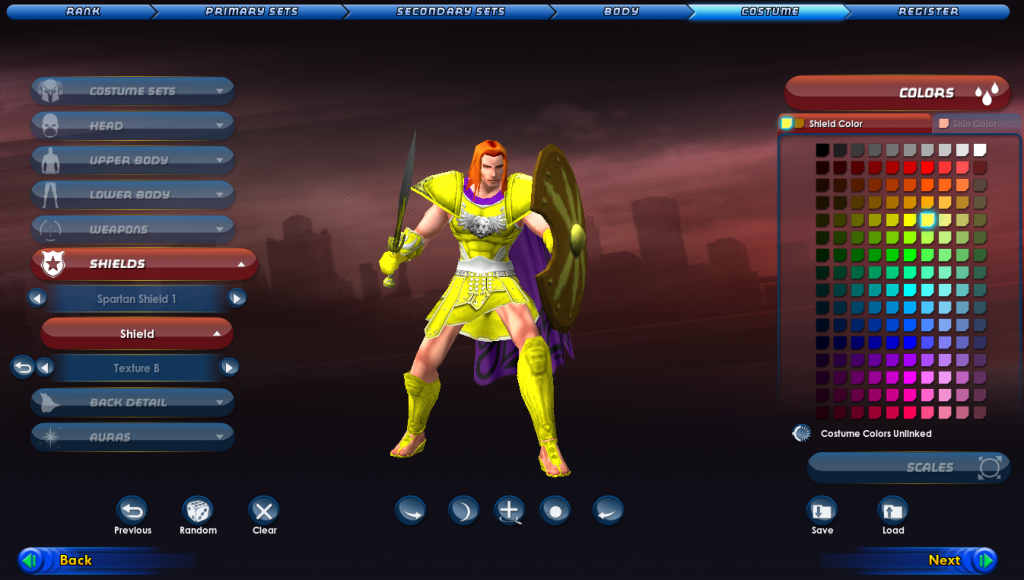
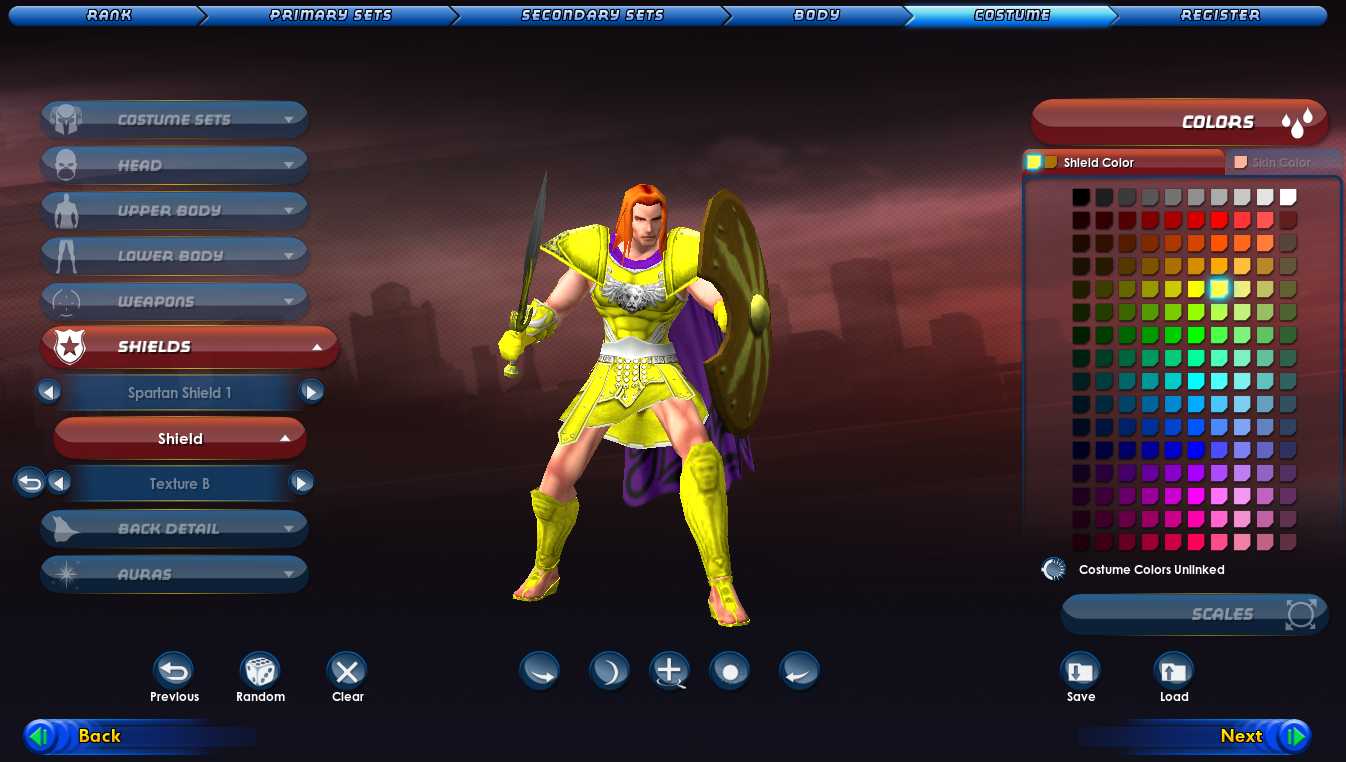
(Achilles, with his famous shield.)

It’s time for a team-up. But, as an Arachnos captor points out, what are they going to do, kill the entire Trojan army?
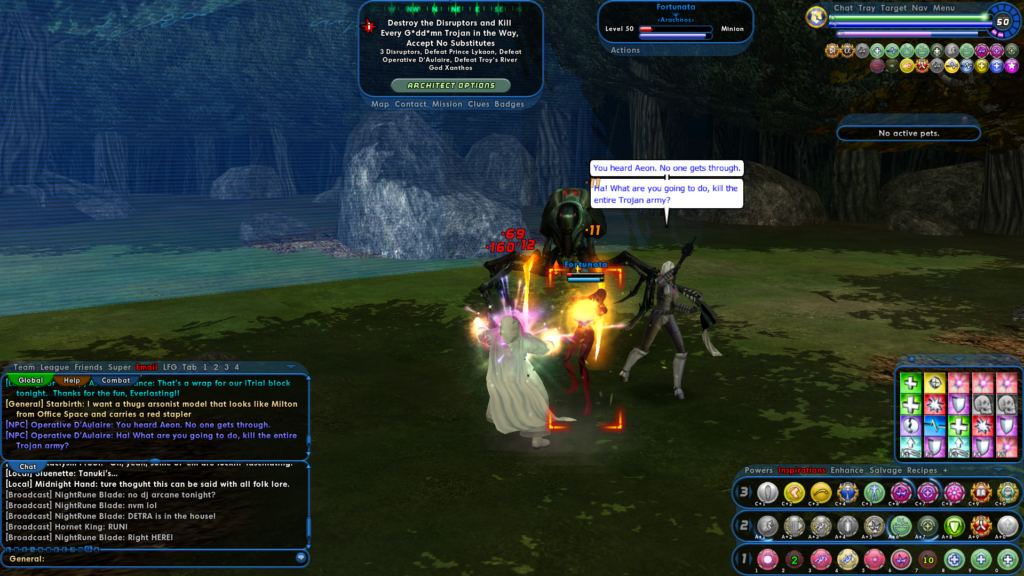
Spoiler alert: Yes, yes they are.

The rampage is the longest mission in the arc, as the players plow through a ton of enemies named in the Trojan epic cycle. Relative shlubs like Asteropaios and Lykaon go down first, and by then the Skamander river is so choked with blood that Xanthos, its river god, attempts its revenge.
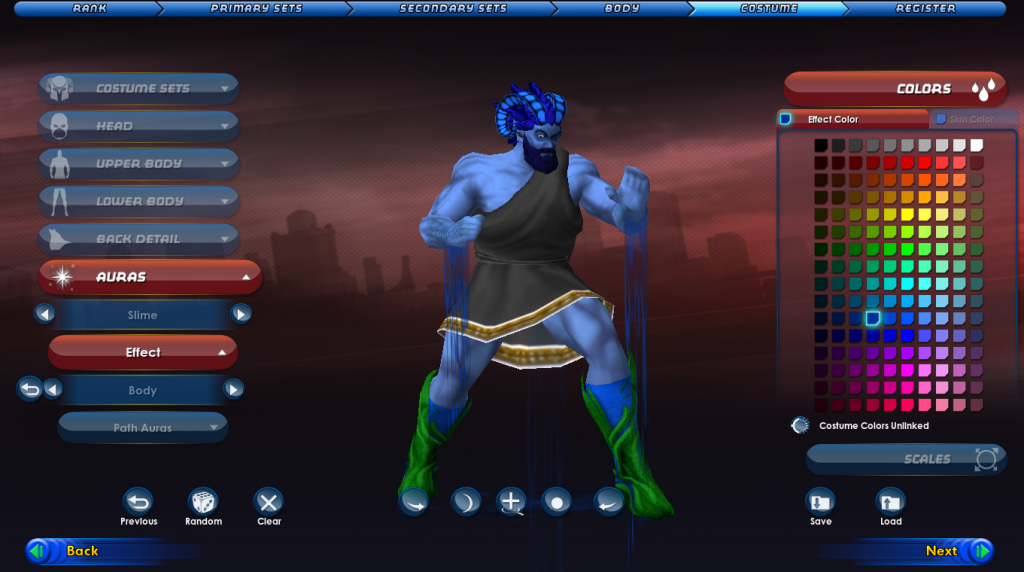
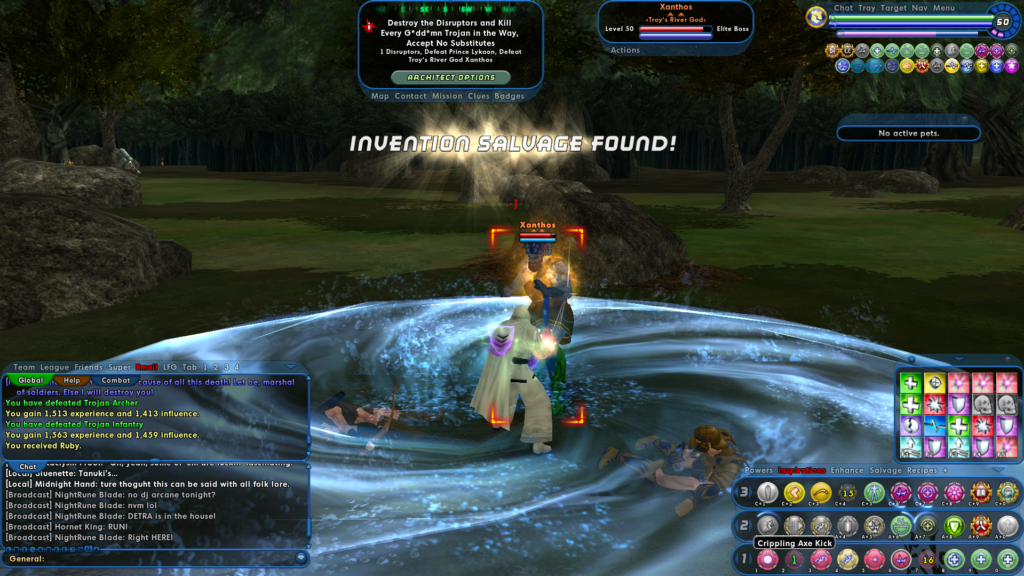
(Xanthos, a.k.a. the Scamander River God. The blue slime is water animated to drip.)
Ever seen CoH’s Water Blast power set? Now you have!

But that’s not all! Prominent allies take the stage, like the Amazon princess Penthesilea…
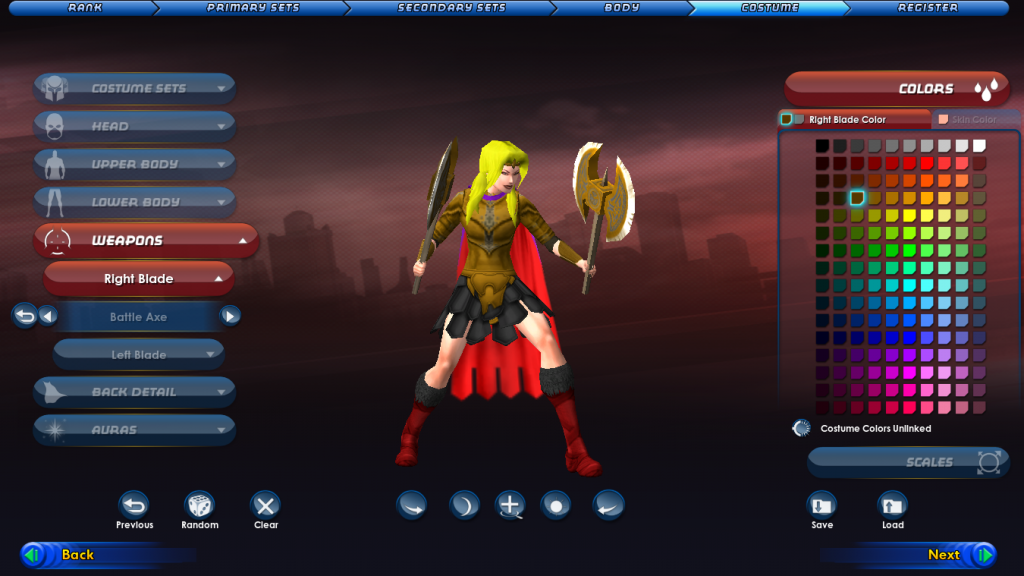
(Penthesilea, princess of the Amazons, with double labrys axes. Way to represent, girl!)

…and the son of the dawn goddess Eos! His name is Memnon, prince of Aethiopia.
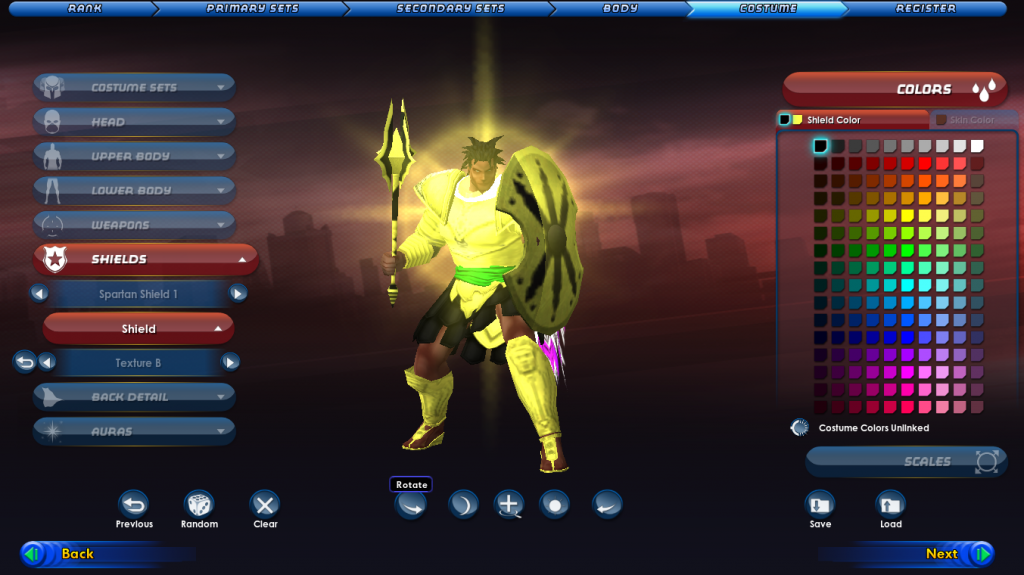
(Memnon, son of the Dawn and sporter of awesome dreads.)

Each of them call on Dr. Aeon for help, but the villain is gone, leaving them to face their fates alone. Interestingly, the players find Dr. Hamilton amid all the fighting, and Troy’s star quarterback, Prince Hektor, reveals more as the players fight him.
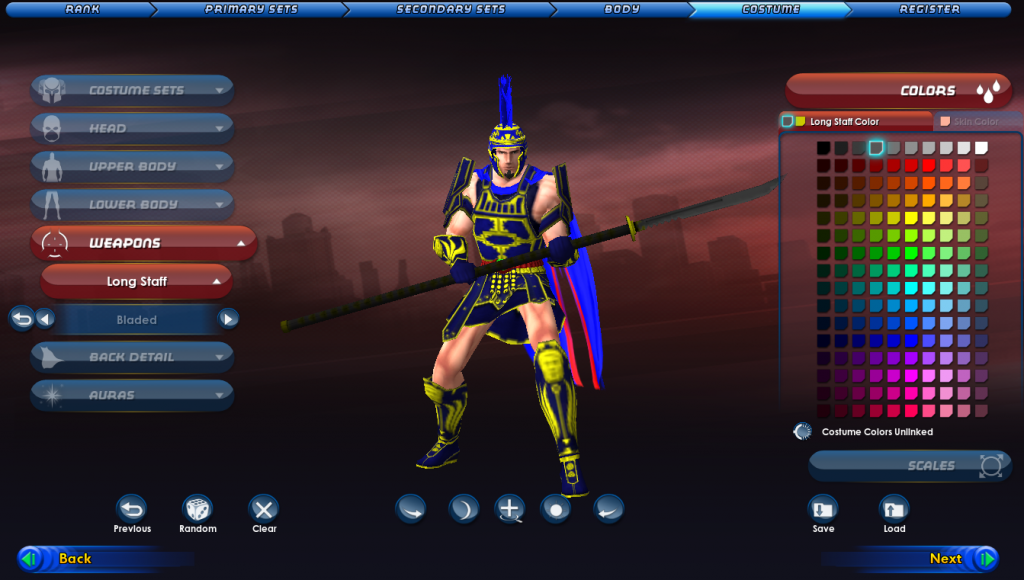
(Hector, prince of Troy. The spear looks more like a naginata, but it’s the closest I could get.)

Hektor says he knows where Aeon has gone, but to preserve his honor and spare the lives of his people, he’s going to throw the fight. The player makes it look good, defeating him as per normal gameplay. When the mission is over, Dr. Hamilton and Hektor let the player in on the Arachnos plan.

So What’s the Plan, Exactly? Enrage the Death Machine?

The reason Aeon interrogated all the Greeks he could find and killed off Patroklos was because he wanted Akhilleus to be visited by his mother the night before the battle, as the story goes. Akhilleus’ mother is Thetis, a sea goddess who is responsible for Akhilleus’s famous powers.

When Akhilleus was an infant, Thetis dipped him in the headwaters of the River Styx, and wherever the water touched, it made him immortal and invulnerable. Because she held him by the heel while she dipped him, that heel is his one weak, mortal part, the proverbial “Achilles heel.”

Dr. Aeon’s plan was to capture and interrogate Thetis for the location of the Styx’s headwaters. And now he’s taken his best commandos and dipped them in the Styx. He’s going to make an army of super-soldiers who cannot die.

Mission 5: The Isle of the Styx

The player goes to the island of Skotados to rescue Thetis. The player battles normal Arachnos enemies, the nymphs of the Styx (the river of death), and the now-invulnerable Arachnos soldiers. It’s a tough fight (the super-soldiers are a mob of all bosses), but Akhilleus and Hektor are there to take their revenge on Aeon, and having them both on the players’ side is a combo that the gods never saw coming.
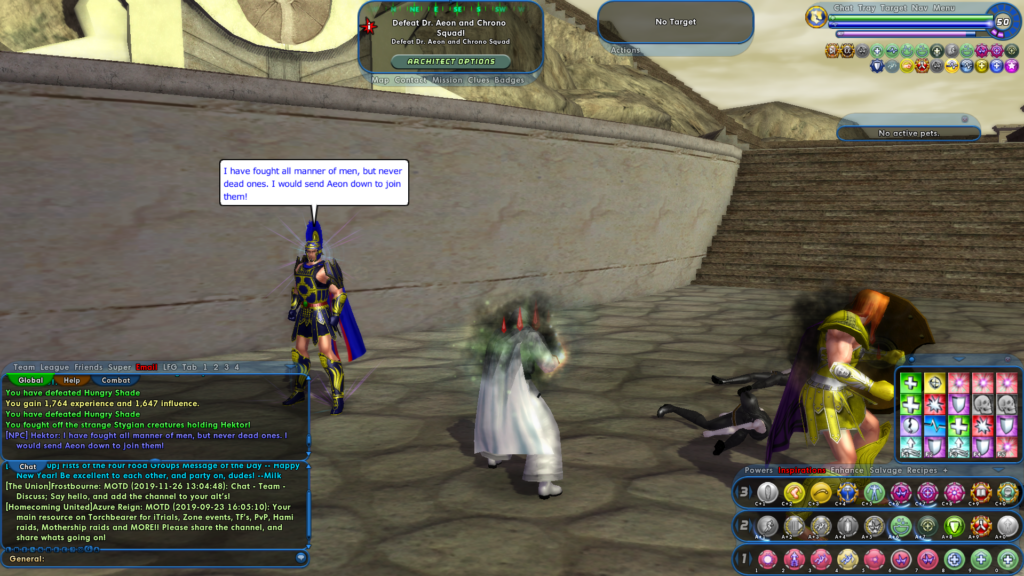
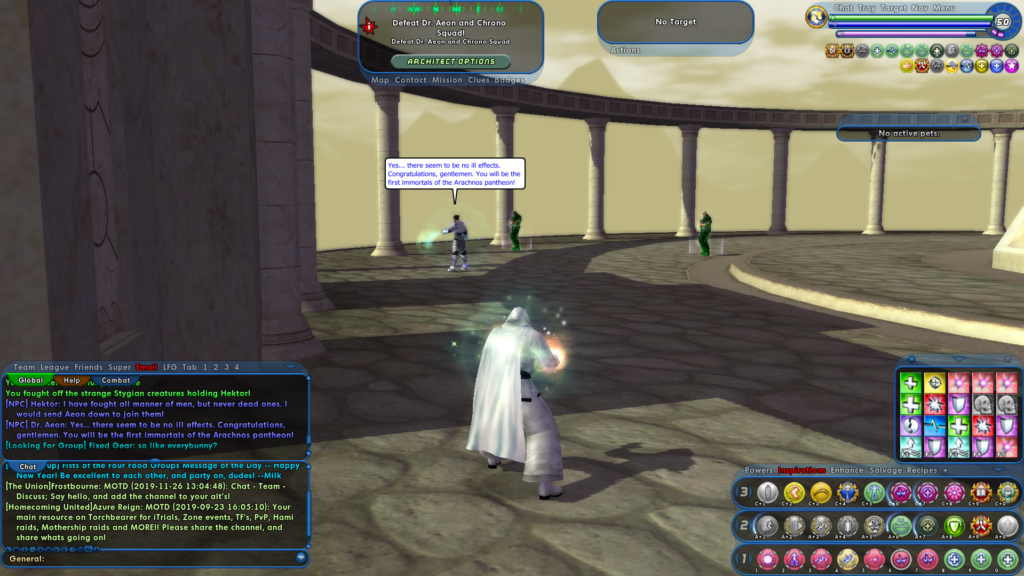
In the end, the player drops Dr. Aeon off with Mender Lazarus, who will enforce the sanctity of Earth’s timeline. What he does to Aeon is only hinted at, but it’s probably NSFPC: Not Safe For Paragon City.
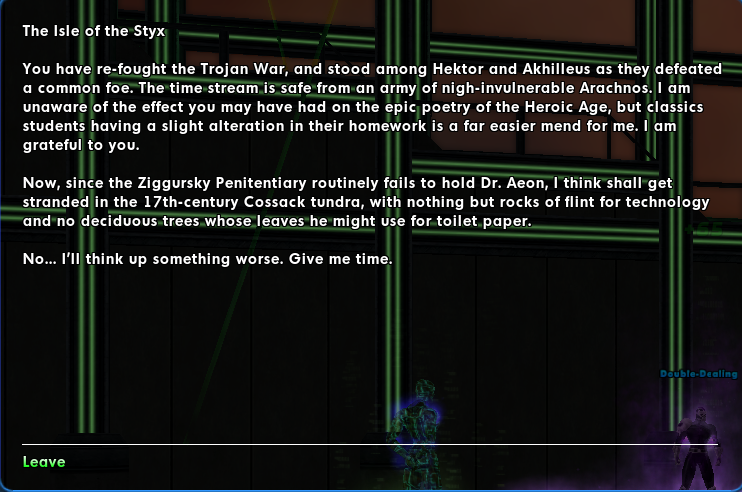
And that’s our show! Hope you enjoyed this little excursion.

If you’ve made it this far and actually have a City of Heroes (Homecoming) account, the arc is #31899. Just enter that into the search bar at the Architect Entertainment interface, and the arc should be playable.

See you around the city!
City of Heroes: Homecoming

In 2004, the massively multiplayer online role-playing game City of Heroes hit the shelves. A little awkward at first, it had a few laudable strengths. It wasn’t trying to compete in the same space as the innumerable fantasy MMOs. The costume generator kicked butt, assuring that ensured no two heroes looked exactly the same. It had mix-and-match power sets that made you feel like a superhero from the get-go. Who really wants to play a level 1 peasant with “tattered cloth armor” as your starting equipment every time? And, importantly, it continued to constantly improve with every new patch (or, as the game called them, “issues”).

One of these improvements was the capability to design your own player-created content. Using the “Mission Architect” system, players could create up to five missions in an arc. Each could use pregenerated maps, normal or customizable enemies, a selection of mission goals, and NPC dialogue they could enter themselves.

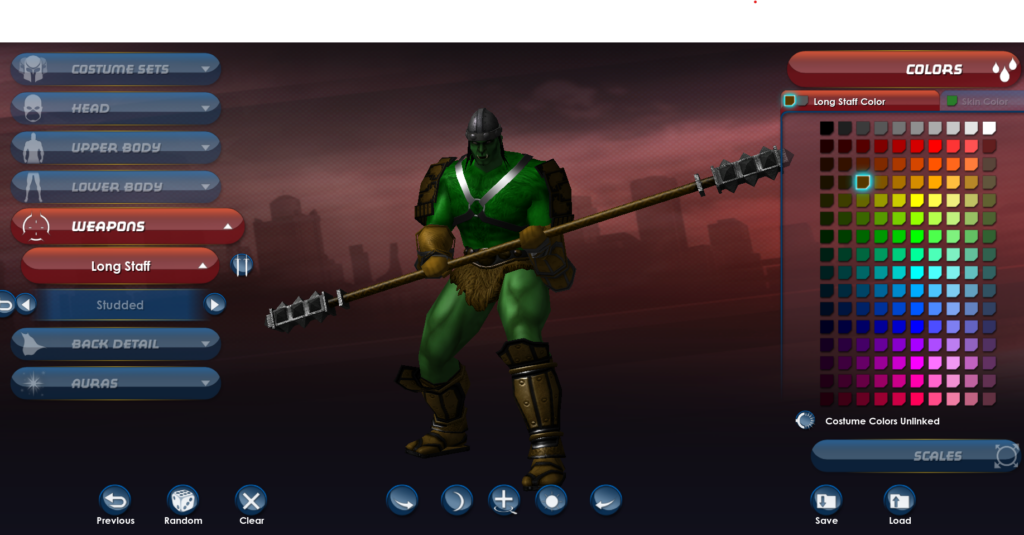
A shot of the City of Heroes character editor, showing a goblin with a double-headed staff.

Choose Build Your Own Adventure

Two notable types of adventures resulted. The first type was players designing the missions’ enemies for maximum experience gain. They ground out levels and loot as fast as humanly possible. Useful for condensing the time you spent getting levels, but overall, nothing amazing.

The second type of adventure unleashed the creative energy of thousands of players, as they spent hours polishing their virtual baby until it shone. I saw adventures where you descend into the Paris catacombs to fight the Phantom of the Opera. You could battle archvillains themed to the major arcana of tarot cards. One that I found particularly hilarious had you take the job of the Fashion Police, dueling enemies with the most garish costumes imaginable.

And Then the “Thanos Snap” Happened

Despite the love and money of a sizeable fan base, City of Heroes was shut down in 2012 by its parent company, NCSoft.

Unknown to NCSoft, however, a Secret Cabal of Reverse Engineers (names obscured to protect the criminals) absconded with the game’s source code and played in private for the following seven years. In 2019, their secret came out and they opened the servers up to players. Coming home was remarkably like the citizens of Marvel’s Earth-616 after their five-year absence.

A year or two later, NCSoft, who had moved on to other ventures, eventually gave the servers an official blind eye. As long as the private servers didn’t attract attention with bad (read: legally liable) behavior, they could operate and even create their own new content.

Due to differences in philosophy and general drama, several different teams managing their own servers have popped up. I use the Homecoming servers. Homecoming doesn’t try to preserve the game exactly as it was in 2012. Instead, it adds content for a better user experience. Though I haven’t tried to create official content for them, I have made use of their Mission Architect to create stories I think players could love.

So, Get to the Game Already!

So far, I’ve written two Architect arcs, each with five missions:

Dr. Aeon and the Wrath of Achilles (AE #31899)

The player tries to stop Arachnos’ obnoxious super-science expert from going back in time to change the course of the Trojan War. The heroes battle Trojans, Amazons, Aethiopian allies, a river god, and Arachnos soldiers with a certain… mythological edge.

Big Trouble in Little Rokugan: (AE #71669)

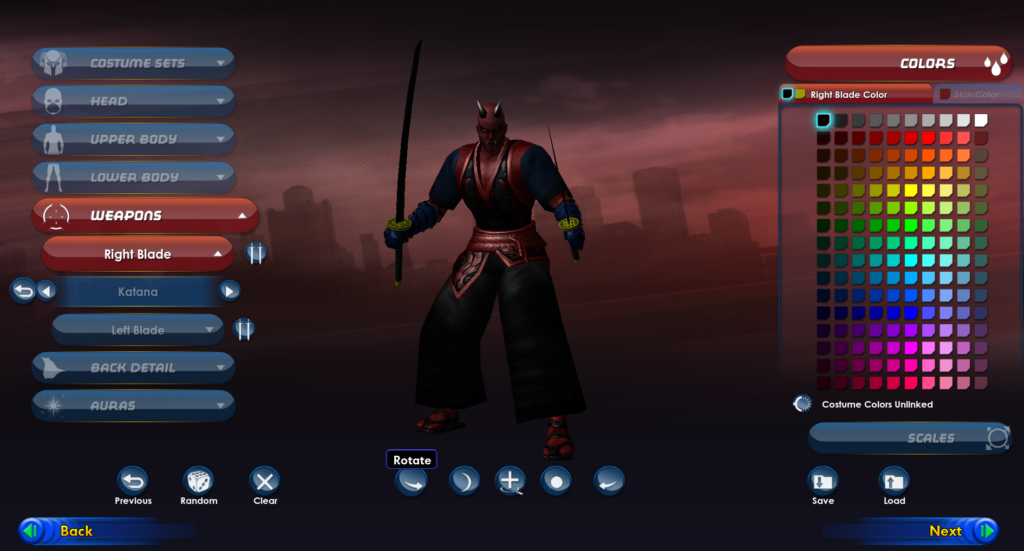
The Portal Corporation opens up a wormhole to the land of the samurai RPG Legend of the Five Rings. The oni of the Shadowlands steal weapons from Paragon City and intend to use them to conquer the Emerald Empire. It will take heroes from both worlds to stop them!

“This Thing of Darkness”

Napoleon supposedly said, “To understand a man, you must know the world he lived in when he was twenty.” And to understand this story, that’s not far off.

It was the 1990s, never mind the exact year. The cyberpunk future loomed, but it was at least a generation away. I was reading The Tempest in a class themed around the colonization of the New World. I encountered a phrase that stuck with me: Two of these fellows you must know and own; this thing of darkness I acknowledge mine.

Pretentious, of course, to quote Shakespeare’s Prospero, but I was young, and referencing him seemed like a natural outgrowth of my favorite pulp subgenre, RPG fiction. I wrote up a short story told in a film-noir-like tone, a la Blade Runner. It was about a hired killer battling the inner monster of cyberpsychosis. I got a pretty good grade on it, and before I consigned it to the bin, I noticed that the Isaac Asimov Awards for undergraduate fiction were looking for submissions.

“Well, crap,” I said to myself. “I might not be able to compete with the pros writing The Magazine of Fantasy and Science Fiction, or even Cyberpunk 2020 and Shadowrun, but I’ve seen the stuff people my age crank out. I could compete with them, easy.” So, I submitted “This Thing of Darkness,” and won an honorable mention. Got a T-shirt and a little certificate I could put on my wall. The story didn’t get into a magazine or an anthology or anything cool like that, unless you count our campus science fiction club fanzine. I chalked it up as a minor success and filed it away on my hard drive, never to be looked at again.

Except…

I had a habit. Whenever I got a new computer, I transferred over all my old writing, even my high school fanfic. Then I got my first laptop, and did it again. And again. I converted the files to more recent formats when they started getting incompatible with current versions. And I just kept them in a folder, stored away, just in case.

Fast-forward to the fall of 2025. I was focused. I was writing away on Civil Blood‘s sequel, determined that this year I’d finish its rough draft. But Raconteur Press had a call for stories to be put into a book called Pinup Noir: High Class Muscle. They wanted heroes with a moral code, men (no ladies… their stories were in the previous Pinup Noir collection) who were good but definitely not harmless. Detectives, bouncers, bodyguards, hitmen.

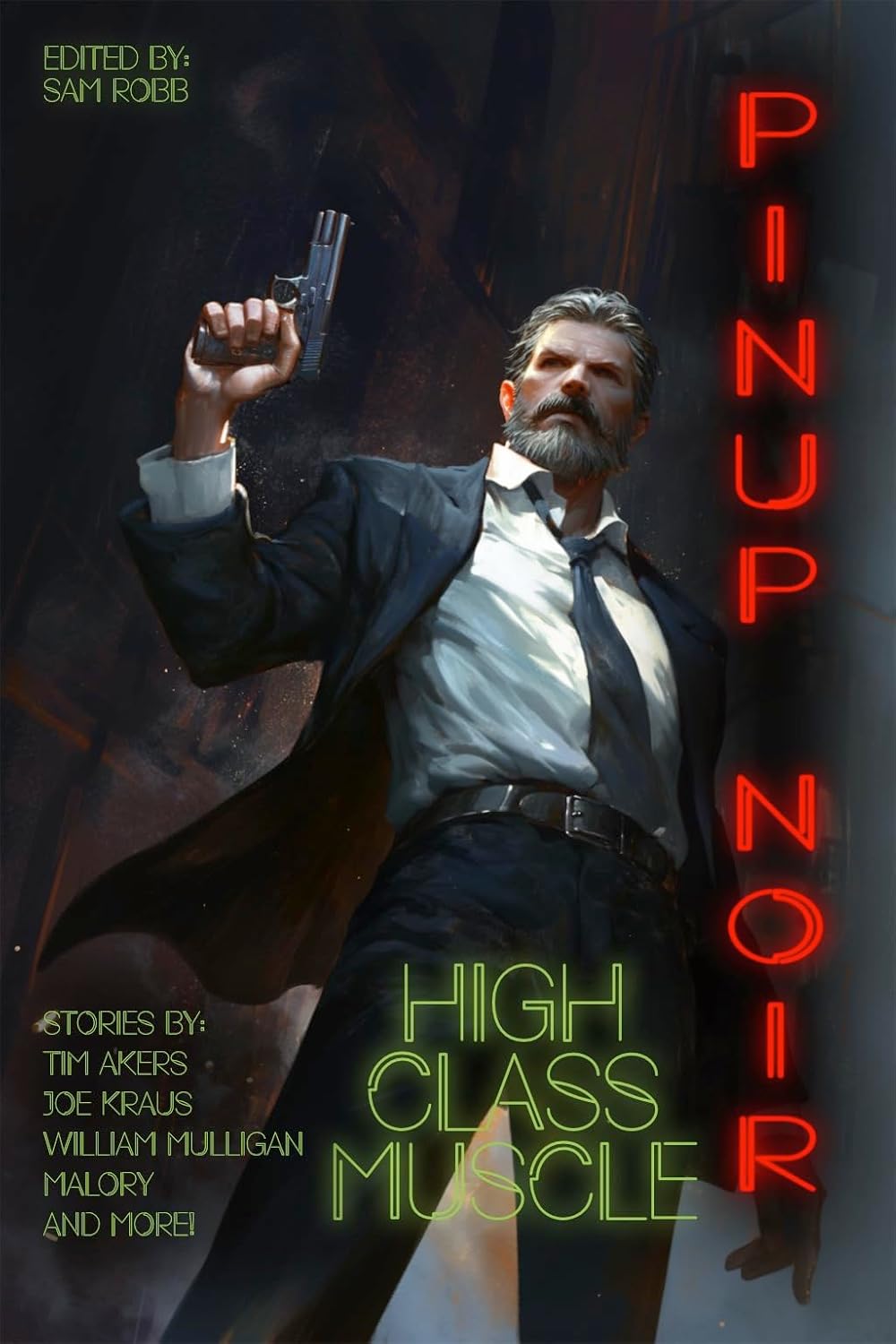
A bearded bodyguard with a gun takes center stage on the cover of "High Class Muscle."

The writing prompt reminded me of my old story. I didn’t want to take time away from the Civil Blood universe… but would it be that much to revise and submit one story I’d already written?

Turns out my hunch was right. I dug out the file I hadn’t seen in decades (inconveniently labeled “Introduction to Fiction and Poetry Assignment #8”). I fixed up the grammar, punctuation, and spelling mistakes that a student might tolerate but that modern me never would. Ran it past a writer’s workshop. It went over pretty great.

I edited away lines about being a brooding antihero because they’re an overdone trope now, and laughed at the descriptions of cellular phones that treated them like a novelty. But the core story was there: a murderer who must acknowledge the darkness, because it won’t stop with just him.

And, some thirty-ish years later, “This Thing of Darkness” has found a home. Pinup Noir: High Class Muscle is available in paperback and on Kindles via Amazon, here.

We’re well past 2020 and living in cyberpunk’s disposable future. But sometimes you can do okay clinging to the past.

In Which I Trade New Stories for Old

"Fangs for the Mammaries" @2023 by Clyde Caldwell

It’s been another long dearth of posts, but I assure you, it’s for a good reason. When we last left our intrepid writer, he was modifying Civil Blood‘s sequel to match up with real-world molecular biology. What’s been going on since then?

Writing. Lots of it. By day, I’m working away on Wayfinder for Airship Syndicate. I recently graduated from contract writer to full-time senior writer, and the game is closing in on its Early Access date. Therefore, for the first time in a few years, you might be able to play a game and see my dialogue and text, out in the wild.

By evening, I’m writing the second installment of the Skia Project, the technical name for the world of Civil Blood. I’m not a fast writer, but I’ve gotten up to about 38,000 words, with a target goal of 100,000 to 130,000. That’s about the same size as Civil Blood, which clocked in around 129,000 and fit into just under 400 pages. Naturally, just because I reach the end of the novel doesn’t mean I click on Amazon’s buttons and hit “upload” right away. I put Civil Blood through about ten drafts before I felt it had the punch it needed: pacing, stakes, beautiful turns of phrase. The sequel might not take quite as many drafts, but I don’t want to skimp on quality. The “too long, didn’t read” here is that I’m making good progress, and I’m committed to it.

But oh, are there other projects percolating in my brain. I’ve had not one, but two dreams — literal dreams — about Shadowrun projects that made me wake up and say, “Huh. Could I write that?” It turns out independent authors have been invited to contribute to the game’s universe with a profit-sharing deal, and the temptation is strong. I will probably focus on my own universe for the foreseeable future… but never say never.

And then there’s my daily shot glass of nostalgia. This year has hit me hard with good memories of tabletop roleplaying games. Let me break down just how much TTRPGs have meant to me this year:

1) I play an MMO in which I run into TTRPG gamers all the time. On the Everlasting server in City of Heroes: Homecoming I met up with the players who play Vampire: The Masquerade and Legend of the Five Rings characters. This got me telling stories of the best V:TM tabletop campaign I was ever in, and I thought, “You know, that’d make for an okay series of blog posts, both to amuse the players and help Storytellers with some basic principles.” So I’m posting that ASAP.

2) The Dungeons & Dragons: Honor Among Thieves movie came out, and it was everything I wanted the 2000s D&D movie to be. I wish it had been more profitable, but I’ll take what I can get.

3) I ended up following some topics on Quora, Reddit and Twitter, and the trifecta means I end up reading conversations about the TTRPG scene, which I haven’t been in for a long time. Doesn’t matter that most of the talk is about D&D and not my preferred games, I still grok the language, and have nothing against the big dog.

4) My son is getting to be an age where his friends are starting to play. We had a boffer-stick LARP birthday party for him, and it was highly successful — no crying, no excluded kids, the teams were even, a generally great experience. Our family tried Werewolf: The Apocalypse during the pandemic quarantine as a way to pass the time without interacting with other kids, but that’s a distant memory now. He’s going to try D&D later this summer.

5) Some of the Bioware fans have found me on Twitter and they ping me with Codex questions and the like, so I’m not escaping that world any time soon, either.

6) Wayfinder is a fantasy RPG that reminds me of some of the high school AD&D games I used to play in. One of the main writers is Keith Baker of Eberron fame, so fantasy RPGs are in the DNA of everything we do.

So, with all that said, I’m going to walk down memory lane with the Shot Glass of Nostalgia page. Because while I have new stories to tell, there is value in the old ones. And to all those who have never heard them… perhaps they will smile as well.

We will start with a vampire buffalo. Or, at least, a would-be vampire buffalo, and why my wife was Prince of a city and never got deposed.

In Which “The Texas Chainsaw Massacre” Meets Miyamoto Musashi

Many years ago in Los Angeles, I was up late at night watching the Independent Film Channel. This was around the time of the breakout success of the Blair Witch Project. It being October, the traditional horror month, the IFC showed the original Texas Chainsaw Massacre. By way of introduction, they asked some film expert why he thought indie horror films spawn stories of phenomenal success. Studio films like those of Alfred Hitchcock in his ’60s oeuvre were carefully crafted, but indie horror, particularly in the ’70s to ’90s, had many stories where the not-very-cerebral flicks were made on shoestring budgets and still became wildly popular.

The expert said, “Well, when you watch an Alfred Hitchcock horror movie, you’re in suspense because you’re in the hands of a master. When you watch an indie horror movie, you’re in suspense because you’re in the hands of a f**ing maniac.”

It is with that spirit that I present to you a bit of roleplaying game writing my wife and I did long ago. Because I liked gamemastering samurai horror, and it wasn’t because I was Hitchcock.

I dug these out of the vaults, as it were. There’s three adventures, all tournaments for the samurai fantasy tabletop roleplaying game Legend of the Five Rings. They put the players through their paces with roleplaying challenges, a little mystery, and combats. They were playtested in gaming tournaments at the Origins and Gen Con conventions, over the course of three separate game sessions apiece.

I doubt I’d ever call what I did in tabletop games “wildly popular,” but some fans liked the work enough to archive the original versions of these adventures on the L5R fan site Kaze No Shiro. To add a little value here, I’ve cleaned up the old versions’ visual presentation and added a few sections based on fan feedback.

Curious gamemasters can read “Mirror, Mirror,” “Fortunes Lost,” and “Hindsight” here. Curious players who wanna read ’em can get off their duffs and become curious gamemasters.

The adventures are free to download and play. I don’t have a tip jar or Patreon or anything like that. If you liked the games, maybe you’d like my novel.

Vrrrooom vrrroooom vrrrrraaawwwwwr…

A Writing Tour


This is is where I show off promotional materials, excerpts from books, links to published or produced works, and so forth. My LinkedIn page covers my specific responsibilities for the collaborative projects.

I have also spoken at the Game Developers’ Conference on the topic of writer research skills. If you’re an attendee, you can find my 2016 lecture “What Wikipedia Doesn’t Know Can Hurt You,” in the GDC Vault.

Video Games

Pirates of the Caribbean

Relics of Gods

The Mass Effect Trilogy

Star Wars: The Old Republic

FableLabs Projects

My Loft

Wayfinder

City of Heroes: Homecoming

Novels

Civil Blood: The Vampire Rights Case that Changed a Nation

Short Fiction

“The 10:40 Appointment at the NYC Department of Superhero Registration”

“The Torturer of Camelot”

“High Water Mark”

“This Thing of Darkness”

Television

The Agency

Tabletop Role-Playing Games

Legend of the Five Rings

Shadowrun

Earthdawn

Paranoia

The Shot Glass of Nostalgia” — Tabletop Stories to Help Your Games

Comics

Mythkillers

M.I.T.H.

Writing Samples

These are resume fodder: YouTube videos of my video game work, and interactive fiction in small, digestible chunks.

A Twine Writing Sample:

“A Hell of Heaven” — A Cyberpunk-Genre Twine Mission (15 minute read)

A choose-your-own-adventure in interactive prose. “A Hell of Heaven” is in the vein of Cyberpunk, Shadowrun, or similar games that occur twenty minutes into the future. If technology allows our brain to be edited by others, what makes our decisions ours?

Videos:

A Question of Motivation Part 1 (MMO Quest Giving)

A short and sweet side-quest as it originally appeared in Star Wars: The Old Republic. Takes about 5 minutes to watch, which is why I put it first.

“Shoot the mouthy one” is a very Sith answer, but it does not avail the player here.

A Question of Motivation Part 2

The gameplay of the rest of the adventure, including the twist at 10:34 and decision/quest turn-in at 18:31. Total dialogue time about 5 more minutes.

Stomping giant insect-like Colicoids? You’re gonna need a bigger boot.

Companion Character: EDI Makes a Joke ~35 seconds

The Enhanced Defense Intelligence says this early on in her ME3 dialogues, so a lot of fans are familiar with this joke.

Hey, EDI, you do remember how Shepard died in ME2, right? Juuuuust checking.

Companion Character: EDI and Liara ~ 30 seconds
This ME3 scene plays if you never completed one particular ME2 DLC.

What is there to say but “Oops?”

Companion Character: EDI Compilation ~ 13 min

EDI goes through a lot: her installation in a human-like body prompts many questions about mortality and human behavior. It ultimately leads her to decide that destroying the Reapers is worth her own death. Here’s a supercut of many of her conversations.

“But it was something good.”

Priority: Citadel from Mass Effect 3 (Action Sample, RPG Video Game) ~ 30 min

Kai Leng’s first appearance, a showdown with the Virmire Survivor, and finally a use for those Citadel elevators. (Mayhem. Mayhem is the use.)

The variant lines possible in the Virmire Survivor face-off are quite complex under the hood.

Citadel DLC — Thane’s Memorial Service (Dialogue Sample, RPG Video Game) ~30 min

Didn’t feel like you got a proper goodbye to Thane in Mass Effect 3? DLC to the rescue!

A rare chance to revisit what I thought was a shortcoming in the main game.

Citadel DLC — Silver Coast Casino Infiltration ~ 30 min

A casino heist? In a game without stealth? We made it work! Here’s two versions.

This one is a walkthrough, so it has commentary. It includes the mission briefing.

I leveraged BioWare’s strength — dialogue — into our brief foray into stealth gameplay.

This one has no commentary, but does not have the mission briefing.

“Right, right… what did I say?”

(And just for fun, the Silver Coast Casino mission’s red carpet entrances — all 27 dialogue variations!)

“Needs a little something… now it’s perfect.”

Wayfinder‘s Traditions of Eventide (Seasonal MMO Content) ~ 15-47 min.

In a break from doom and gloom, I wrote gaming’s equivalent of the Hallmark Christmas Special, in which Lord Halar tries to assist his scientist granddaughter Avala during the winter holiday. The emotional beats at the end are all the more poignant if you know Avala is an Echo… in other words, like the player, she died and has returned to live an uncertain existence. The first mission is 15 minutes, but if you want the full 47-minute tour, I had my hands on every bit of dialogue in the patch.

“That’s not what ‘objectively’ means…”

Text and Worldbuilding:

Mass Effect Codex, Galaxy Map, Weapon and Item Entries

I headed up a lot of unglamorous-but-essential lore-building text on the Mass Effect Trilogy. (I helped a little bit on ME1, and took over for ME2 and ME3.)

First-Person Shooter Sample:

“Voice in the Ear” (Modern Military Shooter Level)

To demonstrate my skills with short, urgent dialogue (more so than the BioWare or Wayfinder samples) and to throw in a little level design, I added this documentation, adapted from a timed writing test. All names have been changed to protect the guilty.

Romance Genre Samples:

The Double (Contemporary Romance Fiction)

Pinning Him Down (Contemporary Romance Interactive Fiction in Twine)

I briefly wrote for I Got Games/AVGLife’s interactive romance novels, and would welcome the chance to revisit the romance genre. Twine makes it easier to simulate the flow of an interactive piece without starting my own studio.

Interactive Quizzes:

“What Do I Know About Video Games?” (A Twine Quiz)

And to end our tour, a little Web content, because I’ve done that, too!

Blog